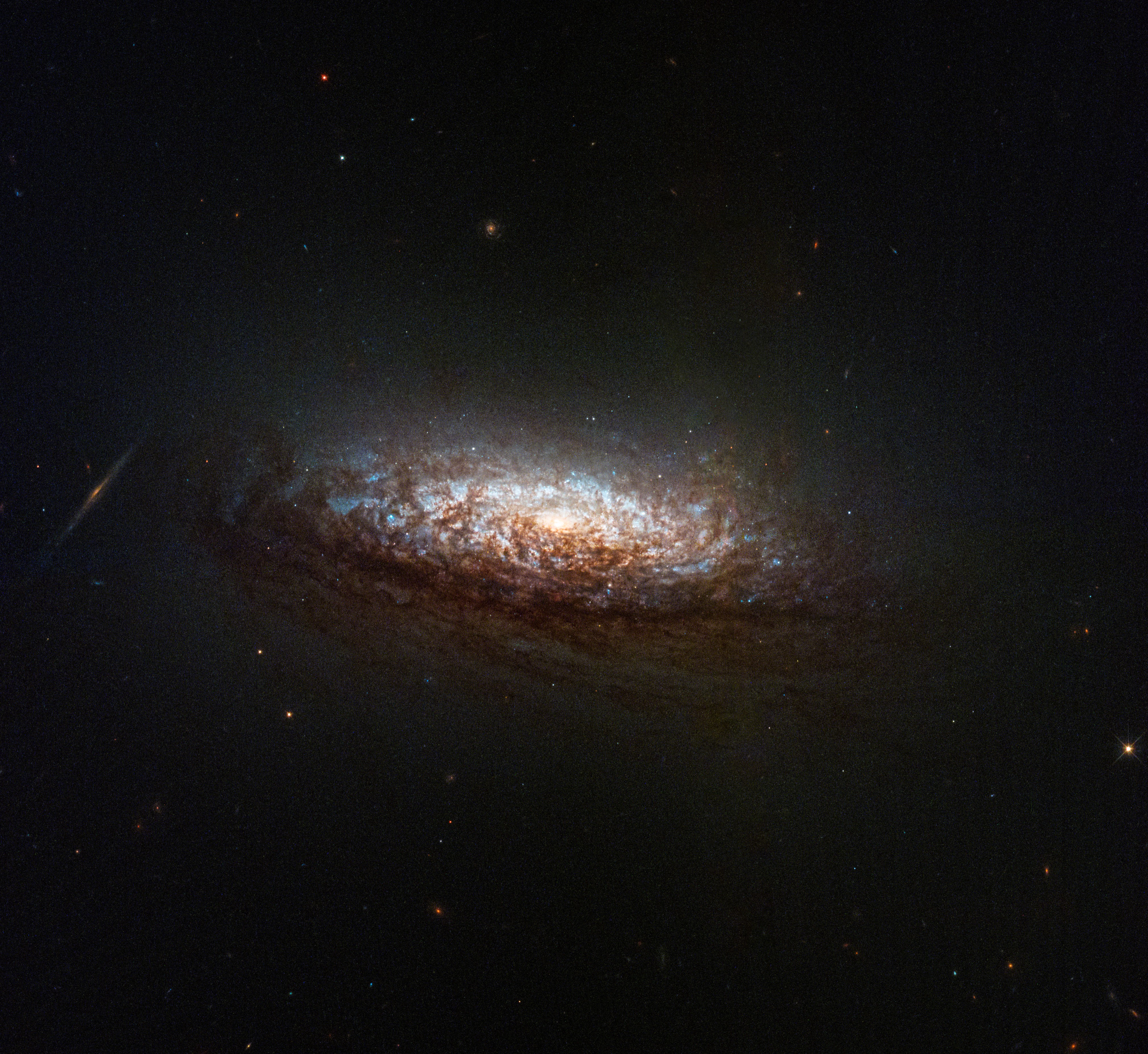
NASA releases Hubble image taken in new pointing mode
science.nasa.gov
NASA releases Hubble image taken in new pointing mode
1–10 of 174 posts
Re: NASA releases Hubble image taken in new pointing mode
#2The magic of hot fixes in production.
Re: NASA releases Hubble image taken in new pointing mode
#3I’d love to see some actual data on this - what’s the impact on resolution, maximum exposure time, etc.?
Re: NASA releases Hubble image taken in new pointing mode
#4[dead]
Re: NASA releases Hubble image taken in new pointing mode
#5Pretty incredible what they are able to do with a i486!
Re: NASA releases Hubble image taken in new pointing mode
#6Pretty incredible what they are able to do with a i486!
We used to get quake and Warcraft running on them from memory.
It was - is! - a great chip.
Re: NASA releases Hubble image taken in new pointing mode
#7NASA has such a tiny budget in comparison to other stuff....so they really have to stretch that money as far as they can, and especially considering spacecraft....its a very unforgiving production environment.
Am I making a joke about deploying in production? Yes, yes I am. But I also know NASA really does the best they can and I am amazed at the insane work and effort that they do to make sure spacecraft they send actually work.
Re: NASA releases Hubble image taken in new pointing mode
#8In case anyone just wants the download: https://science.nasa.gov/wp-content/uploads/2024/06/hubble-n...
Re: NASA releases Hubble image taken in new pointing mode
#9Pretty incredible what they are able to do with a i486!
Luckily the processing for this sort of control loop is usually very simple mathematically. It's gonna be a few multiplies and a bunch of adding and subtracting most likely. The challenge is designing that mathematical formula, and making sure to take the readings from the sensors and output them to the actuators on time.
Re: NASA releases Hubble image taken in new pointing mode
#10I’d love to see some actual data on this - what’s the impact on resolution, maximum exposure time, etc.?
“Once Hubble is on target, the steadiness of the telescope in one-gyro mode is almost comparable to that of a full three-gyro complement… Although one-gyro mode is an excellent way to keep Hubble science operations going, it does have limitations, which include a small decrease in efficiency (roughly 12 percent) due to the added time required to slew and lock the telescope onto a science target… If Earth or the moon block two of the fixed head star trackers’ fields of view, Hubble must move further along in its orbit until the star trackers can see the sky and its stars again. This process encroaches upon science observation time. Second, the additional time the fine guidance sensors take to further search for the guide stars adds to the total time the sensors use to complete the acquisition. Third, in one-gyro mode Hubble has some restrictions on the science it can do. For example, Hubble cannot track moving objects that are closer to Earth than the orbit of Mars. Their motion is too fast to track without the full complement of gyros. Additionally, the reduced area of sky that Hubble can point to at any given time also reduces its flexibility to see transient events or targets of opportunity like an exploding star or an impact on Jupiter. When combined, these factors may yield a decrease in productivity of roughly 20 to 25 percent from the typical observing program conducted in the past using all three gyros.“ [0]
[0] https://science.nasa.gov/mission/hubble/observatory/design/h...