Live data from Hacker News

Economic Termites: Monopolies not noticeable enough for most of us

thebignewsletter.com

101–110 of 457 posts

Re: Economic Termites: Monopolies not noticeable enough for most of us

#101

I very much agree with the premise that economists unduly focus on a few metrics of dubious quality - labor force participation, personal consumption expenditures, market capitalization, wage growth, etc - and overfit them to construct a coherent narrative about the "strength" of the economy and what the experience of living in that economy must be like. There's a story right now being peddled by all the talking head…

There are two Americas, the one that HN folks inhabit and the underclass. The former is doing great. The latter has grown and shifted. I grew up in a rural community that was in the process of unraveling from a prosperous farming and light industrial area to a rural slum. There are zero operational farms in that area today. The one I worked for as a teen was in continuous operation since the Dutch colonial period. Th…

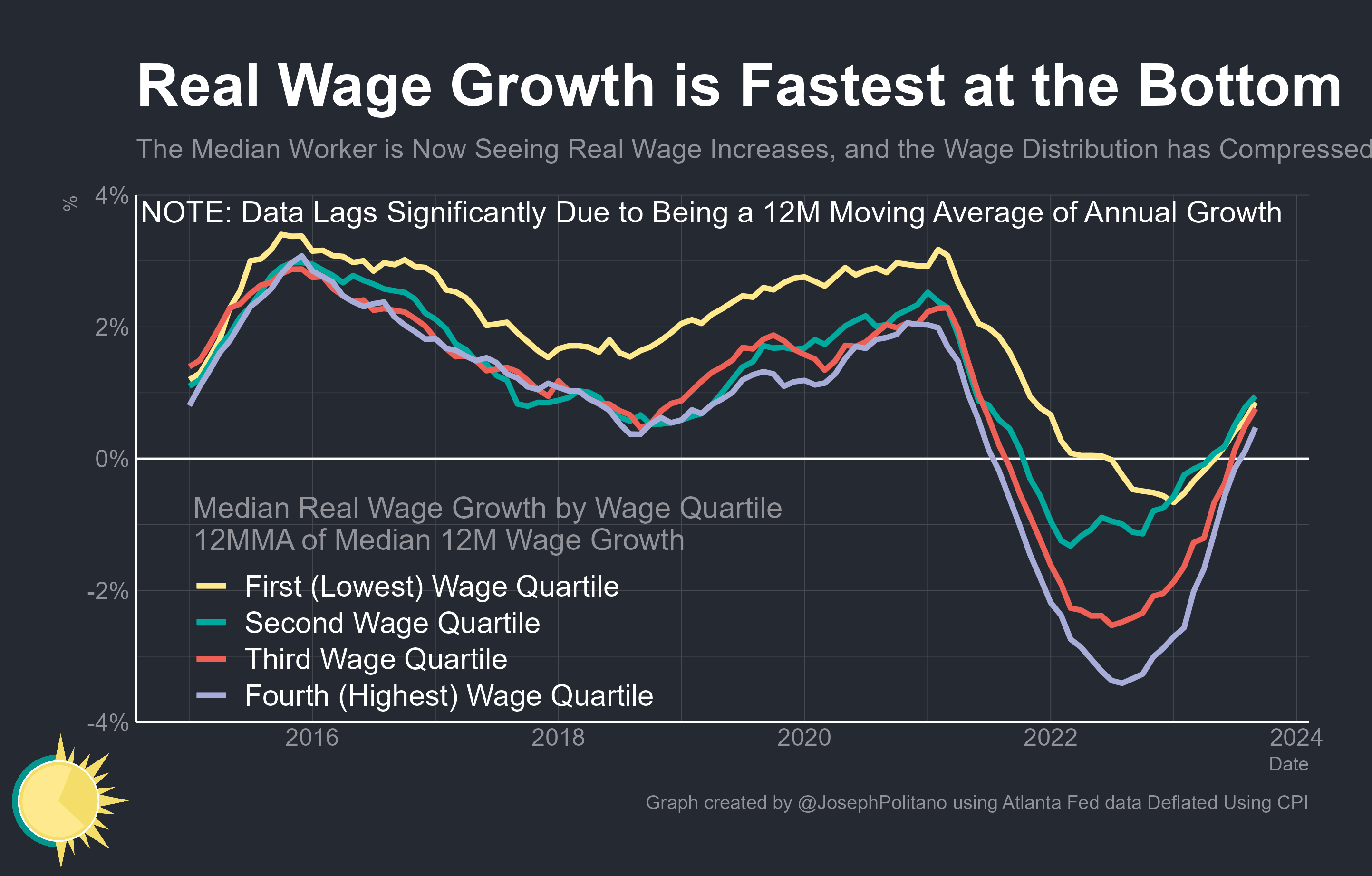
Since 2016, real (inflation-adjusted) wages have risen quickly for people in the bottom quartile, while for upper-income workers they've been stagnant. Obviously, most people on HN are still better off than manual laborers, but the gap has narrowed substantially (a big reversal from 1995-2015) and that's a good thing.

https://substackcdn.com/image/fetch/f_auto,q_auto:good,fl_pr...
Re: Economic Termites: Monopolies not noticeable enough for most of us

#102

I very much agree with the premise that economists unduly focus on a few metrics of dubious quality - labor force participation, personal consumption expenditures, market capitalization, wage growth, etc - and overfit them to construct a coherent narrative about the "strength" of the economy and what the experience of living in that economy must be like. There's a story right now being peddled by all the talking head…

> is not properly capturing what all consumers know

Yeah because every time a metric looks bad it gets adjusted to look better either by changing the weights or removing items from the calculation which dilutes it's effectiveness

Re: Economic Termites: Monopolies not noticeable enough for most of us

#103
I used to work for a competitor to AutoDesk. Popular opinion was that we had, at least in a few key areas, a genuinely better product, but it was pretty discouraging trying to make headway against "but I already know Revit".

Vendor lock-in in professional tools is an interesting topic. Sometimes it is active and malicious, but often it's just the natural tendency to keep using the tools you already know how to use.

Re: Economic Termites: Monopolies not noticeable enough for most of us

#104
post #78

Earlier quoted context omitted.

That’s a pretty weird take to me. Crime stats and polling of people’s perception of crime show this as clearly the wrong approach for instance. Most studies show that no matter what direction crime is going in, a substantial majority of people think their neighborhoods are safer and that everywhere else is basically a war zone that is getting worse. There’s a total disconnect locally/nationally in perception that is…

>Crime stats and polling of people’s perception of crime show this as clearly the wrong approach for instance. The only crime stat you can trust is murder and that's because bodies can't be hidden (easily). Everything else gets swept under the rug. When I wanted to report my car broken into I was hung up on three times because of a poor quality line, which was fine before I told them what I was calling for. When I we…

But this hasn't changed over decades. Policing never was 100% effective and crime was always underreported. Yet if you ask people it's crime getting worse YoY.

Re: Economic Termites: Monopolies not noticeable enough for most of us

#106

I very much agree with the premise that economists unduly focus on a few metrics of dubious quality - labor force participation, personal consumption expenditures, market capitalization, wage growth, etc - and overfit them to construct a coherent narrative about the "strength" of the economy and what the experience of living in that economy must be like. There's a story right now being peddled by all the talking head…

I agree with much of this and I'll add one of my biggest stressors - opaque pricing. One of the biggest "innovations" in the US in the last decade or so seems to be to add as many hidden fees as possible to every service imaginable. Obviously it's hardly a new idea; I'm sure that human nature being what it is, they had to deal with it in Mesopotamia. But it makes budgeting very difficult; I suppose it's like living i…

This seems to be rooted in a generalized problem which I'll hastily call the conscious abuse of polite understanding, or abuse of economic consensus. Another possible rubric for this, a bit more sensationalized, would be "destructive precision".

A simple example would be the hollowing-out of conventional terms everyone believes they hold the same settled definition of, such as "a flight." Instead of transacting according to what consensus suggests "a flight" meant a decade or two ago, when most would have expected this term to have thoroughly matured to the point of semantic stability, instead delivering against the most contextually minimized, stripped down interpretation of the term possible that still qualifies as valid, and attaching fees to all of the other attendant associations of value that used to be included in the scope of general consensus of the term.

Re: Economic Termites: Monopolies not noticeable enough for most of us

#107

Earlier quoted context omitted.

I agree with much of this and I'll add one of my biggest stressors - opaque pricing. One of the biggest "innovations" in the US in the last decade or so seems to be to add as many hidden fees as possible to every service imaginable. Obviously it's hardly a new idea; I'm sure that human nature being what it is, they had to deal with it in Mesopotamia. But it makes budgeting very difficult; I suppose it's like living i…

>> I'll add one of my biggest stressors - opaque pricing. Economic "models" make assumptions like markets being efficient. Meanwhile in the business classes next door they teach how to avoid competition because it's a race to the bottom. They all learn the prisoners dilemma as an example because it's how you need to think to avoid overt collusion. I'd like an economic model as powerful as the laws of thermodynamics,…

> Economic "models" make assumptions like markets being efficient. Meanwhile in the business classes next door they teach how to avoid competition because it's a race to the bottom

You've more-or-less verbatim described the impetus behind the modern development of behavioral economics. That older sort of classical theory which you describe -- the one which frames the world in terms of "rational economic agents" -- has been out of vogue for nearly two decades now. Sure, you can still find the idea taught in classes... but professors now treat the classical ideas more like a simplified foundation rather than gospel -- much like a physics professor teaches Newtonian Physics before moving on to Relativity.

> I'd like an economic model as powerful as the laws of thermodynamics, where everything is included if not explicitly. But I haven't seen one.

... and this is where you diverge in thinking from the new-school behavioral economists. According to the new-school, economics is a social science, a thing of statistical measurements and probabilities. Most modern economists would probably be inclined to chide you and say that attempting to characterize economics in terms of hard laws would be the same as disregarding the human element -- a reversion to the classical idea of "rational economic agents".

Re: Economic Termites: Monopolies not noticeable enough for most of us

#109

I very much agree with the premise that economists unduly focus on a few metrics of dubious quality - labor force participation, personal consumption expenditures, market capitalization, wage growth, etc - and overfit them to construct a coherent narrative about the "strength" of the economy and what the experience of living in that economy must be like. There's a story right now being peddled by all the talking head…

Why do you exclude the possibility that talking heads in news and politics are pedaling the idea that consumers feel it’s terrible? Most everyone I know seems to be living it pretty good with much less concern for the future. Certainly compared to 2023 and even compared to 2019.

That's very good for you, you should count yourself lucky. But i think we should trust people when they tell us how they feel. Do you live paycheck to paycheck? Are you aware that a majority oh Americans (55-69%) do, defined as struggling to save or invest anything past the monthly expenses?

I'm a late 20s man who made it into tech, I'm doing great! My friend who got into tech might kind of hate their corporate job lives but they're monetarily at least able to pay their student loans after 5 years of working. A few kids were able to start construction/lawn businesses, i don't know the details but they appear to be doing well. Every single other person that i know, who's finances I'm aware of directly, or indirectly (social media posts, etc. ) is having a hard time right now. I can count on one hand the number of people who feel good about the current US economy that i know, i speak and have spoken to dozens of people about this.

Literally only the comp sci graduates are having a good time right now, and even that's starting to tighten. Jobs are getting more scarce, people have to take pay cuts to be able to actually have a life again, etc. You could say I'm doing well right now and then i could say that must mean everyone is doing well and the whole thing is propaganda. But there's a lot more than just successful people out here, we're on HN anyways, that says a lot about our socioeconomic status and friend groups.

Re: Economic Termites: Monopolies not noticeable enough for most of us

#110
I do wonder if a better antitrust strategy would be to pursue a portfolio of actions against second- or third-tier companies like this; the current strategy of going up against Meta, Google, Apple is sound in terms of raw size of antitrust abuses going on, but they remain some of the most popular brands in the US and so it’s often hard to show consumer harm.

As a counterpoint, I suspect building momentum by actually winning a bunch of smaller cases for companies like Autodesk or Verisign where the average consumer doesn’t have an opinion, could shift the Overton Window on the issue.

I know you come into leadership positions at agencies like the FTC planning for only having 4 years, maybe the above is naive politically. Still, one can hope.

Post reply on HN