Live data from Hacker News

Lithium-free sodium batteries exit the lab and enter US production

newatlas.com

141–150 of 396 posts

Re: Lithium-free sodium batteries exit the lab and enter US production

#141
post #101

Earlier quoted context omitted.

Just have the same batteries in the charging station to smooth out power usage? Seems a lot cheaper and operationally less complex than a gas station.

This assumes that the same number of vehicles use the charging station. Lower charge times means potentially higher steady-state throughput.

Higher steady-state is mostly a good thing. You need to bulk up the power lines, but you're making good use of them and have lots of money to spend on them.

Re: Lithium-free sodium batteries exit the lab and enter US production

#142

> can be procured through a reliable US-based domestic supply chain free from geopolitical disruption. The same cannot be said for common lithium-ion materials like cobalt and nickel. This is good... only for the US. The world doesn't need another industry where US solely is a monopoly.

Most countries in the world don't have their own cobalt or nickel mines, so it's good for all those countries too.

Re: Lithium-free sodium batteries exit the lab and enter US production

#143

Earlier quoted context omitted.

This falls in line with a plug in hybrid being an excellent alternative to evs for most people. 30-50 miles of driving around town for work an errands, with an ICE for the occasional longer trip. Almost all driving will be electric without the charge anxiety.

My hesitation with hybrids is that I keep all the associated maintenance costs of an ICE engine. Now I have two power trains and energy systems to maintain instead of just one.

You do, but at least repair costs should be low because typically you won't put very many miles on that engine.

Suppose 90% of your miles are electric. After you've put 250K miles (400K km) on the car, you've only got 25K miles (40K km) on the engine. Rarely do you have significant engine trouble at that mileage.

Also, the engine design can probably be simplified if it's just acting as a generator. You don't need a turbo to provide extra bursts of power. Nor things like variable valve timing for good performance across a wide range of RPMs. Maybe you could even use an air-cooled engine like old VW Beetles and Porsches.

Re: Lithium-free sodium batteries exit the lab and enter US production

#144

Earlier quoted context omitted.

I imagine the idea they were proposing is ~most energy being locally generated, 48v should be fine from solar panels to batteries. But I can't see that working on denser cities, or factories, or less sunny climates.

This is what I'm referring to. Houses mostly, the reason we need such high voltage is because someone can turn on an oven and consume 5kw. But that oven only runs for 1 hour, or more averagely, 30 minutes. So in the context of 200kwh battery systems at EVERY house, and inverters at every house, that oven can easily run off the inverter, and the house would never need to pull down heavy wattage from the grid. In this…

Understood, but even if you are trickle feeding thousands of small houses with say 1kw(max) each, that still requires Megawatts of power. 1k*1k=1M. Therefore, you still need high voltage transmission lines to move this power from the source.

Re: Lithium-free sodium batteries exit the lab and enter US production

#145

Earlier quoted context omitted.

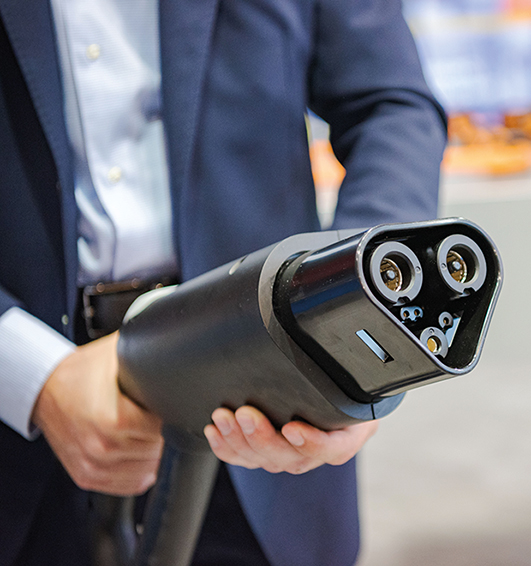
I wonder what that will mean for charging infrastructure that suddenly has to deliver 10x power to enable that. Not sure that sort of charging could be as ubiquitously placed as gas stations

Indeed the charging cables are already massive. Just need some superconducting cables.

Liquid cooled cables aren't too bad.

Megawatt charging system is big but doesn't seem unreasonable, and that gives you 5x the amps. In two minutes it can add 80kWh to an 800 volt battery, and the max voltage is 1250.

https://resources.news.e.abb.com/images/2023/5/12/0/Next_gen...

https://www.engineerlive.com/sites/engineerlive/files/ITM.11...

Re: Lithium-free sodium batteries exit the lab and enter US production

#146
post #105

Earlier quoted context omitted.

This is truly one of those "it begins" moments. The article touches on it - but the news goes well beyond the battery. Li ion batteries come with significant geopolitical baggage beyond simple cost. The situation is well summarised by the graph on this page. https://www.weforum.org/agenda/2023/01/chart-countries-produ...

"Mostly from Australia and Chile" seems like the opposite of baggage, that sounds like about the best you could hope for in a global commodity, so many of which come from unstable regions, conflict regions, or outright adversaries. Yes, I know that China does most of the refining/assembly, but that has little to do with the chemistry. "Building new Na-ion capacity outside China" is probably even harder than "building…

Let's unpack it then.

You've stated:

>"Mostly from Australia and Chile" seems like the opposite of baggage, that sounds like about the best you could hope for in a global commodity, so many of which come from unstable regions, conflict regions, or outright adversaries.

So let's break it down with some facts (all easily searchable.)

(1) The graph states that Australia is the largest producer of Lithium, and states that of their exports, 90% goes to China.

(2) Australia exports the majority of its lithium. (https://www.abs.gov.au/articles/insights-australian-exports-...)

(3) Lithium ion batteries are currently reliant on Cobalt for their cathode.

(4) The DRC (Congo) is the largest producer of Cobalt, then Indonesia, then Russia.

>"seems like the opposite of baggage ... unstable regions, conflict regions, or outright adversaries"

From (1) and (2) we can see that the world is dependent on China for the only viable battery option for a range of modern applications. Thus the claim that this isn't baggage is not supported. Secondly China is also considered an adversary of the USA, by the USA. Thirdly the claim that this does not involve unstable/conflict regions is also not supported due to (3) and (4).

Part two: you've also stated the below:

>"Building new Na-ion capacity outside China" is probably even harder than "building new li-ion capacity outside China."

While this is a baseless comment, let's look at it anyway:

(5) The article is specifically about the commencement of mass production of Na batteries in the USA.

That already refutes the core premise of your statement, but let's follow it further.

(6) The article notes that unlike Li batteries, the materials are trivially sourced domestically.

That's an important difference from Li batteries, and significantly boosts the viability of competitive production in the USA (and other countries outside of China).

Re: Lithium-free sodium batteries exit the lab and enter US production

#147
post #105

Earlier quoted context omitted.

This is truly one of those "it begins" moments. The article touches on it - but the news goes well beyond the battery. Li ion batteries come with significant geopolitical baggage beyond simple cost. The situation is well summarised by the graph on this page. https://www.weforum.org/agenda/2023/01/chart-countries-produ...

"Mostly from Australia and Chile" seems like the opposite of baggage, that sounds like about the best you could hope for in a global commodity, so many of which come from unstable regions, conflict regions, or outright adversaries. Yes, I know that China does most of the refining/assembly, but that has little to do with the chemistry. "Building new Na-ion capacity outside China" is probably even harder than "building…

Unless you are from those places. Ie few years ago we visited Salar de Uyuni, biggest salt flat in the world, properly amazing place. And one of the biggest deposits of lithium. Any form of mining (and you know in Bolivia it won't be eco-friendly unless miracle happens) will destroy at least some aspects of it. And there are massive plans.

Now sure not that many species of animals/plants will be affected compared to say some rainforest location, but it still pains me to even imagine it. If it will bring good jobs to the locals then at least some good locally will be achieved, but thats not always the case.

Re: Lithium-free sodium batteries exit the lab and enter US production

#148

> can be procured through a reliable US-based domestic supply chain free from geopolitical disruption. The same cannot be said for common lithium-ion materials like cobalt and nickel. This is good... only for the US. The world doesn't need another industry where US solely is a monopoly.

I think the article was saying that these batteries are buildable with easy-to-find materials for anyone, USA included. I don't think there's anything in them that can only be found in the United States.

Re: Lithium-free sodium batteries exit the lab and enter US production

#149
post #105

Earlier quoted context omitted.

This is truly one of those "it begins" moments. The article touches on it - but the news goes well beyond the battery. Li ion batteries come with significant geopolitical baggage beyond simple cost. The situation is well summarised by the graph on this page. https://www.weforum.org/agenda/2023/01/chart-countries-produ...

"Mostly from Australia and Chile" seems like the opposite of baggage, that sounds like about the best you could hope for in a global commodity, so many of which come from unstable regions, conflict regions, or outright adversaries. Yes, I know that China does most of the refining/assembly, but that has little to do with the chemistry. "Building new Na-ion capacity outside China" is probably even harder than "building…

Cobalt, however, which is used in common lithium battery chemistries, is mostly sourced from the DRC (Congo), much of it under terrible conditions: forced labour, child labour, and rampant environmental degradation. The book Cobalt Red: How the Blood of the Congo Powers Our Lives [1] is a real eye-opener if you haven’t read it. Fascinating and deeply disturbing.

1: https://www.goodreads.com/book/show/60784614-cobalt-red

Re: Lithium-free sodium batteries exit the lab and enter US production

#150

We’re undergoing a Cambrian explosion of battery chemistries at the moment. Other startups, such as From Energy is scaling up production of Iron Air batteries in West Virginia, which will be an order of magnitude cheaper than lithium ion and will provide grid scale power [1]. North Harbour Clean Energy Promised to build a manufacturing facility in Australia to build Vanadium Flow batteries, which have very high charg…

> which will be an order of magnitude cheaper than lithium ion

Maybe. But take a lot of these cost claims with a giant pinch of salt: TCOE/TCOS at scale is what matters and we won’t have any real idea what that will be while most of these battery chemistries are still pre commercialization.

That being said the cambrian explosion is very encouraging. Just good to temper optimism sometimes.

Source: I talk to grid battery developers for my business

Post reply on HN