Live data from Hacker News

No one buys books

elysian.press

321–330 of 752 posts

Re: No one buys books

#321
post #294

Earlier quoted context omitted.

Is the thinking that the person who pirated it was never going to buy it anyways?

They may or may not have bought it, but the calculations of "lost sales" assume that 100% of them would have bought it at full price, which is absurd. I'd wager it is closer to 10%.

In my lifetime I've easily bought 100x more books used than new, which (from their perspective) is economically indistinguishable from piracy. Any of those "lost sales" estimates strike me as entirely bogus.
Re: No one buys books

#322
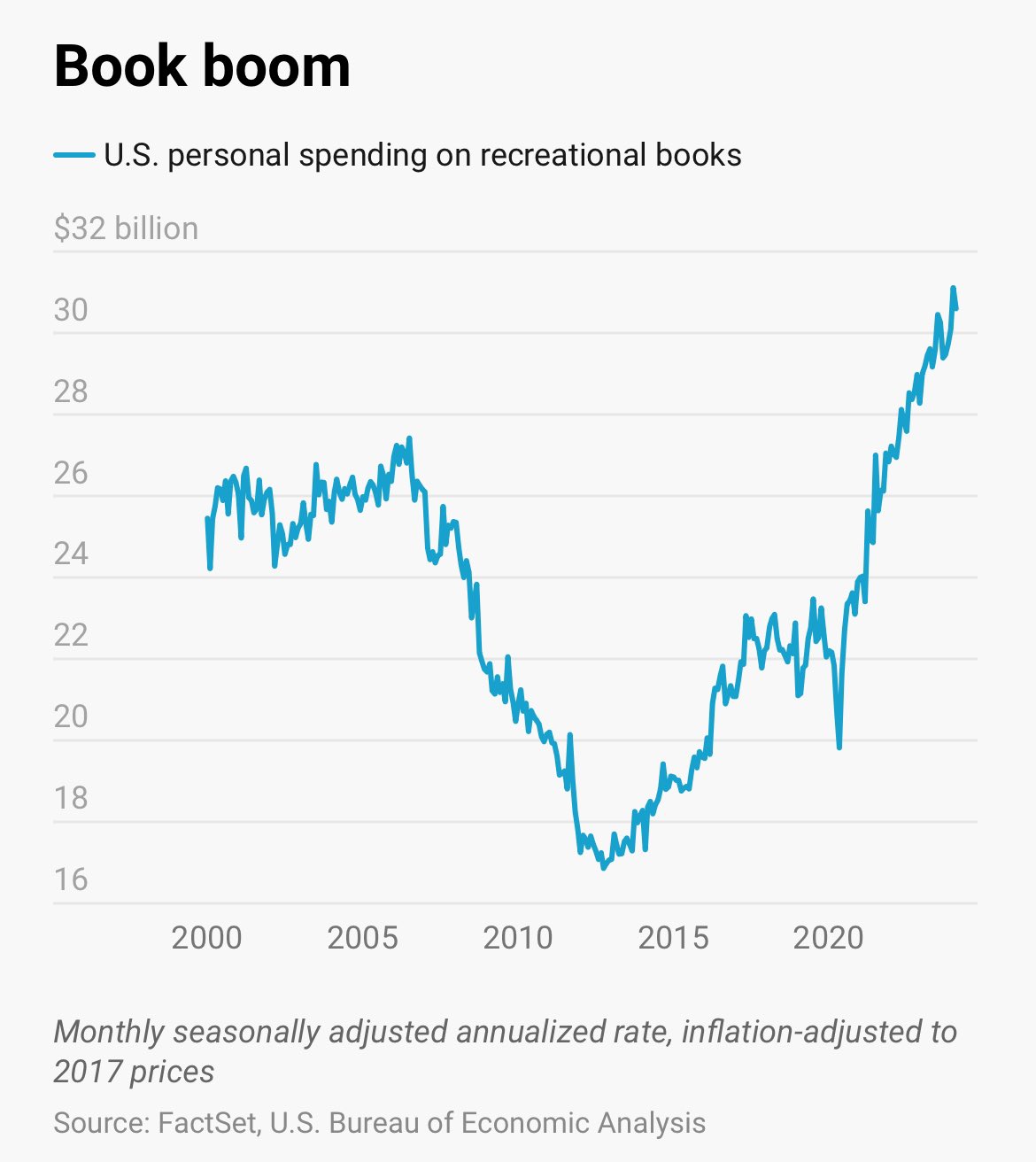
I think at least half of the top level comments didn't read the article, and mistook it for an article about reading habits. It's actually about the number of books that sell well, not the number of readers.

Re: No one buys books

#323

>> Obviously, given the number of people searching on Amazon for products, that gives them a huge advantage because when people go onto Amazon, they—if the book isn’t there for what they are searching for, they could create that book. This is a really weird thing to say. It seems to assume that people are indifferent to the quality of the writing in the books they read.

Looking at the best-selling Amazon-published titles leaves the impression that this is the case.

Re: No one buys books

#324

I'm currently writing a book about independent thinking and I have zero expectations that it will sell even a single copy. However, the net gain I will get from having completed the goal of writing the book is invaluable to me personally.

I love the idea of owning books you can’t find anywhere else. One of the main reasons I don’t bother going to bookstores is because I know everything there is just gonna be on Amazon anyway, and with reviews.

But the idea of coming across a strange book few people have read, and finding unconventional wisdom and writing inside that no publisher would ever put out, sounds exciting!

I think more people should write books and publish them in small quantities and just give them away for others to discover some day. Let the books circulate through the world, growing old and more mysterious with time. It’d be better than keeping some static blog site that will disappear after a decade.

Re: No one buys books

#325
post #51

I recently started buying paper books. Yes, it's not particularly ecological, but I found that I'm able to focus at the text much better this way. My Kindle (despite plenty of obvious advantages) just doesn't really work for me. It took me years to realize this, but I always start to tinker with the brightness settings, switch pages back and forth, go into the book library and back, play with highlighting words, etc.…

I read paper books because I can flip back and forth without friction, and I can underline and scribble.

I don't know why eReader interfaces make these two functions -- critical for deep reading -- so difficult.

Kindle is optimized for linear reading only. So beach reading and long romances.

But if you do the kind of reading that Mortimer Adler's "How to Read a Book" proposes (skimming, inspectional reading, writing notes), you pretty much can't with Kindles.

Re: No one buys books

#326
post #81

Most books today are sold with DRM and when the DRM servers are deactivated the books stop working. This happened with the Microsoft ebooks store and has happened with countless other DRM media. Sometimes books are automatically revised, or censored. Sometimes accounts holding DRM licenses are deleted or deactivated by mistake. The only way to actually own a book these days is to buy it on paper, or from one of the r…

The books sold through Apple Books are all sold without DRM. That's pretty standard now.

That's not at all standard.

Most books Apple sells come with DRM.

This section of the Apple documentation explains how a publisher can control whether DRM is used for their book:

https://itunespartner.apple.com/books/support/30-manage-book...

All of the major eBook stores sell books with and without DRM (including Amazon Kindle, Rakuten Kobo, Apple Books, Google Play Books).

Whether an individual book includes DRM on all of these stores is down to the publisher, and you won't typically see books from the major publishers offered without DRM.

Re: No one buys books

#328
post #51

I recently started buying paper books. Yes, it's not particularly ecological, but I found that I'm able to focus at the text much better this way. My Kindle (despite plenty of obvious advantages) just doesn't really work for me. It took me years to realize this, but I always start to tinker with the brightness settings, switch pages back and forth, go into the book library and back, play with highlighting words, etc.…

I've been buying used books from local booksellers and betterworldbooks.com when I can't find them locally.

Seems like a fair compromise to me re: ecological impact.

Re: No one buys books

#329

In my essay “Writing books isn’t a good idea” I wrote that, in 2020, only 268 titles sold more than 100,000 copies, and 96 percent of books sold less than 1,000 copies. That’s still the vibe. yaawn..this useless stat again? The author erroneously mixes fiction with non-fiction. Of course, non-fiction from a boutique or niche publishing house will have smaller sales and thus depress the average. This includes such boo…

the stat is also leaving out an important part of the market, 10,000 books. (I think that's the size of a run of books; the actual number is not important, the vast range between 1000 and 100,000 is)

Re: No one buys books

#330

Earlier quoted context omitted.

Notwithstanding what I understand about the publishing industry, I'm talking about the marginal cost of distributing a .mobi or whatever versus manufacturing a printed book, not the entire cost of publishing an eBook.

That's only a dollar or two of difference per unit in costs to the publisher. The majority of their costs are exactly the same for ebooks and printed books.

Sure, I never said they weren't.
Post reply on HN