Earlier quoted context omitted.
The originals still exist and you’re free to watch those instead. This just provides a new way to watch older movies should you choose to do so. Or not.
> The originals still exist and you’re free to watch those instead. This is far from certain, unless "you" are willing to engage in piracy. It's often difficult or impossible to legitimately buy (or even rent) the original, unadulterated versions of older films.
AI made these movies sharper – critics say it ruined them
131–140 of 270 posts
Re: AI made these movies sharper – critics say it ruined them
#132My biggest gripe with these AI film enhancements is that they are adding information that was never there. You're no longer watching the original film. You no longer have a sense of how contemporary film equipment worked, what its limitations were, how the director dealt with those limitations, etc.
> how contemporary film equipment worked, what its limitations were, how the director dealt with those limitations, etc. Non-film buffs, i.e. most viewers, don't care about this.
... consciously ...
Assuming competent cinematography, it will have an effect on the viewer whether they can analyze it or not.
Re: AI made these movies sharper – critics say it ruined them
#133The "AI" versions of the movie stills are darker and "greener" or "bluer" in all cases in this article, which is NOT the case when you watch the movie. It's a mistake on the part of whoever put together the image comparisons. The culprit here is that the non-AI screenshots are taken from presumably 1080p non-HDR sources, while all the AI screenshots are taken from presumably 4K HDR sources. The "AI" images are all di…
The shame is in comparing compressed-to-hell streaming versions to Blu-Ray in the first place, and commenting on how the Blu-Ray is "sharper." ANY Blu-Ray version should be much better than streaming. The NYT isn't free. I don't respect such shoddy feature-writing.
That should change over time: Blu-Ray is a format released about 20 years ago, and our streaming bandwidth (and encoding algorithms) keep improving.
Re: AI made these movies sharper – critics say it ruined them
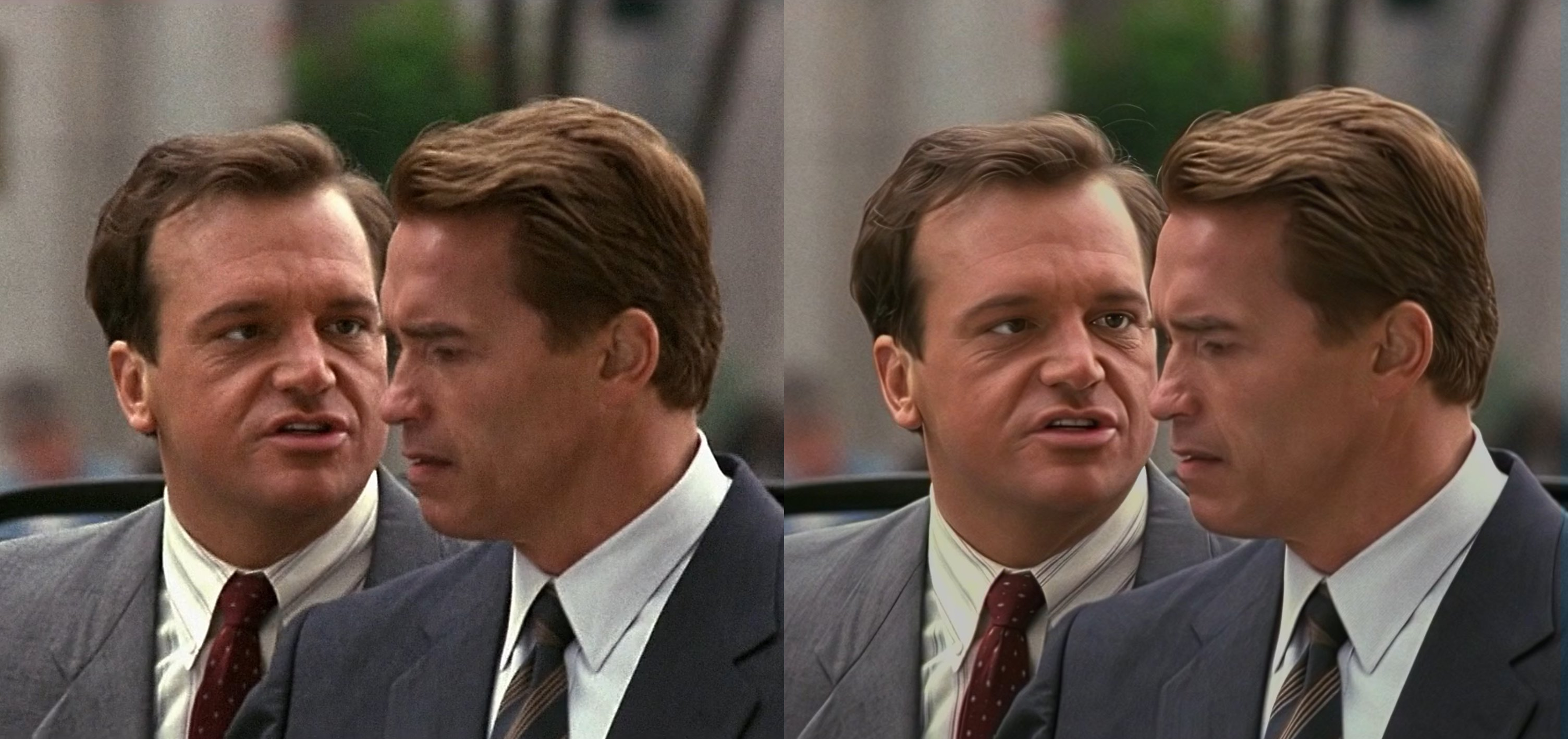
#134Wow, that tweet they link to with a super punched in shot looks really really bad! Hard to believe Cameron thought this looked better than just a normal 4k transfer, yikes. Was really looking forward to a UHD release of The Abyss but now I'm not so sure... https://twitter.com/RazorwireRyan/status/1735753526167347232
I don't see how these can be compared. They are totally different color schemes. It's possible that if you took the right image and displayed it using the same color scheme as the left image that it would look better than the left image.
https://www.matteason.co.uk/share/true-lies-colours.png
And the full-size original for comparison:
https://pbs.twimg.com/media/GBaikRhX0AEcjuy?format=jpg&name=...
(I just overlaid the original on the left over the upscaled version on the right and set the blending mode to Colour in Photoshop)
Re: AI made these movies sharper – critics say it ruined them
#135When I was a kid I had a classic playstation (PS1) it had multiple kinds of video outputs, one of which was S-video, which was a lot sharper than composite, problem was sharper wasn't better, it made pixel games have sharp edged pixels and the blur and scanlines that blended were missing, it also made the motions of 3D things just look clunky and disconnected. In almost every way possible the higher resolution output…
And then some people do masterpiece remasters like that Silent Hill where they removed the fog because modern systems can draw more. Also ruined the atmosphere.
Re: AI made these movies sharper – critics say it ruined them
#136Earlier quoted context omitted.
> how contemporary film equipment worked, what its limitations were, how the director dealt with those limitations, etc. Non-film buffs, i.e. most viewers, don't care about this.
I agree, most people watch the movie for the story that unfolds. Few are looking at things like framing the subject, the pull of the focus, subtle lighting differences between scenes, they are interested in the story, not the art of filmmaking. The people offended by this are the ones that are crying about the art being taken out of it.
Re: AI made these movies sharper – critics say it ruined them
#137> The recent Cameron restorations were based on new 4K scans of the original negative, none of which needed extensive repair of that kind. [...] The A.I. can artificially refocus an out-of-focus image, as well as make other creative tweaks. “You don’t want to crank the knob all the way because then it’ll look like garbage,” Burdick said. “But if we can make it look a little better, we might as well.”
The only movies which would require upscaling to 4K are those released between about mid-2000s to mid-2010s, the advent of native digital cinema, but filmed in 2K. Everything before was filmed in 35mm film, which can be scanned to 4K with information to spare; everything after is filmed in native digital 4K or more.
Moreover, upscaling which deal only with resolution has absolutely no need of AI. Any TV will decently upscale in _real-time_ a non-4K movie, and more sophisticated techniques can give basically indistinguishable results. 2017's _Alien: Covenant_ was voluntarily produced in 2K but released in 4K through upscaling and the image look just great.
Re: AI made these movies sharper – critics say it ruined them
#138Earlier quoted context omitted.
Cameron doesn't give a crap. He just needs his latest shot of money.
It seems little wild to assume the maker of a movie would care less about the movie than a random mob on the internet (instead of maybe just having a different opinion) but the assumption does feel very internet.
I bet even Kubrick would have been tempted if the situation came about.
Re: AI made these movies sharper – critics say it ruined them
#139My biggest gripe with these AI film enhancements is that they are adding information that was never there. You're no longer watching the original film. You no longer have a sense of how contemporary film equipment worked, what its limitations were, how the director dealt with those limitations, etc.
If there is a movie which is only shot in 1080p and I have a 4k TV, it seems like there’s three options. One, watch it in the original 1080p with 3/4 of the screen as black border. Two, stretch the image, making it blurry. Three, upscale the image. If you give me the choice, I’m choosing 3 every time. Sorry if it sounds crass, but I feel the process of shooting the movie is less important than the story it is trying…
Re: AI made these movies sharper – critics say it ruined them
#140Earlier quoted context omitted.
Wouldn't that be the original film?
It depends. A large movie - yes. But many movies were made with less of a focus on the cinema and more on the video rental ("direct-to-video") or TV syndication. TV content like Star Trek the Next generation were definitely never meant to display in high definition, and such things can show in props etc.