Live data from Hacker News

Baltimore's Key Bridge struck by cargo ship, collapses

wbaltv.com

111–120 of 1001 posts

Re: Baltimore's Key Bridge struck by cargo ship, collapses

#111

Somehow I find it surprising how completely the bridge collapsed after the damage. I understand that a container ship collision is serious, but you could imagine a scenarios where the bridge slumps or buckles but doesn’t just disintegrate like that. It’s surprising that ships capable of doing this damage were probably regularly driving past it, and its safety as a thoroughfare depended entirely on those collisions no…

Why would slumping or buckling but not-quite-collapsing be a functionally better outcome than complete failure? In both cases, the sheer size of the physical changes is going to lead to forces that humans won't survive, so there's no benefit there. In both cases, the bridge is going to have to be completely demolished before rebuilding, so there's no benefit there.

A bridge that could stand the loss of a single support pier without any significant collapse would obviously be preferable -- but that's a big ask. I'm not a structural engineer, but I am aware of scaling laws [1] and it feels to me that those scaling laws are going to mean that increasing the margin of safety by x is going to increase costs by x^n. For a project like this one, where cost was apparently the deciding factor over a tunnel, that matters.

[1] https://galileo.phys.virginia.edu/classes/609.ral5q.fall04/L...
Re: Baltimore's Key Bridge struck by cargo ship, collapses

#112

Somehow I find it surprising how completely the bridge collapsed after the damage. I understand that a container ship collision is serious, but you could imagine a scenarios where the bridge slumps or buckles but doesn’t just disintegrate like that. It’s surprising that ships capable of doing this damage were probably regularly driving past it, and its safety as a thoroughfare depended entirely on those collisions no…

You could try to avoid collisions with barriers, or make the bridge fail differently (only a few spans), or make it tolerant to a single support failing. But you need a pretty beefy steel beam to survive a direct hit by... Uh... 200,000t(??) traveling even at a slow jogging pace. (And then it transfers the energy into the rest of the bridge, which will very much not like it).

I guess we can be happy failure like this is rare, and that the bridge was not busy: reports indicate 13 cars, and about 7 persons still missing. This could be so much worse.

The best way to think about measures is after we know the full chain of events that have lead to this.

Re: Baltimore's Key Bridge struck by cargo ship, collapses

#113

Oh, this makes me feel bad for Baltimore. Only bad news seem to come out of this town. Its reputation -- both domestically and internationally -- is mostly informed by The Wire, Freddie Gray/BLM, a dysfunctional city government, the 2019 ransomeware attack, the spoiled batch of J&J Covid vaccine... and now this. It's a real shame. It's a good place.

John Waters on Baltimore:

https://www.theguardian.com/travel/2014/nov/28/john-waters-b...

John Waters’ Baltimore:

https://baltimore.org/what-to-do/john-waters-baltimore/

Re: Baltimore's Key Bridge struck by cargo ship, collapses

#114
post #103
post #98

Earlier quoted context omitted.

I would say the damage is about the same, The ship knocked down a pier and all spans connected to the pier went down. The difference is, on the baltimore bridge is that the spans are a lot longer. But all other spans(the ones nearly out of frame) are still standing.

Parts of the Francis Scott Key Bridge not connected to the hit pylon went down too. The beam structure above the road that supports the whole thing collapsed and took down other spans.

Yes the entire truss section dropped. However the bridge is quite a few times longer than it's trussed section. and none of those spans dropped.

Re: Baltimore's Key Bridge struck by cargo ship, collapses

#115
post #103
post #98

Earlier quoted context omitted.

I would say the damage is about the same, The ship knocked down a pier and all spans connected to the pier went down. The difference is, on the baltimore bridge is that the spans are a lot longer. But all other spans(the ones nearly out of frame) are still standing.

Parts of the Francis Scott Key Bridge not connected to the hit pylon went down too. The beam structure above the road that supports the whole thing collapsed and took down other spans.

Maybe it's the extra momentum that took it over the edge, which if it were built in the 70s probably were designed with static loading in mind without the benefit of dynamical simulation?

Re: Baltimore's Key Bridge struck by cargo ship, collapses

#117

Somehow I find it surprising how completely the bridge collapsed after the damage. I understand that a container ship collision is serious, but you could imagine a scenarios where the bridge slumps or buckles but doesn’t just disintegrate like that. It’s surprising that ships capable of doing this damage were probably regularly driving past it, and its safety as a thoroughfare depended entirely on those collisions no…

Why would slumping or buckling but not-quite-collapsing be a functionally better outcome than complete failure? In both cases, the sheer size of the physical changes is going to lead to forces that humans won't survive, so there's no benefit there. In both cases, the bridge is going to have to be completely demolished before rebuilding, so there's no benefit there. A bridge that could stand the loss of a single suppo…

>Why would slumping or buckling but not-quite-collapsing be a functionally better outcome than complete failure?

Well for starters, there's a better chance of less (or ideally no) people forced to get their feet wet and go missing or die from drowning or hypothermia.

Re: Baltimore's Key Bridge struck by cargo ship, collapses

#118
post #103
post #98

Earlier quoted context omitted.

I would say the damage is about the same, The ship knocked down a pier and all spans connected to the pier went down. The difference is, on the baltimore bridge is that the spans are a lot longer. But all other spans(the ones nearly out of frame) are still standing.

Parts of the Francis Scott Key Bridge not connected to the hit pylon went down too. The beam structure above the road that supports the whole thing collapsed and took down other spans.

And that structure probably existed because the bridge has fewer longer spans, probably since the seabed below the bridge is deeper (and needs to be deeper to support container ships passing below).

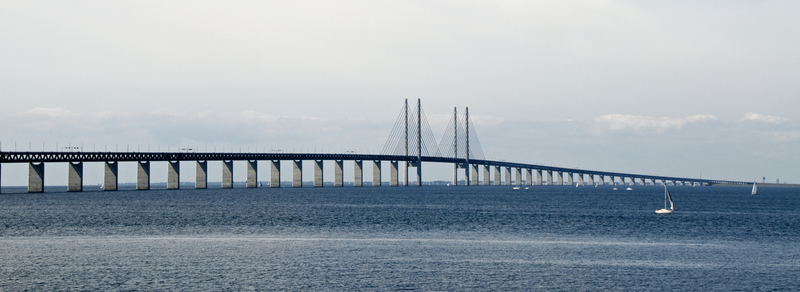
The Öresundsbron (connecting Sweden and Denmark) features both short segments but also with an overhand section in the middle for larger ships to pass through. (1) The great belt bridge (inside Denmark) is slightly higher but has the same kind of profile, one of the largest cruise ships barely making it under it is shown passing in the video below (2).

I think the simple truth is that we're vulnerable to these kinds of accidents unless we build far far sturdier bridges, but at these scales to allow passage of ships of these sizes the cost would just make many bridge projects prohibitably expensive.

1: https://www.norden.org/sites/default/files/styles/content_si...

2: https://www.youtube.com/watch?app=desktop&v=j1Cs0C8LkeU

Re: Baltimore's Key Bridge struck by cargo ship, collapses

#120
post #37

DALI (IMO: 9697428) is a Container Ship and is sailing under the flag of Singapore. Her length overall (LOA) is 299.92 meters and her width is 48.2 meters [1]. Based on the track, it appears the ship changed course slightly and slowed as it approached the bridge [2]. [1] https://www.marinetraffic.com/en/ais/details/ships/shipid:28... [2] https://www.marinetraffic.com/en/ais/home/shipid:2810451/zoo...

That's clear in the livestream video too. It's like it was fairly on track then changed to head straight for the pylon. A lot of smoke starts coming out of the funnel at the same time as the course change, and the ship's lights go out before impact.

It appears to have lost power twice before veering into the foundation of the bridge..
Post reply on HN