Sigh...learning about TPUs a decade ago made me invest heavily in $GOOG for the coming AI revolution...got that one 100% wrong. +400% over 10 years isn't bad but I can't help but feel shortchanged seeing nvidia/etc
Google's First Tensor Processing Unit: Architecture
11–20 of 197 posts
Re: Google's First Tensor Processing Unit: Architecture
#12> However, although tensors describe the relationship between arbitrary higher-dimensional arrays, in practice the TPU hardware that we will consider is designed to perform calculations associated with one and two-dimensional arrays. Or, more specifically, vector and matrix operations. I still don’t understand why the term “tensor” is used if it’s only vectors and matrices.
Tensor is from mathematics and was popularized over a century ago.
I know what a tensor is mathematically. However, as far as I can see, ML isn’t based on tensor calculus as such.
Re: Google's First Tensor Processing Unit: Architecture
#13Earlier quoted context omitted.
I was confused as hell for a long time when I first got into ML, until I figured out how to think about tensors in a visual way. You're right: fundamentally ML is about vector and matrix operations (1D and 2D). So then why are most ML programs 3D, 4D, and in a transformer sometimes up to 6D (?!) One reasonable guess is that the third dimension is time. Actually not. It turns out that time is pretty rare in ML, and it…
Thanks for the background! I still don’t think it’s appropriate to call a batch of matrices a tensor.
You'd hate particle physics then. "Spin" and "action" and so on are terrible names, but scientists live with them, because convention.
Convention dominates most of what we do. I'm not sure there's a good way around this. Most conventions suck, but they were established back before there was a clear idea of what the best long-term convention should be.
Re: Google's First Tensor Processing Unit: Architecture
#14> However, although tensors describe the relationship between arbitrary higher-dimensional arrays, in practice the TPU hardware that we will consider is designed to perform calculations associated with one and two-dimensional arrays. Or, more specifically, vector and matrix operations. I still don’t understand why the term “tensor” is used if it’s only vectors and matrices.
I was confused as hell for a long time when I first got into ML, until I figured out how to think about tensors in a visual way. You're right: fundamentally ML is about vector and matrix operations (1D and 2D). So then why are most ML programs 3D, 4D, and in a transformer sometimes up to 6D (?!) One reasonable guess is that the third dimension is time. Actually not. It turns out that time is pretty rare in ML, and it…
just because an image is 2-D doesn’t mean that the model can’t use higher dimensional representations in subsequent layers.
For an image, you could imagine a network learning to push the image through a filter bank that does oriented local frequency decomposition and turns it into 4D {height}x{width}x{spatial freq}X{orientation} before dealing with color channels or image batches
Re: Google's First Tensor Processing Unit: Architecture
#15> However, although tensors describe the relationship between arbitrary higher-dimensional arrays, in practice the TPU hardware that we will consider is designed to perform calculations associated with one and two-dimensional arrays. Or, more specifically, vector and matrix operations. I still don’t understand why the term “tensor” is used if it’s only vectors and matrices.
I was confused as hell for a long time when I first got into ML, until I figured out how to think about tensors in a visual way. You're right: fundamentally ML is about vector and matrix operations (1D and 2D). So then why are most ML programs 3D, 4D, and in a transformer sometimes up to 6D (?!) One reasonable guess is that the third dimension is time. Actually not. It turns out that time is pretty rare in ML, and it…
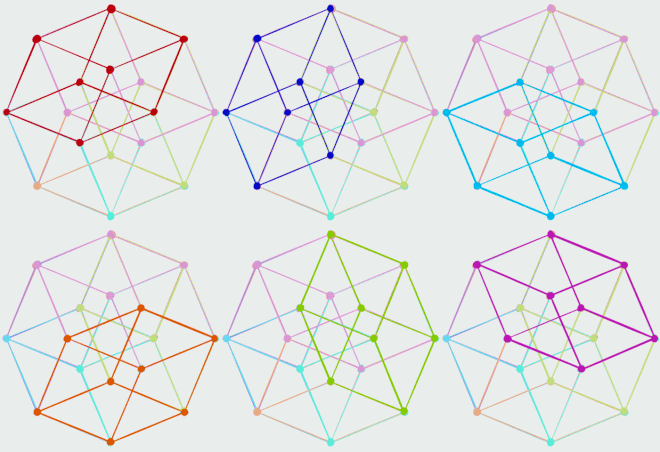
For whatever reason, I have held a mental image of a Tensor as a Tesseract/HyperCube where the connections are like the Elastic workout bands where they have differing tensile resistances, and they pull on one another to create their encapsulated info-cluster - but I have no clue if thats truly an accurate depiction, but it works in my head....
https://upload.wikimedia.org/wikipedia/commons/thumb/1/1a/Or...
Re: Google's First Tensor Processing Unit: Architecture
#16Sigh...learning about TPUs a decade ago made me invest heavily in $GOOG for the coming AI revolution...got that one 100% wrong. +400% over 10 years isn't bad but I can't help but feel shortchanged seeing nvidia/etc
+400% over 10 years isn't bad.
Re: Google's First Tensor Processing Unit: Architecture
#17> However, although tensors describe the relationship between arbitrary higher-dimensional arrays, in practice the TPU hardware that we will consider is designed to perform calculations associated with one and two-dimensional arrays. Or, more specifically, vector and matrix operations. I still don’t understand why the term “tensor” is used if it’s only vectors and matrices.
I was confused as hell for a long time when I first got into ML, until I figured out how to think about tensors in a visual way. You're right: fundamentally ML is about vector and matrix operations (1D and 2D). So then why are most ML programs 3D, 4D, and in a transformer sometimes up to 6D (?!) One reasonable guess is that the third dimension is time. Actually not. It turns out that time is pretty rare in ML, and it…
>One reasonable guess is that the third dimension is time. Actually not. It turns out that time is pretty rare in ML, and it's only (relatively) recently that it's been introduced into e.g. video models.
WRT to ML - may time be better thought of where a thing lives in relation to other things that occurred within the same temporal window?
so "all the shit that happened in 1999 also has an expression within this cluster of events from 1999" - but the same information appears in any location where it is relationally contextual to the other neighbors, such as the SUBJECT of the information? Is this accurate to say why its 'quantum' because the information will show up depending on where the Observation (query) for it is occurring?
(sorry for my kindergarten understanding of this)
Re: Google's First Tensor Processing Unit: Architecture
#18Earlier quoted context omitted.
Tensor is from mathematics and was popularized over a century ago.
I know what a tensor is mathematically. However, as far as I can see, ML isn’t based on tensor calculus as such.
Something similar happens on Wikipedia, where topics that use math inevitably get explained in the highest level math possible. It makes topics harder to understand than they need to be.
Re: Google's First Tensor Processing Unit: Architecture
#19Sigh...learning about TPUs a decade ago made me invest heavily in $GOOG for the coming AI revolution...got that one 100% wrong. +400% over 10 years isn't bad but I can't help but feel shortchanged seeing nvidia/etc
[deleted]
Re: Google's First Tensor Processing Unit: Architecture
#20> However, although tensors describe the relationship between arbitrary higher-dimensional arrays, in practice the TPU hardware that we will consider is designed to perform calculations associated with one and two-dimensional arrays. Or, more specifically, vector and matrix operations. I still don’t understand why the term “tensor” is used if it’s only vectors and matrices.
Well, in the transformer forward pass there are a bunch of 4-dimensional arrays being used.