Live data from Hacker News

Webb and Hubble confirm Universe's expansion rate

esa.int

321–330 of 380 posts

Re: Webb and Hubble confirm Universe's expansion rate

#321
post #283
post #150

Earlier quoted context omitted.

As I understand it, before the big bang the whole observable universe was contained in a small sphere and then it started to expand metrically. Is this interpretation correct? Another thing: suppose I point a laser beam to the space and by chance this laser beam never finds any kind of matter in its way, where is this laser going to? To an infinite void? Is it correct to say that stars radiate energy to the infinite…

> before the big bang the whole observable universe was contained in a small sphere and then it started to expand We have no evidence of any time when the universe was not expanding. At the earliest times we have evidence of, the universe was already expanding (extremely rapidly--much, much, much more rapidly than it is now). At those times, our observable universe was indeed contained in a very small volume. > suppo…

>According to our best current model, no, the laser beam will never stop passing by matter, of approximately the same average density as the matter we can see.

I didn't understand this part, why would the laser beam would never stop passing by matter? Because of the metric expansion of the universe? Isn't it reasonable to assume that there is a skirt of the universe where matter keeps expanding into nothingness?
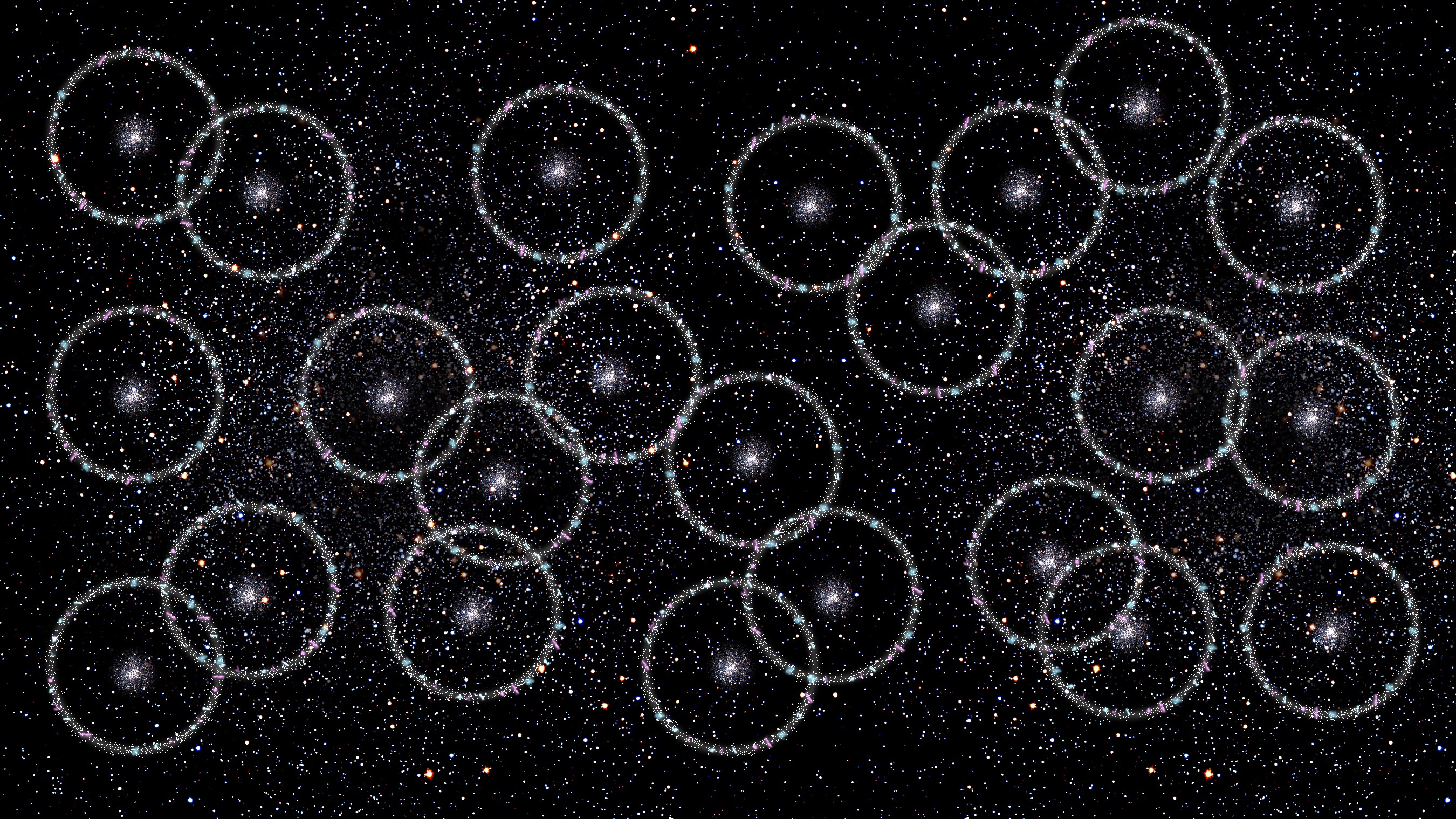
Re: Webb and Hubble confirm Universe's expansion rate

#322

Earlier quoted context omitted.

But I believe he was the winner for many years under price is right rules.

Can you claim to be a winner under the rules of a game that won’t be invented yet for hundreds of years?

* thousands

Re: Webb and Hubble confirm Universe's expansion rate

#323

Earlier quoted context omitted.

What's the value in """daring to imagine""" about cosmology? This is nothing more than reality based fan fiction. >A lot of great science started as a strange idea. Disagree. A lot of great science started with "This weird math I'm doing is the only way to fit this data", which is an extremely different thing. Do you not think physicists and cosmologists and their nerdy friends have thought of wild ideas? Do you not…

Thank you. It's good to know I'm not the only one who feels disrespected from people on the sidelines who clearly never opened a cosmology textbook. It's one thing to ask curious questions, but "why don't you just do the thing that was ruled out 100 years ago" and expecting a detailed rebuttal is a bit rich. It's like asking "why don't they cure cancer by cutting it out of the body". Or "why don't you just apply basi…

> No one ever invents ... fringe theories on baryonic acoustic oscillations

BAOs are clearly the sucker-marks made when the great and mighty Kroll https://tardis.fandom.com/wiki/Kroll> seized the walls of the universe!

https://insidetheperimeter.ca/wp-content/uploads/2021/05/Bar...

I'm not nearly as bothered by people typing out what they themselves admit are essentially physics fantasies (especially when prefaced with "I'm not a physicist" or the like), as by people who try to convince readers with even less exposure to physics that some alternative to good theories is clearly better but that the powers that be of theoretical physics are somehow suppressing it, and then clearly have little understanding about how the good theories work. There's a lot of that, especially in DM threads.

Re: Webb and Hubble confirm Universe's expansion rate

#324

I don’t really understand how we can make conclusions about the entire universe when literally all of the data is collecting from one point in space. Couldn’t there be local effects that obfuscate global behavior? Is there an implicit caveat asterisk on all such statements that is like “as far as we can possibly tell from the data we have” and the reality is we really, really don’t know for sure?

> “as far as we can possibly tell from the data we have” Isn't that self evident in all cases? In cosmology, the implicit assumptions are the Corpernican principle and that GR is correct. That is covered in introductory texts, but unless stated otherwise, it is usually not mentioned, especially not in press releases. I mean, maybe you're just a Boltzmann brain floating in space and nothing is real. Fun to think about…

I’m not talking about physics being different in different places. I’m talking about the signal we are getting from far away quite likely being altered between its origin and when it gets to us.

Different branches of science have vastly different degrees of certainty. I don’t feel there is sufficient effort put towards communicating this well to the public, especially with respect to the Big Bang, and that annoys me because lay people seem to use it as a factual version of an origin myth when really it probably isn’t any more factual than any other random myth you could pick.

It’s very irresponsible to replace the cultural origin myth, which is psychologically important to humans. The whole “explosion from nothing” myth may actually be contributing to modern people’s feelings of meaninglessness.

Re: Webb and Hubble confirm Universe's expansion rate

#325
post #161

Earlier quoted context omitted.

How is is that dark energy density does not change with time? Surely the total amount of dark energy has to be constant (energy can't be created or destroyed, and all that), and then as the universe expands, that's then the same amount of energy over a larger volume, right?

/me not a cosmologist. I think the story is that dark energy is indeed created, in the new emptiness resulting from the expansion of space. I believe it's supposed to be spacetime that expands, not 'space'. But it's beyond me to explain what that even means; as I understand it, spacetime refers to the whole Universe, across all of time. To 'expand' means 'to become larger over time'. But if the thing that's expanding…

It is in fact the metric expansion of space. The spatial part of the Robertson-Walker spacetime metric expands equally along the time axes of a family of freely-falling future-directed worldlines (we can call them "Eulerian observers", and individual clusters of galaxies are good approximations).

That is, in the past, galaxy clusters are relatively close together, and in the future they are relatively very far apart.

If you need an image, think of a vase of cut flowers, with the stems tightly bound together at the bottom of the vase, and the flowers loosely separated at the top. Time is in the direction away from the vase's bottom. A super thin slice through a stem represents a snapshot of a galaxy cluster at a particular time in its existence.

https://s3-eu-west-1.amazonaws.com/images.linnlive.com/de6e1...

https://media.istockphoto.com/id/578833902/vector/expansion-...> : time increases from the left to the right.

Re: Webb and Hubble confirm Universe's expansion rate

#326

Earlier quoted context omitted.

>"Dark matter" poses a problem for particle physicists, who have so far been unable to find any fundamental particles that would produce the observed properties. It's clear to me why we haven't made any new discoveries in cosmology in the past two decades. It's this exact attitude of "the model is the truth". All models are wrong. The data can help you improve it, but you have to at least want to improve it.

What do you think they do now? How do you propose they do it differently? What evidence do you have that what they are doing now doesn't work, and does the all the evidence of how they work support your hypothesis? Be detailed, because your comment just has some motivational speaker nonsense but no depth. For example, in the last 20 years cosmology has: + Refined its model of stellar formation based on observational…

Why should I? I am dedicating my life to my biggest passion, which is not cosmology.

If one does commit themselves to their passion they should strive to push the field further forward, not stagnate it.

It can be done.

https://arxiv.org/abs/2402.19459

Re: Webb and Hubble confirm Universe's expansion rate

#327
post #164

Earlier quoted context omitted.

two black holes in highly elliptical orbit, so they they nearly collide when they come together. at the center of mass is a cloud of iron atoms. When the black holes nearly collide tidal forces across iron nuclei rip them apart. These ripped apart atoms can then be re-harvested and used as fuel in a fusion engine. The energy loss from ripping the atoms apart is then recovered by the black holes by taking advantage of…

I could definitely be wrong, but I don't see how dark energy would enter this scenario. DE doesn't seem to play a role in gravitationally bound systems like two black holes orbiting each other.

dark energy increases the distance between objects, adding to the system's energy by increasing the gravitational potential energy. Without the contribution from dark energy, after several cycles the pull from the iron atoms would cause the black hole orbit to decay.

Re: Webb and Hubble confirm Universe's expansion rate

#328

The article mentions the cosmic distance ladder, which is one of my favorite things in all of science. How do we know how far away the really far stuff is? It's non-trivial and I find the history fascinating. It all started with knowing the distance from the earth to the sun. Nobody had a clue until Richer and Cassini got within 10% in 1672. Then we nailed it down in 1769 with James Cook's voyage to Tahiti, the prima…

> Then we nailed it down in 1769 with James Cook's voyage to Tahiti, the primary purpose of which was to observe the transit of Venus from the other side of the world.

He was captaining the Endeavour for that journey! Which is what that space shuttle orbiter was named after. And it's the reason why the shuttle uses that British spelling. It was also the source name for the command module of Apollo 15. And, the Crew Dragon (SpaceX) that got to the ISS last week is named Endeavour (after the shuttle orbiter). The shuttle is at the California Science Center and they recently "stacked" it along with the external tank and boosters. (and it means a few years before accessible again). It was way cooler when you could walk right under it.

When Hubble launched, an error in the production of its mirror ruined its vision. It was Endeavour on mission STS-61 in 1993 that corrected it.

Re: Webb and Hubble confirm Universe's expansion rate

#329
post #204
post #128

Earlier quoted context omitted.

Just a fringe speculation without any physical basis: maybe the Big Bang emits a 4-dimensional spherical shell of matter at c ? With the direction in which we are traveling at c called “time”, and the other three which we're not moving through called “space”; diverging rays having spatial velocity relative to each other equal to tan(alpha) i.e. flat projection; and at any given point on the 4-sphere's 3D surface ever…

This is a really interesting thought. I will be noodling on this tonight. Thanks

[deleted]

Re: Webb and Hubble confirm Universe's expansion rate

#330
post #321
post #283

Earlier quoted context omitted.

> before the big bang the whole observable universe was contained in a small sphere and then it started to expand We have no evidence of any time when the universe was not expanding. At the earliest times we have evidence of, the universe was already expanding (extremely rapidly--much, much, much more rapidly than it is now). At those times, our observable universe was indeed contained in a very small volume. > suppo…

>According to our best current model, no, the laser beam will never stop passing by matter, of approximately the same average density as the matter we can see. I didn't understand this part, why would the laser beam would never stop passing by matter? Because of the metric expansion of the universe? Isn't it reasonable to assume that there is a skirt of the universe where matter keeps expanding into nothingness?

> why would the laser beam would never stop passing by matter?

Because there is matter everywhere in our universe. It never stops.

> Because of the metric expansion of the universe?

It is true that, in order for there to be matter everywhere in our universe, it must be either expanding or contracting. (There is an edge case, the Einstein static universe, but it is unstable against small perturbations, like a pencil balanced on its point, so it is not a viable option.)

> Isn't it reasonable to assume that there is a skirt of the universe where matter keeps expanding into nothingness?

No. Such a model cannot match our observed data.

Post reply on HN