Live data from Hacker News

'Mathematically perfect' star system being investigated for potential alien tech

space.com

231–240 of 347 posts

Re: 'Mathematically perfect' star system being investigated for potential alien tech

#231
post #228
post #47

Earlier quoted context omitted.

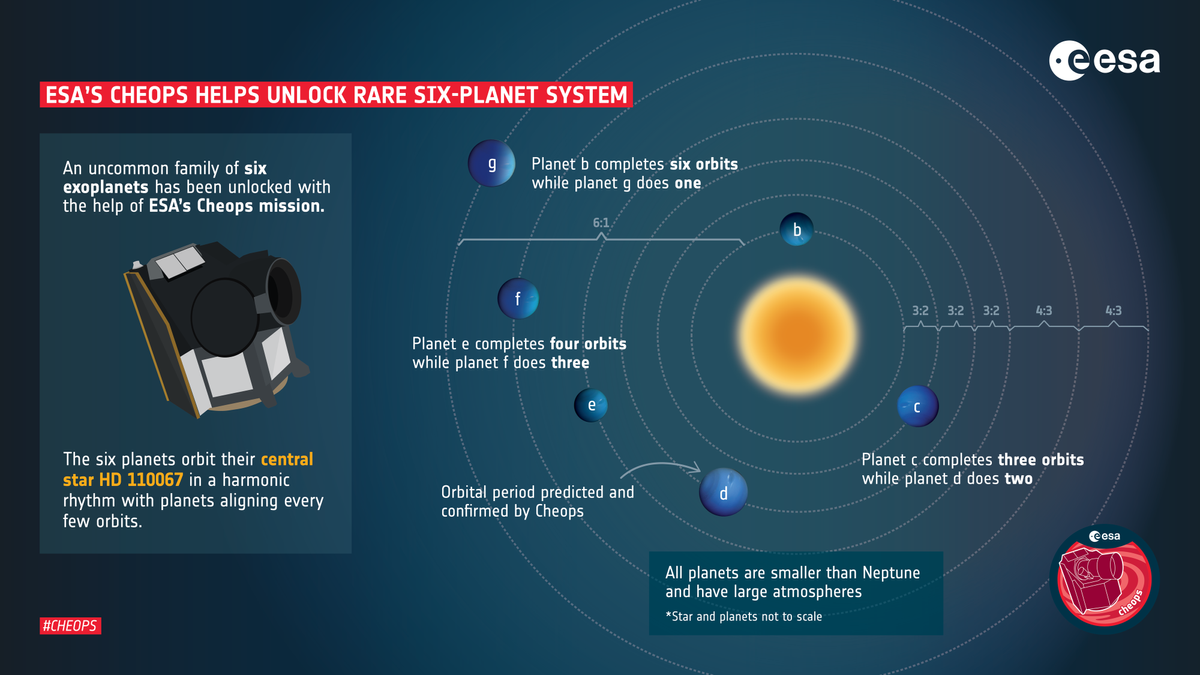
As detailed in the companion article [1], for every 54 orbits of planet 1, planets 2..6 orbit 36, 24, 16, 12, and 8 times respectively, giving successive ratios of 2/3, 2/3, 2/3, 3/4 and 3/4. After those 54 planet 1 orbits, all planets are in the same relative position. [1] https://www.space.com/six-sub-neptunes-found-100-light-years...

The last ratio should be 2/3 again.

Actually the ratios are correct [1], but the typo is in my inferred orbit count for planet 6 which should be 9, not 8. Well spotted!

[1] https://cdn.mos.cms.futurecdn.net/DEAyqYXn7pfD7ZboApakhe-120...
Re: 'Mathematically perfect' star system being investigated for potential alien tech

#232
post #190

Earlier quoted context omitted.

Maybe they don't. They might live on a rocky planet further out and just use TrES-2b as a place to run their solar farm because it's extremely close to their star and (due to being uninhabited) didn't have any NIMBYs opposing large-scale construction projects. Note how far out from the planet's orbit NASA expects the habitable zone. We aren't very good yet at finding planets that aren't huge or nearly hugging their s…

To be fair, if your solar farm can be in orbit around a planet that's not your legal address for tax purposes, it can just orbit the star?

Could be legacy reasons. Maybe they initially built it around this planet, or maybe they’re from a moon in or it around it, and now it provides more than enough energy for their needs. I find people looking for aliens always expect them to be doing the most efficient thing and forgoing any semblance of history.

Re: 'Mathematically perfect' star system being investigated for potential alien tech

#233

Earlier quoted context omitted.

The NASA exoplanet visualizer is very cool. Did not know about that. Thanks for sharing. I imagine those hypothetical visualizations will improve over time as our understanding of the exoplanet data gets better. It is amazing what you can derive from a single pixel of light.

Not sure why, but the visualizer is giving me a strong urge to boot Outer Wilds again.

Love that game

Re: 'Mathematically perfect' star system being investigated for potential alien tech

#234

I've often thought planet TrEs-2b [0], the darkest planet ever discovered orbiting a star, would be the best candidate for extra terrestrial life. My theory is that its darkness is down to the fact that the civilisation there has figured out a way to harness solar energy to near 100% capacity, along the lines of a Dyson sphere [1]. [0] https://exoplanets.nasa.gov/exoplanet-catalog/1716/tres-2-b [1] https://en.wikiped…

> My theory is that its darkness is down to the fact that the civilisation there has figured out a way to harness solar energy to near 100% capacity, along the lines of a Dyson sphere

That doesn't work quite the way you think. If you harness all the energy your planet will start to glow, first red, then white. Eventually becoming as hot as your star, at which point you stop gaining energy.

Unless they are somehow converting that energy to matter, the laws of thermodynamics mean that all that energy eventually becomes heat.

Re: 'Mathematically perfect' star system being investigated for potential alien tech

#236

Earlier quoted context omitted.

Good idea! Um9iZXJ0IEogU2F3eWVyIC0gU3RhcnBsZXgK

Holy cow. ChatGPT 4 actually decoded this. It went into analysis mode, wrote some python, ran it, and gave the correct answer.

Gemini does too, not sure that's all too surprising

Re: 'Mathematically perfect' star system being investigated for potential alien tech

#237
post #190

Earlier quoted context omitted.

To be fair, if your solar farm can be in orbit around a planet that's not your legal address for tax purposes, it can just orbit the star?

Could be legacy reasons. Maybe they initially built it around this planet, or maybe they’re from a moon in or it around it, and now it provides more than enough energy for their needs. I find people looking for aliens always expect them to be doing the most efficient thing and forgoing any semblance of history.

Aww man would be so cool to meet aliens and they show us around their stuff, and it all seems really dumb and convoluted, and they hate it too, but it would be too expensive to rip it all out and start over...

Re: 'Mathematically perfect' star system being investigated for potential alien tech

#238
post #209

Earlier quoted context omitted.

If we extract the maximum possible entropy of the incoming radiation wouldn't that mean we radiated at high-intensity but low-temperature?

What does that mean? Everyday objects don't work like that. Saying ice cubes are cold is roughly equivalent to saying that they radiate less heat than the objects around them. If they radiated at "high intensity" then they wouldn't be cold anymore. "A cold object that radiates heat at high intensity" is a contradiction.

Only for black body radiation do we have a perfect correspondance between spectrum and intensity. But there can be other ways of radiating. Non-black bodies. Antennas. Lasers.

Re: 'Mathematically perfect' star system being investigated for potential alien tech

#239
post #234

I've often thought planet TrEs-2b [0], the darkest planet ever discovered orbiting a star, would be the best candidate for extra terrestrial life. My theory is that its darkness is down to the fact that the civilisation there has figured out a way to harness solar energy to near 100% capacity, along the lines of a Dyson sphere [1]. [0] https://exoplanets.nasa.gov/exoplanet-catalog/1716/tres-2-b [1] https://en.wikiped…

> My theory is that its darkness is down to the fact that the civilisation there has figured out a way to harness solar energy to near 100% capacity, along the lines of a Dyson sphere That doesn't work quite the way you think. If you harness all the energy your planet will start to glow, first red, then white. Eventually becoming as hot as your star, at which point you stop gaining energy. Unless they are somehow con…

Take incoming energy and make antimatter. Store for use outside of the sphere. That will be my premise for the book I am writing. ;)

Re: 'Mathematically perfect' star system being investigated for potential alien tech

#240

Two orbital things we might look for: 1. Activity in geostationary orbits. 2. Orbits where the planet's year is exactly divisible by its day, eliminating leap years.

Are you suggesting #2 is sufficiently unlikely to occur naturally that it becomes a likely technosignature of an alien race whose programmers got so fed up with calendrical calculations that they megaengineered their planet’s rotation as a way of streamlining their datetime libraries?
Post reply on HN