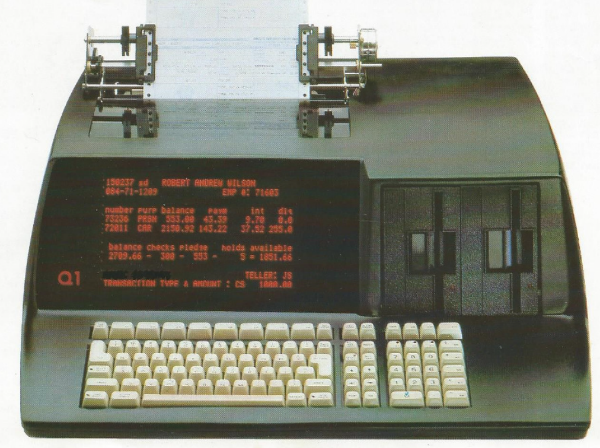
I'm surprised Wikipedia appears to say nothing about the Q1.
It's mentioned briefly in the article, "History of Personal Computers," which gives some links to external content. https://en.wikipedia.org/wiki/History_of_personal_computers
51–60 of 63 posts
I'm surprised Wikipedia appears to say nothing about the Q1.
I worked for Daniel Alroy the founder of Q1. https://www.peel.dk/Q1/ I have never seen one in real life yet. He told me lot of stories, especially how he got into a fight with Intel. He had set out to prove a point that a cheaper simpler machine can be made.
I've also been trying to track down a Q1 FOR YEARS and a friend sent me this article.
Daniel Alroy would be so thrilled about this coverage. To this day, I still haven't visited the Computer History Museum in San Jose, out of respect for his grudge with Intel. (They don't include Q1 in its history.)
Earlier quoted context omitted.
Wikipedia says that the 512x512 PLATO plasma display had a cost of $2500 at a time when that was a much greater value than today. Moreover, I doubt that the cost includes the one thousand high voltage transistors that would have been needed to drive the display. As I have already written, such a display would have been too expensive for a desktop computer with an 8-bit CPU. In the early seventies, as an alternative t…
> As I have already written, such a display would have been too expensive for a desktop computer with an 8-bit CPU. They were subsidized to some extent, but they were nonetheless cranked out by the hundreds. > Vector displays are possible only where there is a drawing spot that can be moved in any programmable direction, i.e. only on CRTs or mechanical plotters. They are not possible with plasma displays. I'm sorry,…
Sounds more like it has Bresenham's algorithm implemented in hardware. It would still plot individual pixels on a 512x512 grid, which is different from how an actual vector display draws lines.
Earlier quoted context omitted.
Wikipedia says that the 512x512 PLATO plasma display had a cost of $2500 at a time when that was a much greater value than today. Moreover, I doubt that the cost includes the one thousand high voltage transistors that would have been needed to drive the display. As I have already written, such a display would have been too expensive for a desktop computer with an 8-bit CPU. In the early seventies, as an alternative t…
> As I have already written, such a display would have been too expensive for a desktop computer with an 8-bit CPU. They were subsidized to some extent, but they were nonetheless cranked out by the hundreds. > Vector displays are possible only where there is a drawing spot that can be moved in any programmable direction, i.e. only on CRTs or mechanical plotters. They are not possible with plasma displays. I'm sorry,…
Earlier quoted context omitted.
> As I have already written, such a display would have been too expensive for a desktop computer with an 8-bit CPU. They were subsidized to some extent, but they were nonetheless cranked out by the hundreds. > Vector displays are possible only where there is a drawing spot that can be moved in any programmable direction, i.e. only on CRTs or mechanical plotters. They are not possible with plasma displays. I'm sorry,…
A vector display is a non-pixel-based screen like a radar screen or oscilloscope. I used a vector computer terminal in 1979. I also used a Plato, which did have vector graphics but was not a vector display.
PLATO used this type of display because it was running over very slow dialup modems, and vectors, while having their limitations, are much more compact than rasters.
Example: suppose you want to draw a line on the 512x512 PLATO display. With a raster method, you have to send 512x512x(number of brightness levels) down the pipe. With a vector display, you only have to send DRAW(X1,Y1,X2,Y2) or (equivalently) DRAW(X,Y,length, angle) 5 numbers versus hundreds of thousands.
The PLATO display had direct hardware support for line-drawing commands. That made it a vector display.
Earlier quoted context omitted.
> As I have already written, such a display would have been too expensive for a desktop computer with an 8-bit CPU. They were subsidized to some extent, but they were nonetheless cranked out by the hundreds. > Vector displays are possible only where there is a drawing spot that can be moved in any programmable direction, i.e. only on CRTs or mechanical plotters. They are not possible with plasma displays. I'm sorry,…
>"The display was a 512×512 bitmap, with both character and vector plotting done by hardwired logic. It included fast vector line drawing capability, and ran at 1260 baud, rendering 60 lines or 180 characters per second." Sounds more like it has Bresenham's algorithm implemented in hardware. It would still plot individual pixels on a 512x512 grid, which is different from how an actual vector display draws lines.
In any case, the PLATO display absolutely did not use "segments", as the OP claimed that it must have. He also claimed that bit-mapped plasma displays "didn't exist at the time".
Earlier quoted context omitted.
A vector display is a non-pixel-based screen like a radar screen or oscilloscope. I used a vector computer terminal in 1979. I also used a Plato, which did have vector graphics but was not a vector display.
No, a vector display is one that takes vectors as input and displays them. What happens inside the display is irrelevant. PLATO used this type of display because it was running over very slow dialup modems, and vectors, while having their limitations, are much more compact than rasters. Example: suppose you want to draw a line on the 512x512 PLATO display. With a raster method, you have to send 512x512x(number of bri…
This might not matter if you have a high resolution, multiple brightness levels, and a CPU/GPU powerful enough to do antialiasing, but for 512x512x1bpp the pixels making up each line will be very visible as "stairsteps".
Earlier quoted context omitted.
A vector display is a non-pixel-based screen like a radar screen or oscilloscope. I used a vector computer terminal in 1979. I also used a Plato, which did have vector graphics but was not a vector display.
No, a vector display is one that takes vectors as input and displays them. What happens inside the display is irrelevant. PLATO used this type of display because it was running over very slow dialup modems, and vectors, while having their limitations, are much more compact than rasters. Example: suppose you want to draw a line on the 512x512 PLATO display. With a raster method, you have to send 512x512x(number of bri…
You are thinking of digital vector GRAPHICS displays with hardware line-drawing support. Analog vector monitors and digital vector graphics raster displays are two different things. Vector monitors can draw nonpixellated curved lines as well as straight lines. Vector monitors can draw lines at any angle without staircasing. If a screen has pixels, it is not a vector monitor.
The 1970s Asteroids arcade game had an analog vector monitor without pixels. Ditto the PDP-1 Spacewar and PDP-11 Lunar Lander, both of which I saw in the 70s. Ditto the Star Wars arcade game. Some vector monitors had rapid-fade phosphors and had to be constantly redrawn, others were bistable storage tubes that retained an image for several minutes without being redrawn. The Plato terminal did not have an analog vector monitor.
https://en.m.wikipedia.org/wiki/Vector_monitor
https://en.m.wikipedia.org/wiki/Star_Wars_(1983_video_game)
https://en.m.wikipedia.org/wiki/Battlezone_(1980_video_game)
https://en.m.wikipedia.org/wiki/Direct-view_bistable_storage...
Earlier quoted context omitted.
This one seems to be 12 rows of 32 columns. Still pretty cool. I wish I could find an 80x24 one (or two 40x24) for a sensible price. Would be lovely for a text-only terminal thingie. > brian dear wrote a very interesting book about the history of the plato project It's an interesting book, full of interesting stories. It is a bit confusing though, as it goes back and forth in time quite a lot - it has a very Primer-l…
Toshiba had plasma luggables in the 80s.
My favourite though is the IBM 3290 terminal.
Earlier quoted context omitted.
The headline is probably wrong, the article text just says "capable of" 16 kilobyte. I also think it's unlikely it had 16 installed. On the other hand, doesn't the screen look like a flatscreen, not a CRT? So the screen itself was probably very expensive in itself. (Probably plasma screen?) Edit: Look at the image and the bank of 3 * 8 socketed chips: https://www.peel.dk/Q1/img/SN615-03.jpg If these are the Intel 210…
Probably not a plasma screen in the 70s. It looks like a bunch of individual characters. They are probably vacuum fluorescent like what was on calculators and the Speak & Spell educational toy from that period.
The display in action on a Q1: https://www.1000bit.it/lista/q/q1europe/q1microlite.png
Close-up shot in a Q1: https://www.peel.dk/Q1/img/SN615-05.jpg
Brochure: https://archive.org/details/TNM_Self-Scan_II_panels_for_data...
There are videos of the display being demonstrated on YouTube. Search for Burroughs Self-Scan.