Earlier quoted context omitted.
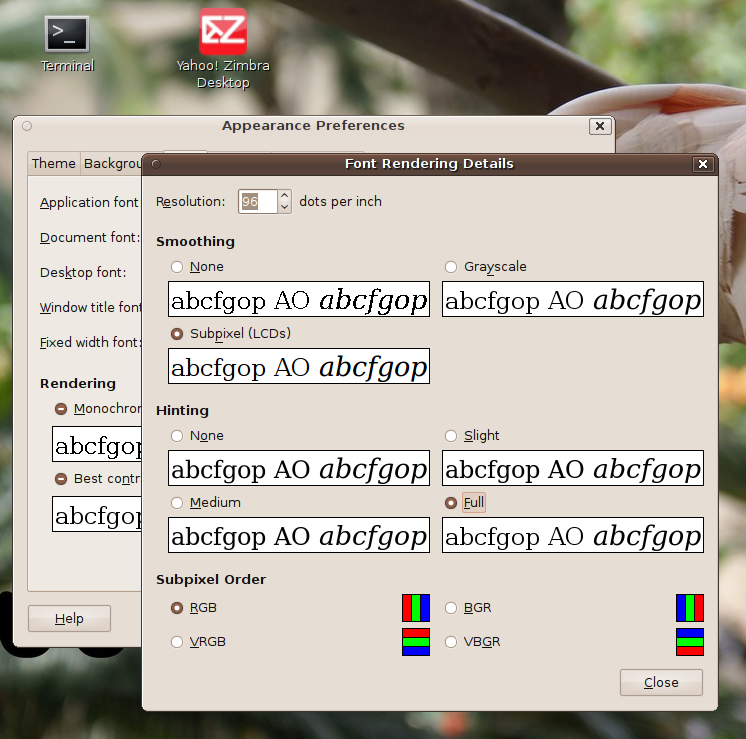
I looked for an image with a white background http://i.imgur.com/9aTz2.jpg
Yep, this is it. Still full hinting, though.
Really? The blues and oranges tell me its sub-pixel rendering.
51–60 of 115 posts
Earlier quoted context omitted.
Yep, this is it. Still full hinting, though.
Really? The blues and oranges tell me its sub-pixel rendering.
Earlier quoted context omitted.
Palm bought BeOS for $11M (and those assets were later transfered to PalmSource which became Access). In 2001 (when BeOS was bought), it might have made a bit of sense. Be was pretty modern then - competing against Windows XP and either the Classic Mac OS which it was far better than or OS X which was very new and so incredibly slow it was nearly unusable - I don't miss those days being a Mac user. However, in 2001 i…
So you are saying that they might as well give up? they have to start somewhere, and choose a good base to start from, from now on its adding those more advanced features and the gravy that users expect. Perhaps the linux guys should have given up around Slackware 1.0? I mean it wasn't exactly as good as the Sun and SGI boxes I was using back then.
This is an absurd statement. Stop wasting time solving problems that don't exist for 98% of the market. "More choice" is not a better than if the choices suck.
"Within 20 seconds or so of restarting, the machine was chugging away with all of its media files in the place they were when they were halted, as if nothing had happened."
This was really cool in the early days of BeOS. But that was more than a decade ago.
People of earth: there is a talent crisis right now. The world needs great developers to build awesome apps for a whole new class of machines. If you feel an urge to "start from scratch" — help rebuild everything for mobile. It's a big job, there are too many projects and not enough developers, and you'll be contributing to a seismic shift in computing.
Stop solving problems that don't exist for most people. Build apps that people will use. Do big things that address 98% of users. These guys clearly have dev chops that I admire, so don't waste them on a project like this.
I like the idea of Haiku OS, but from what I've heard, for binary-compatibility reasons (kernel drivers? All applications? I'm not sure) it still ships with GCC 2.95. Requiring a compiler over a decade old for a modern OS doesn't seem like a good long-term strategy.
IIRC one of the reasons Apple passed on BeOS was that the lack of a stable C++ ABI made app dependencies on the OS classes very fragile. For example, API classes had to be padded out with dummy members to make room for later non-breaking additions to apps. Is this still a problem? Isn't this why just about every other OS exposes it's lowest level APIs as C apis?
Mac OS X drivers are written in C++.
Symbian is fully written in C++.
The new WinRT API for Windows 8 is C++ based along as the user space driver framework.
There is no reason why Apple could not have defined a standard C++ ABI in BeOS, if that was the reason.
The decision to take NeXT instead of BeOS, surely did not have anything to do with technical merits of the underlying systems.
"Where BeOS drove ahead of other operating systems of its time (and where Haiku is still ahead of contemporary operating systems) is that each individual application uses many threads. The core of the application itself has one thread, and each window the application creates has a thread." I might not have been around when BeOS was first created, but this is certainly not a new concept today. I don't think I can name…
On those days Windows NT was already available with a multithreaded kernel from day one and the ability to make use of them at the UI level as well.
When compared with the 9x family, yes, but not with the NT family.
"Haiku is probably the best positioned to challenge the mainstream operating systems like Microsoft Windows and Mac OS." This is an absurd statement. Stop wasting time solving problems that don't exist for 98% of the market. "More choice" is not a better than if the choices suck. "Within 20 seconds or so of restarting, the machine was chugging away with all of its media files in the place they were when they were hal…
Earlier quoted context omitted.
Really? The blues and oranges tell me its sub-pixel rendering.
Yes, it's subpixel rendering on your screenshot. Hinting is "full" as opposed to "medium" or "slight": http://www.clearevo.com/blog/files/AfterFullHint.png
Earlier quoted context omitted.
IIRC one of the reasons Apple passed on BeOS was that the lack of a stable C++ ABI made app dependencies on the OS classes very fragile. For example, API classes had to be padded out with dummy members to make room for later non-breaking additions to apps. Is this still a problem? Isn't this why just about every other OS exposes it's lowest level APIs as C apis?
I never heard this story before. Mac OS X drivers are written in C++. Symbian is fully written in C++. The new WinRT API for Windows 8 is C++ based along as the user space driver framework. There is no reason why Apple could not have defined a standard C++ ABI in BeOS, if that was the reason. The decision to take NeXT instead of BeOS, surely did not have anything to do with technical merits of the underlying systems.
http://haiku-os.org/legacy-docs/benewsletter/Issue2-25.html
Apparently Apple gets around this the usual way by padding out their API classes with extra unused members. I wonder what the solution is in Windows 8 & Symbian.
"Haiku is probably the best positioned to challenge the mainstream operating systems like Microsoft Windows and Mac OS." This is an absurd statement. Stop wasting time solving problems that don't exist for 98% of the market. "More choice" is not a better than if the choices suck. "Within 20 seconds or so of restarting, the machine was chugging away with all of its media files in the place they were when they were hal…
Given that mobile hardware is about where desktop hardware was when BeOS was invented, I wonder if some company could use it as a new smartphone OS. There's an unfinished ARM port in progress but would probably need commercial support to complete.
The thing about innovation is, it's not always possible to predict what will be valuable or not. Not many people would have predicted Linux back in Linus's early days, for example.