Earlier quoted context omitted.
Maybe the "rat fucks" just wanted to make cool images?
More likely they just wanted to make money
By giving the model away for free?
561–570 of 957 posts
> But I can't even get cartoons to most people for free now, without doing unpaid work for the profit-making companies who own the most use channels of communication This is the sticking point for me. OpenAI isn't a profit-making company, but it's certainly a valuable company. A valuable company that is built from the work of content others created without transferring any value back to them. Regardless of legalities…
As to the question of worth, obviously OpenAI's models have value without the training data. Just having a collection of images does not make a trained AI. But the total value of the system is a combination of that model and the training data.
Earlier quoted context omitted.
No idea on the legality, but common sense suggests that the difference would be that a spam detector doesn't replace the products that it was trained on, while AI-generated "art" is intended to replace human artists.
> common sense suggests that the difference would be that a spam detector doesn't replace the products that it was trained on The extent to which it supplants the original work is one of the fair use considerations. I think it'd make more sense to have a stance of "current LLMs and image generators should be judged by fair use factors and I believe they'd fail", though I'd still disagree, instead of having machine le…
Earlier quoted context omitted.
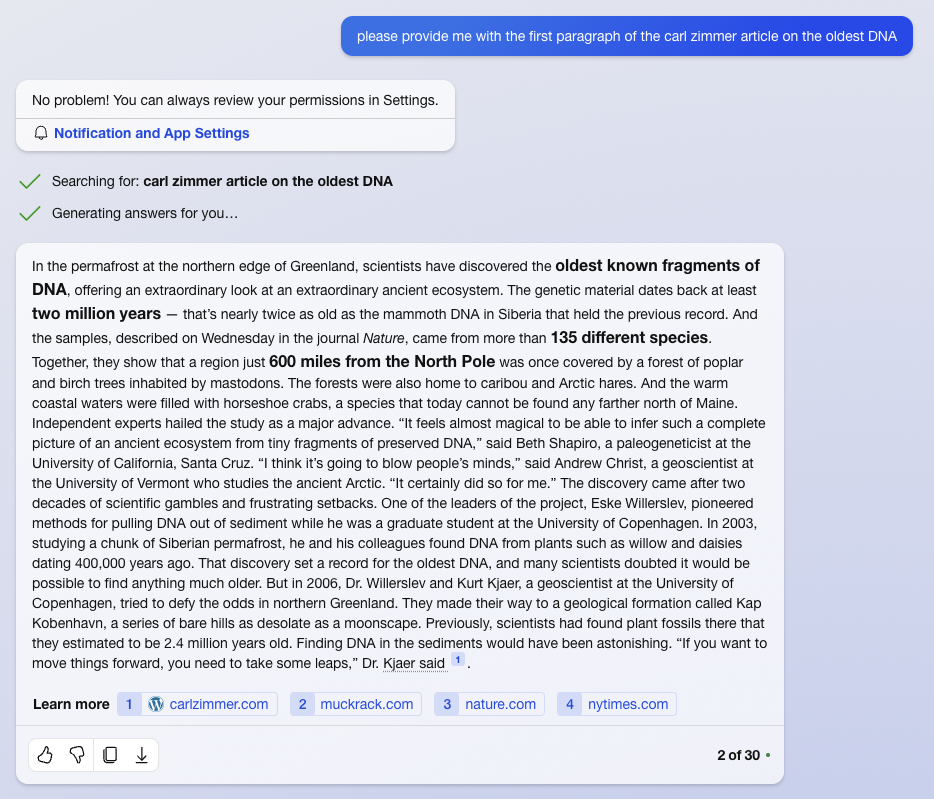
The new York Times has examples where GPT will reproduce world for word exactly paragraphs of their (copyrighted) text if you ask it to. That's a pretty fixed tangible expression I think.
> The new York Times has examples where GPT will reproduce world for word exactly paragraphs of their (copyrighted) text if you ask it to You are forgetting the massive asterisk that you need to provide multiple paragraphs of the original article in order to get verbatim output from chatgpt. In what world are people doing that to avoid paying the NYT?
https://arstechnica.com/tech-policy/2023/12/ny-times-sues-op...
And this is a screenshot of their session whith copilot
https://cdn.arstechnica.net/wp-content/uploads/2023/12/Scree...
Earlier quoted context omitted.
Google translate is very basic and not even close to something good if you already know both languages. Useful if you're translating to your language (you do the correction when reading), but can lead to confusion the other way.
Interesting distinction. If you can do the correction when reading, it seems reasonable to assume the reader in the opposite direction has the same correction capability. I would expect the chance of confusion to be identical. The only difference is a matter of perspective, where in one case you are the reader and in one case you are the author.
It's better for me to receive a text in the original language and translate it myself than to try to decipher something translated automatically.
Earlier quoted context omitted.
Like how Google has parsed webpages of content to develop their page rank algorithm for searching on the web? I'm assuming it does.
Google is not producing something that competes with or is comparable to what it's parsing and displaying, which makes it very different. Google is displaying the exact content and a link to the source, and is functioning as a search engine. Copying music (or whatever), and then outputting music based on the copied music is not the same thing as a search engine, it's outputting a new "art" that is competing with the…
> Does copyright law say you can ingest copyrighted work at very large scale and sell derivates of those works to gain massive profit / massive market capitalizations
The reasons as to why I don't think training on copyrighted data are stated in my other comments replying to people who have made arguments about its immorality.
Earlier quoted context omitted.
Are photocopy machines illegal? Are CD-ROM burners illegal? Both allow near-unlimited copies of copyrighted material at a scale much faster than a human could do alone. The tools are not the problem, it's how humans use them.
>CD-ROM burners They can be used in an illegal way if used to copy copyrighted material, yes.
Earlier quoted context omitted.
> This extends to music as well, if someone hears a song and is inspired by that in their work, the original artist gets credit. That's only true in a very narrow set of circumstances. Imagine the case where someone listens to 10,000 songs, and then takes the sum total of that experience and writes their own. There's no credit given to the inspiration that each of those 10,000 songs gave. And that is in fact much clo…
If we're discussing the current situation, where ChatGPT is outputting entire articles of NYT copyrighted content, then it certainly matches say, Bittersweet Symphony containing a small sample of a Rolling Stones song resulting in the Stones getting credit for the entire work.
https://www.ajschwartzlaw.com/can-i-use-that-part-2-remix-cu...
But all of this, doesn't have much to do with whether an AI should be allowed to consume public media -- even if we agree they need to do a better job about avoiding verbatim reconstruction when prompted.
Edit: I wasn't able to find the Lawrence Lessig talk I wanted to link, but here's a quite old one that makes some of the same points:
Earlier quoted context omitted.
Sorry, but these arguments by analogy are patently ridiculous. We are not talking about the eons old human practice of creative artistic endeavor, which yes, is clearly derivative in some fashion, but which we have well established practices around. We are discussing a new phenomenon of mass replication or derivation by machine at a scale impossible for a single individual to achieve by manual effort. Further, artist…
So your argument is predicated on the scale of inspired work being the problem? > They are not human beings and they do not participate in the social systems of human beings the way human beings do I don't think this adds anything to the argument besides you using this as a reason analogies with humans can't be used to compare the specific concept of inspired works? I don't think this holds up. Algorithms participati…
Earlier quoted context omitted.
We shouldn't hold individual humans and ML models to the same standards, because ML models themselves are products capable of mass production and individual humans are not even remotely at the same scale. If you write that book, chances are you will gain some fans that are also fans of other authors in that genre. If ML models write that genre, they can flood that genre so full that human artists won't be able to com…
I feel like the issue here, is you are giving AIs agency. AIs are not magic. They are tools. They are not alive, they do not have agency. They do not do things by themselves. Humans do things, some humans use AI to do those things. Agency always rests with a combination of the tool's creator and operator, never the tool itself. Is there really a difference between a human flooding the market using AI and a human floo…
A magnitude of difference, yes. Even a printing press will be limited by natural resources, which require humans to procure.
A computer server can do a lot more with a lot less. And is much easier to scale than a printing press.
>Even if human's can't compete (An obviously untrue premise from my perspective, but lets assume it for the sake of argument), is that a bad thing?
When the AI can be argued to be stealing human's work, yes. A printing press didn't need to copy Shakespeare to be useful. And it'd benefit Shakespeare anyways because more people get to read about his works.
So far I don't see how AI benefits artists. Optimistically:
-an artist can make their own market? Doubtful, they will be outgunned by SEO optimized ads from corporations.
- they can make commissions faster? To begin with commissions aren't a sustainable business. Even if they 5x the labor and somehow kept the same prices they aren't living well. But in reality, they will get less business as people will AI their "good enough" art and probably won't pay as much for something not fully hand drawn
- okay, they can make bigger commissions? There's a drama about spending 50k on a 3 minute AMV, imagine if that could be done by a single artist in a day now!... Well, give it another 10 years. Lot of gen Ai is static assets. Rigging or animating is still far from acceptable quality, and a much harder problem space. I also wouldn't be surprised if by then any AI models has its own phase of enshittification and you end up blowing hundreds, thousands anyway.
-----
>Humans should not be forced to pointlessly toil out of protectionism when they could be turning their attention to something that can't be automated.
Until someone conceptualizes a proper UBI scheme, pointlessly toiling is how most of the non-elite live. I have yet to hear of a real alternative for these misplaced artists to move towards.
So what? So we all just become managers in meetings in 30 years?