Live data from Hacker News

Epistemic Learned Helplessness (2019)

slatestarcodex.com

201–210 of 232 posts

Re: Epistemic Learned Helplessness (2019)

#201

Earlier quoted context omitted.

This is really bad advice. Don't let yourself be blocked for several days. Try for 2-3 hours and ask for help.

I'd say that's excessive. An hour max would be more reasonable otherwise you're just creating a discouraging workplace. Note that would be an hour of real effort though, not half arsed googling. Making a genuine effort is more important than the time taken.

The amount of time is entirely dependent on what kind of work it is and what kind of blocked you are. Can’t get your build to succeed? Ask for help quickly. Can’t get your research model to produce useful results on the first try? Maybe try a few things first.

Re: Epistemic Learned Helplessness (2019)

#202

> " Like I mean that on most topics, I could demolish their position and make them look like an idiot. Reduce them to some form of “Look, everything you say fits together and I can’t explain why you’re wrong, I just know you are!” " That isn't making them look like an idiot, reducing them, or demolishing their position. That is completely failing to demolish their position! While also failing to convincingly explain…

It also ignores the question of how the person even got their prior in the first place. Presumably they heard a convincing argument at one point and accepted that - but then later changed their standards to not accept convincing arguments. In fact, how do they even know "if I know that a false argument sounds just as convincing as a true argument, argument convincingness provides no evidence either way"? Presumably t…

> Presumably they heard a convincing argument at one point and accepted that - but then later changed their standards to not accept convincing arguments

No, many people base their views on what their friends thinks, they never reasoned themselves into it.

It is rational to base your beliefs on your friends, and to keep those beliefs to ensure you can continue to fit in with your friends. That is less work and less risky than changing your mind, only few really go against the grain and try to think for themselves, it isn't helping them but some people has to do that for the benefit of our pack.

Re: Epistemic Learned Helplessness (2019)

#203
post #130

Earlier quoted context omitted.

I agree, but in practice now I've come to see that this is an extremely difficult point to discern. As the vast majority of findings flow in as a trickle, there often isn't a large enough delta to identify as a launching point for asking for help. For example, if one continues to search, they will keep finding breadcrumbs leading them to the solution. It is painful to me when someone spends 3 days looking for a solut…

You need to socialize the problem; to broadcast that you are trying to solve something. Some sort of internal discussion board could work. It serves the same purposes as the water cooler. If anyone can think of a way to make software better serve this end I'd love to hear.

> think of a way

An app was recently mentioned in hn comments, for "live blogging" as PIM - a texting-like personal record of your questions and findings as they go by - research notebook meets chat UI. With a trace like that, or even just a browser trace, an AI might, without interrupting, summarize "what's Joe working on" and perhaps "how's that going?", or even "Hey Bob, maybe come chat with Joe?". And it could be nice to have a PIM that helped you maintain distilled clarity of objectives and state of play. Less nice the vision of a micromanager mesmerized by the dashboarded real-time state of his team.

A physics peer-instruction app, in support of "instructor puts up a question; everyone individually commits an answer; discussion with a neighbor; answer again", told students which neighbor to talk with, optimizing for fruitful discussions, knowing seating and the (mis)understandings implied by answers. LLMs open a lot of possibilities for the old dream of computer-supported cooperative work.

When github was band new, I'd hopped it would grow far more social/meetup/hackathony than it ended up. Wander by, see who's around and what people were banging on; stop by the beginner tables and see if anyone was stuck or struggling; maybe join a push; maybe pair or group; interest profiles, matchmaking (eg round-robin pairing, or "oh! a category-theoretic type system in-the-style-of-a-conference-bar discussion!"). Like a team or small community discord with bots, but scaled. Perhaps AI can make something like that more tractable.

Re: Epistemic Learned Helplessness (2019)

#204

Earlier quoted context omitted.

I think part of the trouble many here are having is that they don't even understand why Scott goes to the party, or argues, or wants to convince people of his arguments. Surely, if no one reading my comment here ever agrees with me, my life doesn't change for the worse at all. And if people do agree with me, again, my life doesn't change for the better. I'm mostly here to learn from you people, you sometimes say inte…

Consider the idea that some people feel that they benefit internally from having the experience of becoming less wrong than they were at some earlier time. There are many ways of attempting to become less wrong, and without doubt many of those who follow those ways have other motives. But I do think that there is room for people for whom there is an intrinsic motivation in seeking out the experience of discovering th…

> Consider the idea that some people feel that they benefit internally from having the experience of becoming less wrong than they were at some earlier time.

And helping others become less wrong by sharing one's perspective that was shaped by experience and accumulated knowledge.

Re: Epistemic Learned Helplessness (2019)

#205
post #200

Earlier quoted context omitted.

The claims he's addressing are, boiled down: 1) That leftist movements inevitably become more prone to violence (purges, genocide, violent repression of opponents in general, "reigns of terror") over time, and 2) Democracies have a strong-bordering-on-inescapable tendency to incubate such leftist movements, and to grow more leftist over time. What we should expect to see, then: 1) Radical, violent leftist movements t…

Your claim 2) does not imply your "expect to see" 2). Why? Because democracies don't have to incubate leftist movements in their own country . They can incubate them elsewhere. Which, indeed, they do, as I have said. This, in itself, is not an argument for the "reactionary" claims Scott is arguing against, for reasons I have already given. But it is an argument against Scott's "alternate model". Also, democracies can…

These are interesting claims and points, perhaps, but remain disconnected from the original material. In particular:

> They can incubate them elsewhere. Which, indeed, they do, as I have said.

This needs an immense amount of development to maybe qualify as both connected-enough to this topic to belong in Scott's piece, and a strong enough claim to be worth either explaining and refuting, or adopting and defending. You're claiming that things like declining to prosecute a war against the USSR after WWII is an example of an action that acted as an outlet for what would otherwise have become domestic US leftist political violence in the US. There are, like, several things about that, and your other examples, that need to be filled in before it might be clear that makes any sense at all, plus some kind of pattern of this kind of thing increasing over time needs to be established that can't easily be explained by other, more-straightforward factors. Notably an awful lot of these examples are failures to act—what's that about? How's that an outlet for a kind of "energy" that would otherwise push the US closer to a reign of terror? Why should we think that sort of thing can act as such an outlet? What's the connection between those things? I see none whatsoever—it is not obvious this should be entertained as a relevant and strong line of inquiry.

> Also, democracies can grow more leftist over time (which, I would argue, they have) without becoming internally unstable, as long as a majority of voters continue to vote for policies that move further and further left.

Maybe! But it doesn't appear to make them ever-more violent in the specific way in question. The real events and trends we have before us really don't appear to fit—not to fail to fit your claims, but by the claims made by the folks Scott wrote the piece to address. (This isn't me arguing against you—I follow that you do get that what you're aiming at is Scott's alternative model, not that you're arguing in support of the Reactionaries)

You have proposed some reasons different from Scott's that this may be the case, and fault him for not addressing your proposed reasons, but it remains unclear to me that there's a strong line of argument there, specifically as it relates to the topic at hand. It's not clear to me that he should have brought it up, or that it makes his argument weaker that he did not, let alone that it's part of some set of "schoolboy mistakes" to have not done so.

What I don't find any of this back-and-forth convincing about, is that this piece of Scott's is in error for failing to address this stuff. I definitely am not convinced that failing to entertain (or even mention) some kind of, "the 'temperature' of US leftist domestic political violence has, perhaps, remained cool only because we did stuff like not do much to help Chiang Kai-shek" explanation, constitutes an elementary error.
Re: Epistemic Learned Helplessness (2019)

#206
post #106

Earlier quoted context omitted.

Haha yeah, I've been to rationalist meetups too, and have come to the same conclusion that I don't like them very much. Too much IQ stroking for my tastes. Scott specifically though, has an established history of thinking through arguments that I find much better than most, and I still think someone who trains at this stuff will do better. To extend my analogy a little further from before, if you go to a boxing gym o…

> Scott specifically though, has an established history of thinking through arguments that I find much better than most He has an established history of writing down detailed articles about arguments, yes. Unfortunately, a significant number of his articles contain schoolboy errors that anyone who wants to claim they are better at thinking through arguments than the average person should never have made. I'll mention…

> To say that the US and UK have gone three hundred years with "only the tiniest traces of state-sponsored violence" shows a level of historical ignorance that is just staggering

Scott is not ignorant, therefore it seems more plausible that you should reconsider whether Scott is making the point that you think he's making.

Re: Epistemic Learned Helplessness (2019)

#207

After spending many years studying philosophy I think that the right approach is that you don’t need to come to any conclusions about anything. Aristotle often started with common peoples’ viewpoints on any given topic, along with looking at what experts thought and built his own ideas from there, and of course was very successful with his methodology. Arguments are interesting and obviously some are more correct tha…

> I think that the right approach is that you don’t need to come to any conclusions about anything.

This reminds me of a phrase I often find myself using with people: I am not required to have an opinion about everything.

Re: Epistemic Learned Helplessness (2019)

#208

Earlier quoted context omitted.

> Creationism was nice and neat and logical Also requires less faith

To some degree the idea of a Creator is easier to wrap one's head around than the idea of nothing-->something. Of course it really just rolls the question uphill since you're now faced with 'Where did the Creator come from?'. Happily there are no academic theories on this matter so there's no need to engage with it. Ultimately satisfaction doesn't come from the belief itself, satisfaction comes from the feeling of be…

> To some degree the idea of a Creator is easier to wrap one's head around than the idea of nothing-->something.

Of course that's a mistake, because there wasn't literally nothing, there was just something else.

Re: Epistemic Learned Helplessness (2019)

#209

> I’ve heard a few good arguments in this direction before, things like how engineering trains you to have a very black-and-white right-or-wrong view of the world based on a few simple formulae, Whenever the rationalist writers start talking about engineering, programming, or machine learning in technical terms I have a sudden Gell-Mann Amnesia realization that these people's primary domain is writing and pontificati…

> I don't know any engineers who would characterize the world as being simply defined by "a few simple formulae"

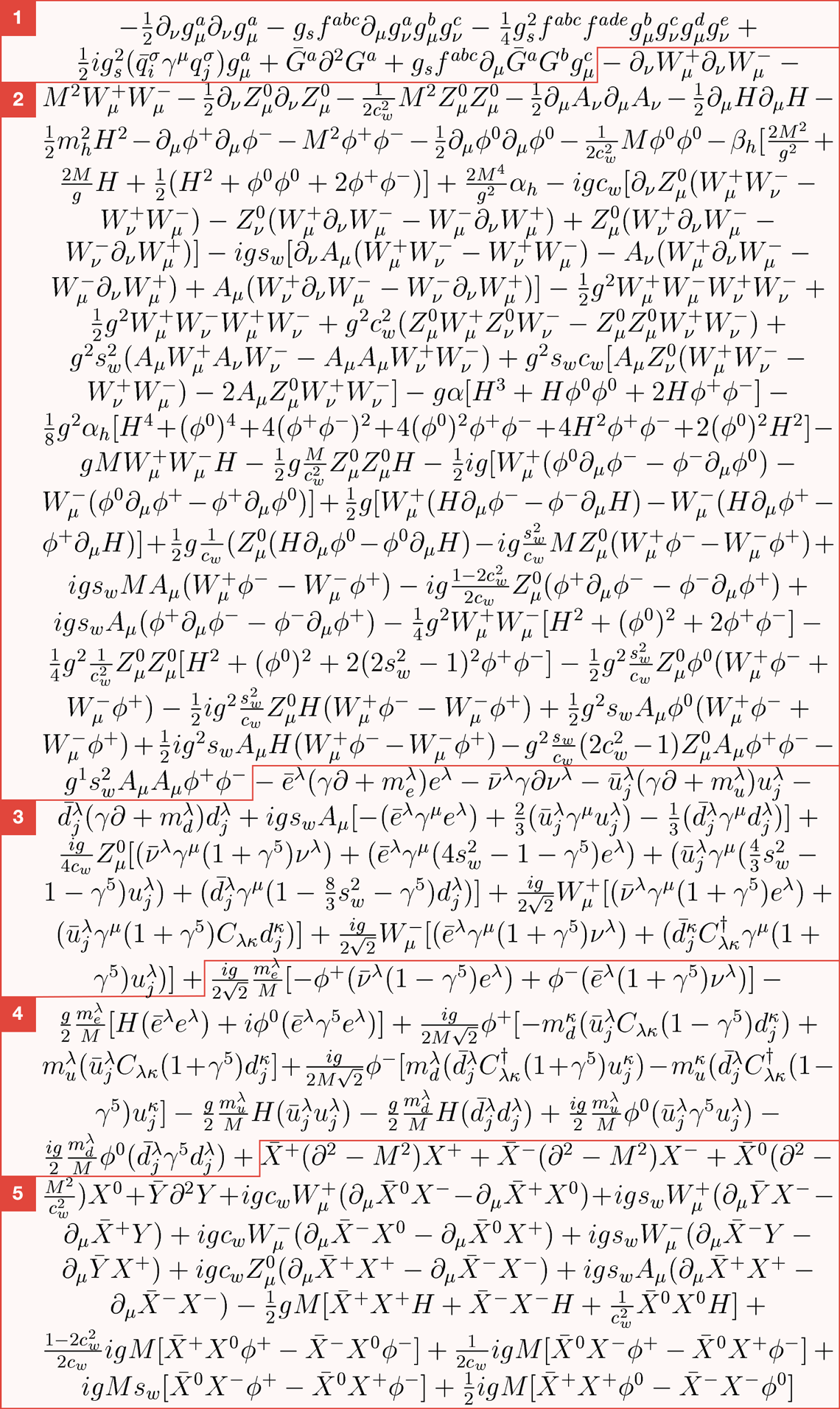
I'm an electrical engineer. The Standard Model of particle physics governs literally all of existence, minus gravity, and it can fit on a single page [1]. Gravity is another few equations that can also squeeze onto that same page. This is a set of fairly simple formulae compared to the unbelievable complexity of existence.

A universal Turing machine can compute any computable function and it's description is even shorter.

In other words, unimaginable complexity can follow from "a few simple formulae". I don't know many engineers that would dispute this. Your problem is that you have some conception of "simple" that does not match what rationalists mean.

[1] https://www.symmetrymagazine.org/sites/default/files/images/...

Re: Epistemic Learned Helplessness (2019)

#210
post #94

Earlier quoted context omitted.

It does seem like odd phrasing. It's correct to not fully trust anything until it's gone through a long verification process.

Don't you have to put some amount of trust in an idea to even consider verifying? And have even more trust in the idea to perform your experiments in the first place? Even in medicine, there has to be someone willing to challenge status-quo ideas, or there's nothing to feed into the "long verification process" in the first place. How do you decide when to be that person?

This seems to be responding to a different comment?
Post reply on HN