Images altered to trick machine vision can influence humans too
1–10 of 86 posts
Re: Images altered to trick machine vision can influence humans too
#2Though not mentioned in the blog post, this seems like it would have some applications for true "subliminal" advertising.
Re: Images altered to trick machine vision can influence humans too
#3I don't see how this is surprising. The noise pattern in the first figure looks cat-like: I can see the ears, the head, the paws, the front half of the body… Having that “seemingly random pattern” to trace over would probably let me sketch a cat, something I can't normally do without a reference. (Though, the face is muddled and in the wrong place – almost like it's a cat collage – so I might only get the outline of a cat.)
This study's result is implied by the stronger result: “a neural network's notion of a category sometimes resembles members of the category”. I'm sure a competent sketch artist could yield similar or better results, being able to take advantage of peculiarities of the human visual system. (In fact, that might be a good follow-up study: I might claim it if nobody else does.)
Re: Images altered to trick machine vision can influence humans too
#4Though not mentioned in the blog post, this seems like it would have some applications for true "subliminal" advertising.
No problem, simply subscribe to our service SafeSight, using the latest imaging technology everything you see is processed by our AI powered manipulation sensing algorithms before your eyes see it, real-time screening and flagging of events together with defensive response suggestions let you take charge. Control your own mind. Feel safe looking out on a world full of messaging and do what you want, not what they want.
Re: Images altered to trick machine vision can influence humans too
#5I don't see how this is surprising. The noise pattern in the first figure looks cat-like: I can see the ears, the head, the paws, the front half of the body… Having that “seemingly random pattern” to trace over would probably let me sketch a cat, something I can't normally do without a reference. (Though, the face is muddled and in the wrong place – almost like it's a cat collage – so I might only get the outline of…
Maybe my brain's just odd... but I don't see the cat-like figure in the noise. I just see noise. There are a few edges, but nothing really cat-like to my mind.
My subconscious pattern recognition for faces and such has always been weak, fwiw.
Re: Images altered to trick machine vision can influence humans too
#6One thing I'd be curious about is how many of these perturbations can you stack up?
A picture of a cat still retains an obvious cat-ness to humans, even when it's been tainted by "truck-ness", but they're slightly more likely to agree it's more truck-y. That response scales with how perturbed it is. (Fig 3 in paper.) If you added the perturbations for "vehicle-ness", would that response be stronger while affecting the image less than cracking up the intensity on the effect? Could you start combining separate concepts, and pick them out individually as like... "activation scores" or something?
If so, feels like compression all of a sudden. I know there's a ton of other ML compression things out there, but that just feels like it could be really information dense.
Re: Images altered to trick machine vision can influence humans too
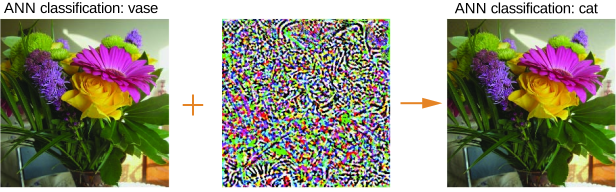
#7I copied the image on the right into all possible AIs that i found on the net. They all told the that it is a vase with flowers. Even the most primitive.
Something seems off here.
Maybe they trained a model that is able to see "hidden" patterns and then they found that they can influence its mind with hidden patterns. For the rest of the general population (both humans and AIs) both images are the same.
Re: Images altered to trick machine vision can influence humans too
#8I copied the image on the right into all possible AIs that i found on the net. They all told the that it is a vase with flowers. Even the most primitive. Something seems off here. Maybe they trained a model that is able to see "hidden" patterns and then they found that they can influence its mind with hidden patterns. For the rest of the general population (both humans and AIs) both images are the same.
Compression possibly? I'm seeing .webps on the paper. Putting them into webpinfo gives me:
    File: /.../41467_2023_40499_Fig3_HTML.png.webp
    RIFF HEADER:
      File size: 671810
    Chunk VP8  at offset     12, length 671798
      Width: 2000
      Height: 2255
      Alpha: 0
      Animation: 0
      Format: Lossy (1)
    No error detected.
Edit: The image on the article itself is an SVG, containing 3 jpegs. So that's absolutely mangled in comparison to the paper's lossy images.
https://deepmind.google/api/blob/website/images/Figure0_svg....
Re: Images altered to trick machine vision can influence humans too
#9[deleted]
Re: Images altered to trick machine vision can influence humans too
#10I copied the image on the right into all possible AIs that i found on the net. They all told the that it is a vase with flowers. Even the most primitive. Something seems off here. Maybe they trained a model that is able to see "hidden" patterns and then they found that they can influence its mind with hidden patterns. For the rest of the general population (both humans and AIs) both images are the same.
I'm not sure that screen-shotting the image will work FWIW - any rescaling interpolation in rendering the image on the page or loading it for a model will likely reduce or nullify the effect.
Also these perturbation based adversarial attacks are often model specific. You take the model's gradient at each pixel and iteratively perturbate the image to make it more and more confident that it's e.g. a cat.