Earlier quoted context omitted.
> How many batteries do we need to store the equivalent energy in 1kg of uranium Energy density isn't, alone, determinant here. The most determinant question is: after taking into account all measures aiming at reducing renewables' production 'intermittency' ('variability' is more adequate), which are: spreading a mix (wind, solar, geothermic...) of renewable sources on a continent, enhancing grid interconnections am…
> Given that the average electric car battery can power the average home for quite a while (days), and that other EV batteries will be online... Regular houses are too small to make it possible to install enough solar to charge the car though. That's without even considering appartment buildings.
First new U.S. nuclear reactor since 2016 is now in operation
871–880 of 1001 posts
Re: First new U.S. nuclear reactor since 2016 is now in operation
#872Earlier quoted context omitted.
The sole point about hydro also is highly debatable: https://news.ycombinator.com/item?id=35521090
If you don’t count fatalities that were caused by the dysfunction of communism, that also eliminates all the fatalities from Chernobyl.
No level of organization is sufficient: https://en.wikipedia.org/wiki/Forsmark_Nuclear_Power_Plant#J...
Re: First new U.S. nuclear reactor since 2016 is now in operation
#873Lots of disfavorable comparisons being made here between nuke and solar. Let's do some math. There is a total of around 10 GWh of deployed grid storage in the US. The US consumed about 4,000 TWh of electricity in 2022. (10GWh/ 4000TWh) * (31,536,000 seconds) == 78 seconds. So, net, there is about a minute and a half of energy storage across the entire grid. (Most, about 90%, is pumped hydro, not battery). Of course,…
Using powerwall as the price of stationary battery storage is like using the running cost of gas/petrol household generators as the cost of generating power at fossil fueled power plants. Powerwalls is not how industrial battery storage is done anywhere on the planet.
Re: First new U.S. nuclear reactor since 2016 is now in operation
#874Earlier quoted context omitted.
And so, we should keep burning coal until that hopefully later happens!
Coal is already dead. We where at 51% coal in 2001 and hit 19.5% in 2022. Existing power plants keep aging and not being replaced. People will bring storage online when it’s needed, but we don’t need it thus we don’t build it. So keep building Solar/Wind and soon enough storage will come online.
And thus solar has been coming for decades. How long after we have an abundance of solar can we wait for good storage?
How many decades can we wait for that to ramp up? (we didn't exactly start our solar journey yesterday).
I feel storage is of immediate urgency, as of yesterday. We don't have a plan and scaling will be a huge challenge.
Using EVs is really tempting though.
Re: First new U.S. nuclear reactor since 2016 is now in operation
#875Re: First new U.S. nuclear reactor since 2016 is now in operation
#876Earlier quoted context omitted.
Nuclear is also quite a lot more expensive than people sometimes calculate here. It cost about 35 billion USD (total cost during build, no maintenance, no fuel) At current potential earning rates of eg. max 10ct/kWh (Georgia) and 1100 MW peak continuous operation it will take 36 years to make the money back. That is without just investing that 35 billion into something else or even adding maintenance and fuel cost wh…
But you will make the money back. This isn’t private industry. This is government. Many programs are ran at a loss, this however nets a sure profit in some time. Bonds can always be sold to take care of upfront costs.
Re: First new U.S. nuclear reactor since 2016 is now in operation
#877Earlier quoted context omitted.
Coal is already dead. We where at 51% coal in 2001 and hit 19.5% in 2022. Existing power plants keep aging and not being replaced. People will bring storage online when it’s needed, but we don’t need it thus we don’t build it. So keep building Solar/Wind and soon enough storage will come online.
We have needed solar for decades. And thus solar has been coming for decades. How long after we have an abundance of solar can we wait for good storage? How many decades can we wait for that to ramp up? (we didn't exactly start our solar journey yesterday). I feel storage is of immediate urgency, as of yesterday. We don't have a plan and scaling will be a huge challenge. Using EVs is really tempting though.
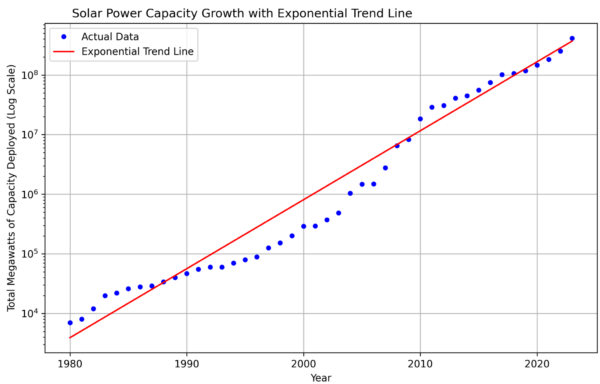
Solar and storage were coming forever, because they cost too much and were rolled out too little. But eventually a tipping point is reached and suddenly prices collapse and deployment explodes. It's not that nothing was happening the long incubation period; the technology was working its way down the experience curve.
Solar has already passed the tipping point and battery storage is doing it right now.
Re: First new U.S. nuclear reactor since 2016 is now in operation
#878Lots of disfavorable comparisons being made here between nuke and solar. Let's do some math. There is a total of around 10 GWh of deployed grid storage in the US. The US consumed about 4,000 TWh of electricity in 2022. (10GWh/ 4000TWh) * (31,536,000 seconds) == 78 seconds. So, net, there is about a minute and a half of energy storage across the entire grid. (Most, about 90%, is pumped hydro, not battery). Of course,…
Nuclear is also quite a lot more expensive than people sometimes calculate here. It cost about 35 billion USD (total cost during build, no maintenance, no fuel) At current potential earning rates of eg. max 10ct/kWh (Georgia) and 1100 MW peak continuous operation it will take 36 years to make the money back. That is without just investing that 35 billion into something else or even adding maintenance and fuel cost wh…
That total cost is for 2 reactors, not one. Vogtle 3 just started operating and Vogtle 4 will start in a few months. If you divide your 36 years by 2, you get 18 years.
Re: First new U.S. nuclear reactor since 2016 is now in operation
#879Earlier quoted context omitted.
Let's do some more math From the article, this new reactor is "estimated to cost more than $30 Billion." (Let's call it 30) & It generates 1,114 Mega Watts. This article [1] says solar panels cost between $0.90 and $1.50 per watt. Let's go with $1/watt to keep the math easy, though I bet it's much cheaper by now, and especially at the scale we'll be buying them at. So for $30 billion dollars, we can have 30 billion w…
Why can’t we make it cheaper and easier to build nuclear plants?
In contrast, something like a solar field, while it has lots of parts, doesn't depend on all those parts working for the field to work. It's by its nature highly redundant and fault tolerant. It also doesn't require supervision anywhere near the same extent as a nuclear plant.
Re: First new U.S. nuclear reactor since 2016 is now in operation
#880Earlier quoted context omitted.
We have needed solar for decades. And thus solar has been coming for decades. How long after we have an abundance of solar can we wait for good storage? How many decades can we wait for that to ramp up? (we didn't exactly start our solar journey yesterday). I feel storage is of immediate urgency, as of yesterday. We don't have a plan and scaling will be a huge challenge. Using EVs is really tempting though.
You don't have a good handle on how experience curves and exponential growth work. Solar and storage were coming forever, because they cost too much and were rolled out too little. But eventually a tipping point is reached and suddenly prices collapse and deployment explodes. It's not that nothing was happening the long incubation period; the technology was working its way down the experience curve. Solar has already…
https://pv-magazine-usa.com/wp-content/uploads/sites/2/2023/...
( https://pv-magazine-usa.com/2023/12/25/all-i-want-for-christ... )
How do you compare storage to that? What storage btw? Because all we have kind of suck for the grid usecase. So there is of course a ton of research for better suited batteries. But we haven't even started production on those.
Are you not underestimating the time to ramp up production? Exponential growth is not gonna save you short to mid term. Especially not compared to solar and wind which of course have huge storage implications.