I know 29 minutes is long but theoretically you can have all the images you ever want in a small 6gb package and run inference on (nearly) everything. That's fucking amazing.
[0] https://www.reddit.com/r/raspberry_pi/comments/hf7lbh/i_made...
31–40 of 88 posts
I know 29 minutes is long but theoretically you can have all the images you ever want in a small 6gb package and run inference on (nearly) everything. That's fucking amazing.
[0] https://www.reddit.com/r/raspberry_pi/comments/hf7lbh/i_made...
Something that I wondered when the Raspberry Pi 5 came out is the weirdness that might be possible now that they have their own chip doing IO cleverness.
On the PI 5, the two MIPI interfaces ave been enhanced to do either output or input, It made me wonder if the ports are now generalized enough that you could daisy chain a string of PI 5's connecting MIPI to MIPI. Then you could run inference layers on individual PIs and pass the activations down the MIPI. 10x 8Gig Pi 5's might not be the speediest way to get an 80gig setup, but it would certainly be the cheapest (for now)
Could be a nice wall paper generator every 29 min. Input a big list of random prompts and let it rotate
This project is a fun POC but it's not very practical for that type of application. A 4090 can generate over 100 images a second with turbo+lcm and a few techniques, you can make 2 days worth of images in 1 seconds. You could make a years worth in roughly 3 minutes and put them on the sd card
I found this claiming an A100 can generate 1 image/s.
https://oneflow2020.medium.com/text-to-image-in-less-than-1-...
Earlier quoted context omitted.
But that's not the point, obviously. Sometimes, being slow is a feature. Besides, a 4090 costs more than a small car.
> But that's not the point, obviously. If you want to say the zero2-w is what's making it then sure. > Besides, a 4090 costs more than a car. They only cost ~0.70USD for 1 hr. In fact you could put this on an A100 for 1$/hr. Renting would make the most sense for this type of thing.
If there's a human in the loop, 100 images/s is likey too much volume, especially if prompt engineering is needed.
At the same time, 2 images/hr is way too slow.
Submitted title was "Stable Diffusion Turbo on a Raspberry Pi Zero 2 generates an image in 29 minutes", which is good to know in order to understand some of the comments posted before I changed the title. Submitters: if you want to say what you think is important about an article, that's fine, but do it by adding a comment to the thread. Then your view will be on a level playing field with everyone else's: https://hn…
Wait, but the new title doesn't seem to be correct
So it’s safe to assume in the next 10 years - AI will be running locally on every device from phones, laptops and even many embedded devices. Even robots- from street cleaning bots to helpful human assistants?
Will models of similar quality to the current LLaMA, GPT, and Stable Diffusion be running locally on devices and edge systems? Very likely.
Will much higher quality models that still require compute incapable by such edge or consumer devices be available, sold as a service, and in high use? Also very likely.
So expect current quality to make it to your devices but don't expect to necessarily move everything to local because the whole ecosystem will improve too. Overton window will shift and it's like asking if gaming will move to phones. In some ways yes, in other ways you're still going to want to buy that Playstation/Xbox/PC.
Could be a nice wall paper generator every 29 min. Input a big list of random prompts and let it rotate
This project is a fun POC but it's not very practical for that type of application. A 4090 can generate over 100 images a second with turbo+lcm and a few techniques, you can make 2 days worth of images in 1 seconds. You could make a years worth in roughly 3 minutes and put them on the sd card
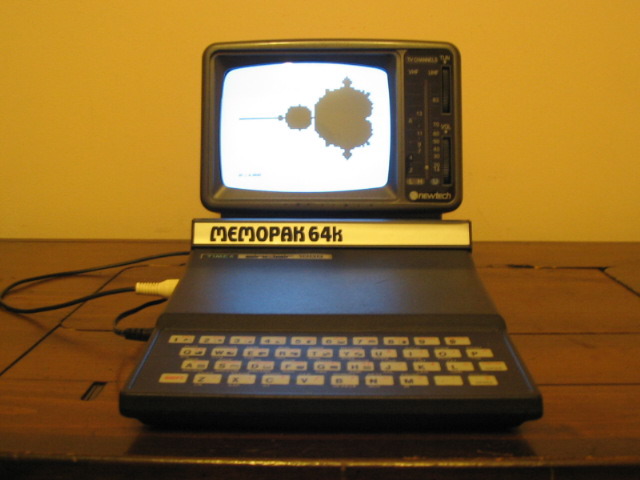
It reminds me of the time it took to generate mandelbrots on home computers in the 80s.
I know 29 minutes is long but theoretically you can have all the images you ever want in a small 6gb package and run inference on (nearly) everything. That's fucking amazing.
But honest question, if this is your goal, why not use a GAN instead? You should still be able to produce high quality images but at a much faster rate (I'd guess around 10 minutes?). Sure, you'll have a bit lower diversity and maybe not SOTA quality image generation, but neither is this thing. Or you could reduce quality. This reddit user seems to be doing fast inference on a pi[0] using stylegan, but that's before…