Live data from Hacker News

280M e-bikes and mopeds are cutting demand for oil far more than electric cars

theconversation.com

31–40 of 756 posts

Re: 280M e-bikes and mopeds are cutting demand for oil far more than electric cars

#31
post #5

We don't need a 4000 lb vehicle to move a ~200 lb person. In order of efficiency: (1) Walk (2) Unicycle, roller skate, scooter (no battery, very little material) (2) Bike (3) Electric bike (and all forms of newfangled electric: escooters, segways) (4) Electric motorbike or scooter (5) Mass transit (can be public/private) transportation: Electric trains (6) Mass transit (can be public/private) transportation: Electric…

How are you defining efficiency here? Is walking really more efficient than cycling? I would put walking as the least efficient manual powered methods mentioned. Aside: I used to unicycle to work, and I have to say that it was both fantastic and much faster than walking while on a 27.5" wheel.

What does a salmon have in common with a man on a bicycle?

They are both Pareto-efficient. Here's a chart of cost of transport (calories/gram/km) vs weight (kg) comparing a salmon vs a bicycle vs a jet fighter etc: https://www.bike.nyc/wp-content/uploads/2017/04/efficiency-g...
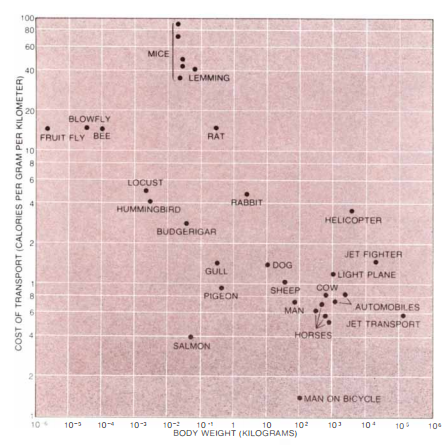
Re: 280M e-bikes and mopeds are cutting demand for oil far more than electric cars

#32
if this is what passes for 'academic rigour, journalistic flair'

> Their batteries make them heavier than a traditional car, and draw heavily on the extraction of rare earth elements

i think your academy is a diploma mill

quoting https://www.sneci.com/blog/are-rare-earths-an-issue-in-the-p... which actually does have something resembling academic rigor

> 15 years ago, the first hybrid vehicles, notably the Toyota Prius and the Honda, were equipped with NiMH (Nickel Metal Hydride) batteries whose negative electrode (anode) was made of a lanthanum-pentanickel alloy (LaNi₅).

> These batteries in the first generation of hybrid vehicles contained about ten kilos of lanthanum, which is a rare earth.

> However, today this battery technology has been replaced by the family of lithium-ion (Li-ion) batteries with much higher performance.

> While some Toyota hybrids sold in Europe are still equipped with NiMH batteries, the vast majority of hybrid and electric vehicles today are equipped with Li-ion batteries… which do not contain rare earths.

> Of course, they contain lithium, cobalt and nickel, but as mentioned above, these metals are not rare earths and do not pose the same problems.

most of the rest of the article explains why rare earths are a red herring and the historical background on why people were concerned about them 15 years ago

> In short, rare earths are not rare at all, the world’s reserves are large, well distributed in the 5 continents and no shortage is to be feared for a long time.

Re: 280M e-bikes and mopeds are cutting demand for oil far more than electric cars

#33
post #3

I'm not really sure where in the US people live that makes them think transportation can be replaced by a bike. I live in San Diego, the climate is great, but there is no way a person can travel any farther than their neighborhood on a bike. The main impediment at this point is the outrageous price of EVs in the US. In China cheap EVs are readily available, trade policies are preventing their import into the US. Bike…

Many places in Europe are very bike-friendly. I used to commute 10km one way daily in pre-WFH time, it was very enjoyable except maybe 1-2 cold months.

Re: 280M e-bikes and mopeds are cutting demand for oil far more than electric cars

#34
post #5

We don't need a 4000 lb vehicle to move a ~200 lb person. In order of efficiency: (1) Walk (2) Unicycle, roller skate, scooter (no battery, very little material) (2) Bike (3) Electric bike (and all forms of newfangled electric: escooters, segways) (4) Electric motorbike or scooter (5) Mass transit (can be public/private) transportation: Electric trains (6) Mass transit (can be public/private) transportation: Electric…

How are you defining efficiency here? Is walking really more efficient than cycling? I would put walking as the least efficient manual powered methods mentioned. Aside: I used to unicycle to work, and I have to say that it was both fantastic and much faster than walking while on a 27.5" wheel.

Walking is probably the most efficient from a (public) health viewpoint. Given that the major problem in the West is lack of physical activity and excess calorie input.

Re: 280M e-bikes and mopeds are cutting demand for oil far more than electric cars

#35

Eliminating the daily commute for those who have jobs where in person presence isn't essential beats all other forms of transportation. But activists, cities, and greenwash companies have all shown their true face, each for their own reasons of self-interest.

I take you don't have kids to take to school and you get all your groceries delivered to your door by someone on an e-bike?

Re: 280M e-bikes and mopeds are cutting demand for oil far more than electric cars

#36
post #17

"In the United States, a staggering 60% of all car trips cover less than 10km." Being lucky enough to live in a walkable city (NYC) this is insane to me. The world is so car-brained.

walking 10km? in most US cities that is neither viable nor safe anymore

Re: 280M e-bikes and mopeds are cutting demand for oil far more than electric cars

#37

We don't need a 4000 lb vehicle to move a ~200 lb person. In order of efficiency: (1) Walk (2) Unicycle, roller skate, scooter (no battery, very little material) (2) Bike (3) Electric bike (and all forms of newfangled electric: escooters, segways) (4) Electric motorbike or scooter (5) Mass transit (can be public/private) transportation: Electric trains (6) Mass transit (can be public/private) transportation: Electric…

I wonder how this ranking might change if we also took into account the energy required to produce the extra calories that humans need to consume in order to get around via these modes of transportation.

Like, you'd probably expend a lot of calories traveling 10 miles by unicycle, and over time maybe that would be more significant than the materials difference compared to cycling?

Of course, it depends a lot on the diet of the human in question.

Re: 280M e-bikes and mopeds are cutting demand for oil far more than electric cars

#38
post #34
post #5

Earlier quoted context omitted.

How are you defining efficiency here? Is walking really more efficient than cycling? I would put walking as the least efficient manual powered methods mentioned. Aside: I used to unicycle to work, and I have to say that it was both fantastic and much faster than walking while on a 27.5" wheel.

Walking is probably the most efficient from a (public) health viewpoint. Given that the major problem in the West is lack of physical activity and excess calorie input.

Which is to say, the least efficient

Re: 280M e-bikes and mopeds are cutting demand for oil far more than electric cars

#39
This is an area that government subsidies could really influence change in urban planning and cutting oil demand. If there was a similar subsidy on bikes as there are on electric cars, I would expect the push back against bike infrastructure would become less. Right now in the Bay Area through poor design and aging infrastructure there is push back on bike lanes. An example is the Richmond bridge, which has a protected bike lane taking a 3rd lane of traffic that could see a larger number of riders if more ebikes become used. Likewise for the Bay Bridge, whose bike lane is a ghost town in the mornings when commute traffic is worst. This would be less of a problem if the lane went entirely to the city.

Re: 280M e-bikes and mopeds are cutting demand for oil far more than electric cars

#40
post #17

"In the United States, a staggering 60% of all car trips cover less than 10km." Being lucky enough to live in a walkable city (NYC) this is insane to me. The world is so car-brained.

walking 10km? in most US cities that is neither viable nor safe anymore

It can include mass transit too. For a practical example, 10km covers all of Washington DC proper if you start at the center, nearly all of which is walkable/bikeable/transit-able.
Post reply on HN