Earlier quoted context omitted.
You would never even get agreement on what more prudently means.
This - to me prudently is something like prioritising: health care, infrastructure, social security, education, defence and policing. I know that many people (even just across the UK), would either disagree with this list, or with the various % that should be attributed to each. One persons 'prudent' would be another persons too much/little etc.
48-nation bloc to crack down on using crypto assets to avoid tax
51–60 of 116 posts
Re: 48-nation bloc to crack down on using crypto assets to avoid tax
#52Perhaps coincidental, but interesting timing given the role crypto plays in getting money into Gaza. It's purportedly a small part of funding that goes in, but maybe one of few left in the current situation.
Here is the summary: https://twitter.com/nic__carter/status/1717210060777009636
- WSJ journalists (Angus Berwick & Ian Talley) write a flurry of articles citing Elliptic data claiming that PIJ (Hamas affiliate) raised $93m in crypto (and cites BitOK claiming Hamas raised $41m) [1]
- Sen Warren uses this article to claim that Hamas raised "over $130m" in crypto. This article is her SOLE citation in her letter. The entire letter depends on the WSJ article [2]
- Over 100 member of Congress sign the letter, which asks for the Biden admin to further crack down on crypto
- Chainalysis comes out with an article disputing the WSJ claims, saying that instead of $82m of terror financing, the real figure is around $450k. It's unclear which wallets they are referring to. Either way, it looks like the WSJ analysis is vastly overstated [3]
- WSJ refuses to follow up or retract, instead writing more articles relying on their claims
[2] https://warren.senate.gov/imo/media/doc/2023.10.17%20Letter%...
[3] https://chainalysis.com/blog/cryptocurrency-terrorism-financ...
Re: 48-nation bloc to crack down on using crypto assets to avoid tax
#53Perhaps coincidental, but interesting timing given the role crypto plays in getting money into Gaza. It's purportedly a small part of funding that goes in, but maybe one of few left in the current situation.
I'm intrigued as to the actual mechanisms of this, especially currently. How does a person (or organisation) in Gaza turn crypto into cash or goods - given the controls that exist in everything that comes into or out of Gaza.
I don’t know enough about the Gaza crypto market to know which state it’s in. But generally, if people are desperate they will try to earn crypto online, and if smugglers can’t get cash out they’ll prefer crypto.
Re: 48-nation bloc to crack down on using crypto assets to avoid tax
#54> ... and a lousy store of value I expect this to be true eventually, but so far Bitcoin has been doing OK as a store of value. Unless people bought in the relatively short peaks, HODLers aren't losing crazy amount of money and one could reasonably anticipate that it'll reach $60k/bitcoin again in the near future. There seem to be people convinced that the crypto types are coming out a long way behind but I'm not rea…
Bitcoin is an inherently good long term store of value, because it has deterministic and finite inflation schedule, which is also plausibly immutable (contrary to fiat cryptocurrencies, called "cryptos"). On the other hand, fiat currencies are a lousy store of value, because they have non-deterministic, but always positive inflation schedule, i.e. they are guaranteed to lose value in the long term. These are just objective facts about their inherent properties.
In addition, Bitcoin includes cryptographic property protection, making it a better store of value in jurisdictions where local authorities won't provide property protection, or the cost of property protection is high. For example, in many countries, it's illegal to own US dollars. Bitcoin is easier to hide and use discreetly, compared to anything physical.
Volatility is a property of the market, not a property of the asset. All things considered, bitcoin should get less and less volatile when time goes on, assuming that it continues gaining adoption. Which is given, as it doesn't have any competition.
Re: 48-nation bloc to crack down on using crypto assets to avoid tax
#55Perhaps coincidental, but interesting timing given the role crypto plays in getting money into Gaza. It's purportedly a small part of funding that goes in, but maybe one of few left in the current situation.
It didn't play a major role, the WSJ made it up due to bad accounting and journalism. Here is the summary: https://twitter.com/nic__carter/status/1717210060777009636 - WSJ journalists (Angus Berwick & Ian Talley) write a flurry of articles citing Elliptic data claiming that PIJ (Hamas affiliate) raised $93m in crypto (and cites BitOK claiming Hamas raised $41m) [1] - Sen Warren uses this article to claim that Hamas r…
Yes, though I said the same thing. Though I also imagine there's a lot of smuggling that has nothing to do with an insurrection.
Re: 48-nation bloc to crack down on using crypto assets to avoid tax
#56I’m not a crypto person, but I have always been curious - how does the tax situation actually work if you don’t want to commit tax evasion? I know that on US tax returns you need to tick a box if you’ve transacted in crypto, and you have to pay tax on the realized gains/losses. How do you actually go about doing that accounting practically given the volatility and the number of transactions? Are there special pieces…
Re: 48-nation bloc to crack down on using crypto assets to avoid tax
#57What is the mechanism for “crypto assets to avoid tax?”
One is simply using crypto as cash equivalent - a mechanism to receive (and spend) undeclared income without paying the relevant taxes, so that drives adopting pretty much the same regulations as for cash, just as there already are various requirements to declare and deanonymize large cash transaction, the same gets implemented for various crypto-assets.
The other is using NFTs (or similar products) for money laundering, again in pretty much the same way as physical art can be used; the key steps being (a) cheaply buy or make some asset-with-undefined-value; (b) have an "anonymous customer" (your own 'sockpuppet') buy it from you at a high price using cash or cryptocurrency. This can be both a form of partial tax evasion, as the capital gains tax you'd pay on this profit is often much lower than what you'd pay otherwise for that income, and also a form of money laundering, if the funds are obtained, for example, from some scam or ransomware operation. And again, the general solution here is to apply the same regulations as for large quantities of cash, such as requiring to identify the counterparty and thus make the potential laundering traceable.
Re: 48-nation bloc to crack down on using crypto assets to avoid tax
#58I’m not a crypto person, but I have always been curious - how does the tax situation actually work if you don’t want to commit tax evasion? I know that on US tax returns you need to tick a box if you’ve transacted in crypto, and you have to pay tax on the realized gains/losses. How do you actually go about doing that accounting practically given the volatility and the number of transactions? Are there special pieces…
I'm pretty sure major exchanges generate the tax form/supplemental schedule/whatever for you in the case of trades on their internal order books (they never really touch chain).
Unless you're doing some very edge case or going out of your way (evasion) there's not much good reason to struggle with some kind of reasonable tax compliance with all of this.
> I know the real cynical answer is that most people just don’t report correctly, but I’m curious how you’d do it if you wanted to be legit.
Not surprisingly when I used to be involved in crypto even discussing an attempt at paying taxes was met with "LOL you idiot bootlicker" types of responses from the crypto community. The only reason they're not in jail or getting hit with heavy penalties from the IRS, etc is because they're too small for anyone to care and audits and budgets for IRS enforcement have been slashed:
https://www.cnbc.com/2023/04/01/heres-why-irs-tax-audits-hav...
Re: 48-nation bloc to crack down on using crypto assets to avoid tax
#59Earlier quoted context omitted.
> but so far Bitcoin has been doing OK as a store of value No, it hasn't. A store of value is supposed to be stable, it's about volatility. By that same reasoning you could argue that Apple or Tesla stock, or even the stock market in general, is a great store of value. But nobody would ever call it that, because it is far too volatile on a daily basis. Trying to argue that a vague long-term uptrend in prices makes so…
>a vague long-term uptrend in prices makes something a store of value A stable and 100% predetermined issuance schedule, along with its scarcity, it's what makes Bitcoin a good store of value. The steady uptrend in prices is the consequence. >useless technology. Just because it's functionality is limited it doesn't make it useless. A store of value that doesn't require boring the planet, or building empty houses, see…
Boring holes isn't tenable but using 15 GW of power is acceptable?
Re: 48-nation bloc to crack down on using crypto assets to avoid tax
#60Earlier quoted context omitted.
You would never even get agreement on what more prudently means.
This - to me prudently is something like prioritising: health care, infrastructure, social security, education, defence and policing. I know that many people (even just across the UK), would either disagree with this list, or with the various % that should be attributed to each. One persons 'prudent' would be another persons too much/little etc.
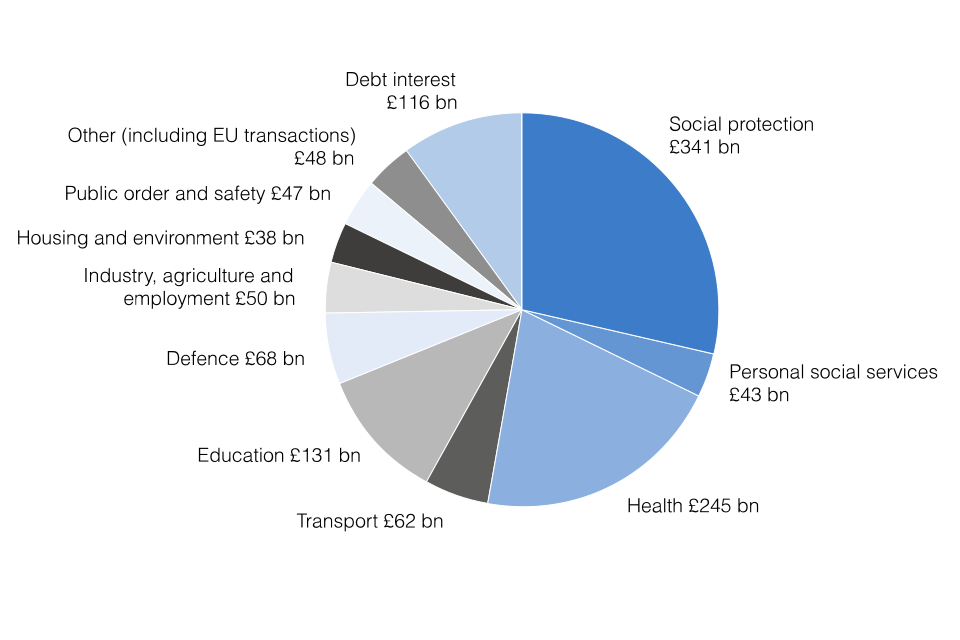
By far the largest categories are Social protection and Health, followed by Education, Debt interest and Defense. I guess you want to increase infrastructure spending. So the question is, what are you going to deprioritize?
Source: https://www.gov.uk/government/publications/spring-budget-202...