Live data from Hacker News

Bibi-binary

en.wikipedia.org

21–30 of 48 posts

Re: Bibi-binary

#21
post #18

For the non-French people here: Bobby Lapointe is also a quite famous singer who loved plays on words, quite difficult to translate!

I wasn't sure if it was the same Boby Lapointe.

But reading the "pronunciation" line in the table made me smile and confirmed that it was.

From now on, I'll be singing the hexadecimal pointers when debugging C++ code.

HIHA !

Re: Bibi-binary

#22
post #4

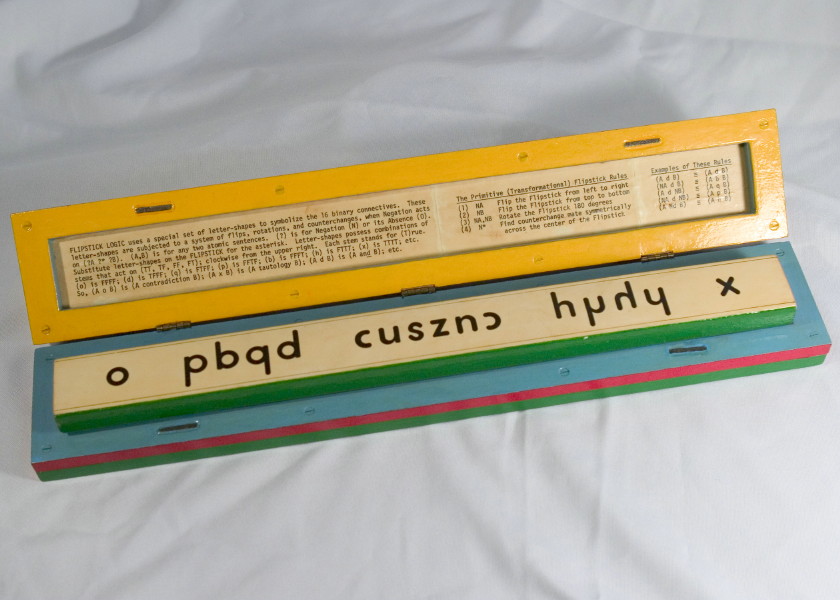
It looks very similar to the "Logic Alphabet". http://www.logic-alphabet.net/images/flipstick_2347_2.jpg Both are systems of symbols meant to encode 4 bits of information. In both cases, pointy bits in the corners of the symbols represent 1 or true, while round bits are 0 or false. A difference is that in the case of bibi-binary the intent is to encode numbers, while the intent of the logic alphabet is to encode trut…

That's actually a really practical set of operators.

Re: Bibi-binary

#23
post #20

Obligatory to also mention the historical Cistercian digits, which used an in-digit encoding to create a base 10000 number system: https://commons.wikimedia.org/wiki/File:Cistercian_digits_(v...

I can see novice monks scraping 9900 on the walls.

Re: Bibi-binary

#25
This part in the introduction says it doesn't have a citation, does anyone have more information?

I'm very curious to learn more:

   "It found some use in a variety of unforeseen applications: stochastic poetry, stochastic art, colour classification, aleatory music, architectural symbolism, etc.[citation needed]"

Re: Bibi-binary

#26

That section on negative numbers seems incomplete. It doesn't indicate how you write negative numbers instead talks about how normal binary computers use twos complement. Edit: I think I was assuming you'd only use 4 bit or 8 bit values with this notation.

Indeed the section on negative numbers is bullshit. One's or two's complement representation only works with fixed-length numbers. Arbitrary-length numbers would need an infinite number of leading 1 digits.

Re: Bibi-binary

#27
It's a fun idea, but I'm confused as to why the inventor decided that decoding would rely on reading the bits in order of top-to-bottom, left-to-right. To make it intuitive to readers of French, you'd expect the order to be left-to-right, top to bottom. To make it intuitive to mathematicians, you might expect it to start in the upper right and proceed counterclockwise, as per the numbered quadrants of a Euclidean plane. The 16 symbols themselves will remain the same regardless of the order in which you visit the bits, but the sequential position of each symbol will change.

Re: Bibi-binary

#28
post #13

Are these in Unicode?

Nope, even finding similar glyphs is difficult for many.

The Logic Alphabet (linked to above at http://www.logic-alphabet.net/images/flipstick_2347_2.jpg), which has a similar concept, seems to have better support: it can represent twelve of the symbols using Latin letters (o, p, b, q, d, c, u, s, z, n, h, and x, although z, u and n seem a bit forced) and the others seem to have decent Unicode equivalents (ɔ or ⊃ (superset), μ (Greek letter mu), ɥ or ч, and maybe ʎ).

Re: Bibi-binary

#29
post #4

It looks very similar to the "Logic Alphabet". http://www.logic-alphabet.net/images/flipstick_2347_2.jpg Both are systems of symbols meant to encode 4 bits of information. In both cases, pointy bits in the corners of the symbols represent 1 or true, while round bits are 0 or false. A difference is that in the case of bibi-binary the intent is to encode numbers, while the intent of the logic alphabet is to encode trut…

> A difference is that in the case of bibi-binary the intent is to encode numbers

bibi-binary is intended to encode raw binary data, not specifically numbers (at least not beyond 15). We already have a script and words which work mostly fine for numbers after all.

> The other difference is that the inventor of bibi-binary was a comedian who obviously did it as a tongue-in-cheek novelty

He was also a mathematician — his studies stopped because of world war II forced labour (from which he escaped) and he did patent bibi-binary, it was not just a joke.

And calling him a comedian is a bit reductive, comedianship was his outlet for a passion for wordplay, something he first tried as a songwriter (and poet), but he could find no singer, so ultimately ended up doing it himself.
Re: Bibi-binary

#30

That section on negative numbers seems incomplete. It doesn't indicate how you write negative numbers instead talks about how normal binary computers use twos complement. Edit: I think I was assuming you'd only use 4 bit or 8 bit values with this notation.

As far as I can see the section on negative numbers was completely made up, or at least it is not sourced in the system's patent. The encoding was mostly defined as a way to transmit (and write down) binary data in nibbles (groups of 4 bits), it does not really concern itself with what that data encodes. The one thing it does support which the wiki does not note, is a run-length encoding: if a syllable ends in R, the…

And of course I forgot about HN's shitty markup and didn't notice before the edition timer ran out.

HORBAR is repeat(0x0, count=5)

DIRHAHOR is repeat(0xF, count=16)

Also in script form this is written as a strange parenthetical. Strange because the repeated nibble gets an open paren "stuck" to it, like a tail. So repeated nibbles don't look much like their base form.

Post reply on HN