Bibi-binary
en.wikipedia.org
Bibi-binary
1–10 of 48 posts
Re: Bibi-binary
#2It reminds me superficially of marching squares https://en.m.wikipedia.org/wiki/Marching_squares
Re: Bibi-binary
#3It reminds me superficially of marching squares https://en.m.wikipedia.org/wiki/Marching_squares
Non-mobile link: https://en.wikipedia.org/wiki/Marching_squares
Re: Bibi-binary
#4It looks very similar to the "Logic Alphabet".
http://www.logic-alphabet.net/images/flipstick_2347_2.jpg
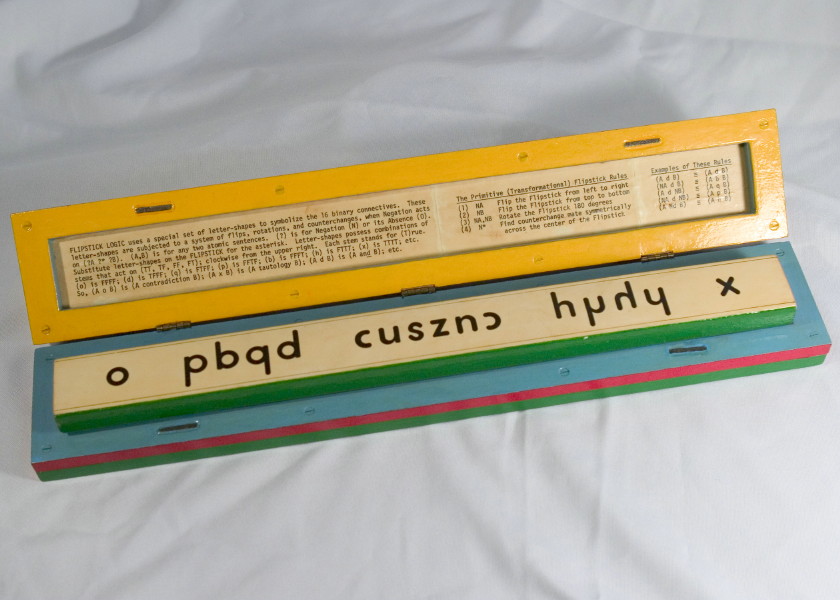
Both are systems of symbols meant to encode 4 bits of information. In both cases, pointy bits in the corners of the symbols represent 1 or true, while round bits are 0 or false.
A difference is that in the case of bibi-binary the intent is to encode numbers, while the intent of the logic alphabet is to encode truth tables of binary logic operators. But fundamentally they encode the same information.
The other difference is that the inventor of bibi-binary was a comedian who obviously did it as a tongue-in-cheek novelty, while the logic alphabet's creator appears to have been quite convinced of the importance of his invention...
Re: Bibi-binary
#5That section on negative numbers seems incomplete. It doesn't indicate how you write negative numbers instead talks about how normal binary computers use twos complement.
Edit: I think I was assuming you'd only use 4 bit or 8 bit values with this notation.
Re: Bibi-binary
#6> "7D0" in conventionally-written hexadecimal, would in Bibi-binary be spoken aloud as "BIDAHO".
I see what they did there.
Re: Bibi-binary
#7> "7D0" in conventionally-written hexadecimal, would in Bibi-binary be spoken aloud as "BIDAHO". I see what they did there.
What did they do ?
Re: Bibi-binary
#8> Using four consonants (HBKD) and four vowels (OAEI), one obtains sixteen combinations:
Why not ordered?
bcdf
aeio
Re: Bibi-binary
#9Re: Bibi-binary
#10> Using four consonants (HBKD) and four vowels (OAEI), one obtains sixteen combinations: Why not ordered? bcdf aeio
The patent explains the reasoning, though I can't say I understand all of it. This is all in the french phonology
- open vowels for even, closed for odd (no idea why)
- back vowel for the second bit being unset, front for set (according to the wiki e is ə and central and mid rather than back and open but...), this kind-of matches the reasoning of the consonants positionality where the front sets the bit.
- H is the first consonant because it's mostly silent
- The patent justifies B, K, and D as labial, guttural, and dental. I guess physically indicating the bits set, with the low bit being the front of the mouth: labial is the low bit, guttural is the high bit, and dental being inbetween is both.
You can see the same physicality in the script, where "sharp edges" point to set bits when the nibble is written in pairs of two, big endian, columnar (so each block is read top to bottom, left to right, rather that left to right top to bottom).
Hence U stands for
    11
    00
c encodes
    01
    01
    10
    10