Live data from Hacker News

USB inventor explains why the connector was not designed to be reversible (2019)

pcgamer.com

121–130 of 544 posts

Re: USB inventor explains why the connector was not designed to be reversible (2019)

#121
post #26

Earlier quoted context omitted.

The first iMac was USB only. https://en.wikipedia.org/wiki/IMac_G3#Specifications

It is genuinely surprising that out of all companies Apple was the one to pioneer USB usage. Quite the stark contrast with their current modus operandi of always making something custom so it can be as incompatible as possible with anything non-Apple (and so they can sell more dongles). Well until they were dragged kicking and screaming to USB-C by the EU anyway.

Every proprietary connector I can think of that Apple has introduced was done to solve a problem that other connectors at the time did not solve.
Re: USB inventor explains why the connector was not designed to be reversible (2019)

#122
post #90
post #6

It didn't really need to go in either way. It just needed to not be rotationally symmetrical while only going in one way. Firewire only went in one way but it was never an issue because it's shape conveyed a clear orientation.

It's amazing that it can take you 3 tries to plug in a USB cable which only has 2 correct ways it can be oriented.

The funniest part is that it still takes 3 tries even when you know what you just said.

Re: USB inventor explains why the connector was not designed to be reversible (2019)

#123
post #90
post #6

It didn't really need to go in either way. It just needed to not be rotationally symmetrical while only going in one way. Firewire only went in one way but it was never an issue because it's shape conveyed a clear orientation.

It's amazing that it can take you 3 tries to plug in a USB cable which only has 2 correct ways it can be oriented.

I've found a trick but have trouble explaining it to people - especially if they haven't build a computer before.

The plastic bit inside of the plug usually goes on the side facing whatever board it's interfacing with.

For example, looking straight on from the back of an ATX case, it's usually on the left side - where the motherboard mounts

Front panel connectors are anarchy... but at least they're usually visible

Re: USB inventor explains why the connector was not designed to be reversible (2019)

#124

>But in an effort to keep it as cheap as possible, the decision was made to go with a design that, in theory, would give users a 50/50 chance of plugging it in correctly (you can up the odds by looking at the inside first, or identifying the logo). I despise this "design decision." Literally bakes in the 50% of the time you plug it in the wrong orientation and lose seconds of your life. Who cares if the sands of time…

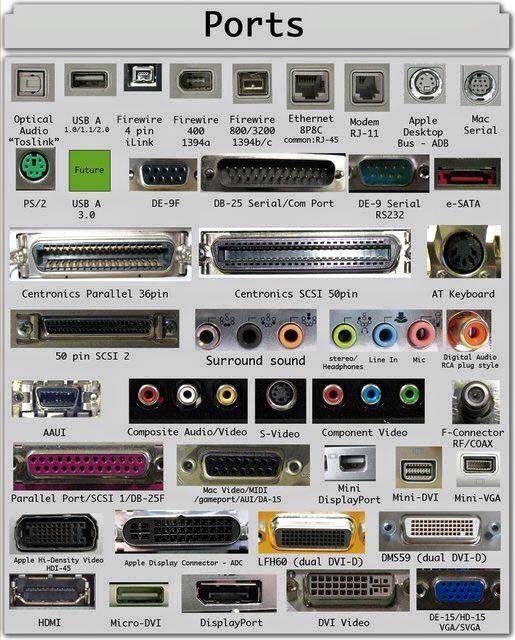
All I can say is that before USB 1.0, the myriad of connections on a PC motherboard were ridiculous. USB was leaps and bounds better beyond PS/2, and VGA and various serial and parallel ports would require you to physically screw in the plug. Just look at: https://www.electronicshub.org/wp-content/uploads/2016/01/Po...

It was a nightmare. And virtually none of those ports would self-install drivers when a device was plugged into it. USB 1.0 was magic when it came out.

Re: USB inventor explains why the connector was not designed to be reversible (2019)

#125
post #81

If you have a reversible connector, then you might be entangled in a dilemma of which way is the "better" or "optimal" or "canonical" way, while with a non-reversible one there is only one way and thus no dilemma. And in fact USB-C is not really physically reversible, because the hardware detects which way it's plugged in and permutes the signals, as opposed to mirroring all the wires, so there is indeed a "right" wa…

> the hardware detects which way it's plugged in and permutes the signals

For USB3/4 signals, yes. But the hardware needed to interact with those signals is complex enough that making it also support swapping pins is a minor detail.

The USB2 and power lines, on the other hand, are all present on both sides. This means that simple devices don't need to detect orientation; they can connect the duplicated pins together and everything works.

Re: USB inventor explains why the connector was not designed to be reversible (2019)

#126
post #64

I know everybody is still on the high from USB-C but I'm still going to go on the record it will be one of the biggest disasters in cable history. 1) There's going to be video-only cables; low-voltage only cables; etc and this time everything is usb-c so you can literally only tell which ables work by testing all of the dozen cables instead of the 1-2 USB-As you have. 2) The connector is symmetrical but the pins aren…

I wish there was a requirement that USB C cables must have sort of ID chip that can be easily read that tells what the cable supports, so that we could have simple testers that you can plug a cable into and be told what speed and power it supports.

Except for power, that is all determinable from the cable itself. USB-C cable supports power and USB2 data. Resistor determines the power, either legacy USB, 1.5A or 3A. Every USB-C cables support that. If there are USB3 pins connected, then it supports USB3 data and alternate mode. I think USB3 has negotiation protocol to figure out the data rate. There is also negotiation about power delivery on USB-C specific pins.

Re: USB inventor explains why the connector was not designed to be reversible (2019)

#128
post #81

If you have a reversible connector, then you might be entangled in a dilemma of which way is the "better" or "optimal" or "canonical" way, while with a non-reversible one there is only one way and thus no dilemma. And in fact USB-C is not really physically reversible, because the hardware detects which way it's plugged in and permutes the signals, as opposed to mirroring all the wires, so there is indeed a "right" wa…

A USB 2.0 device is usually supposed[1] to just short the two possible positions of each data pin in its USB-C port (the four power pins are always shorted, of course, as are the four ground ones). Orientation sensing only comes into play when you start using the SuperSpeed lanes (for signal interference reasons).

[1] https://www.microchip.com/en-us/application-notes/an1953, 1.3.1

Re: USB inventor explains why the connector was not designed to be reversible (2019)

#129

> Making USB reversible to begin with would have necessitated twice as many wires and twice as many circuits Is this still true with USB-C?

From other comments it sounds like no. Instead, every port must detect the orientation and switch to using the correct lines in software. IIUC, each cable also needs a small IC to assist with this.

Re: USB inventor explains why the connector was not designed to be reversible (2019)

#130
post #90
post #6

It didn't really need to go in either way. It just needed to not be rotationally symmetrical while only going in one way. Firewire only went in one way but it was never an issue because it's shape conveyed a clear orientation.

It's amazing that it can take you 3 tries to plug in a USB cable which only has 2 correct ways it can be oriented.

Even after 25 years of using USB devices this still happens to me, today, in fact!
Post reply on HN