Live data from Hacker News

Toyota Will Adopt Tesla-Style Cast Bodies That Might Be Impossible to Fix

thedrive.com

111–120 of 137 posts

Re: Toyota Will Adopt Tesla-Style Cast Bodies That Might Be Impossible to Fix

#111

“cast bodies might be more difficult to fix in the event of major damage, such as a crash.” Raise your hand if you’ve ever had a car NOT be written off after “major damage”. The industry already doesn’t bother to fix cars, they just get scrapped, so I don’t see what the actual difference is.

They don't get scrapped most of the time they are send overseas and repaired.

Re: Toyota Will Adopt Tesla-Style Cast Bodies That Might Be Impossible to Fix

#112

Cast metals are rather brittle, normally? Good for complex shapes that may be further refined by machining, and in compression loads, but not in shear or tension. I would think they would shatter in a collision rather than bend like steel.

They must anneal them

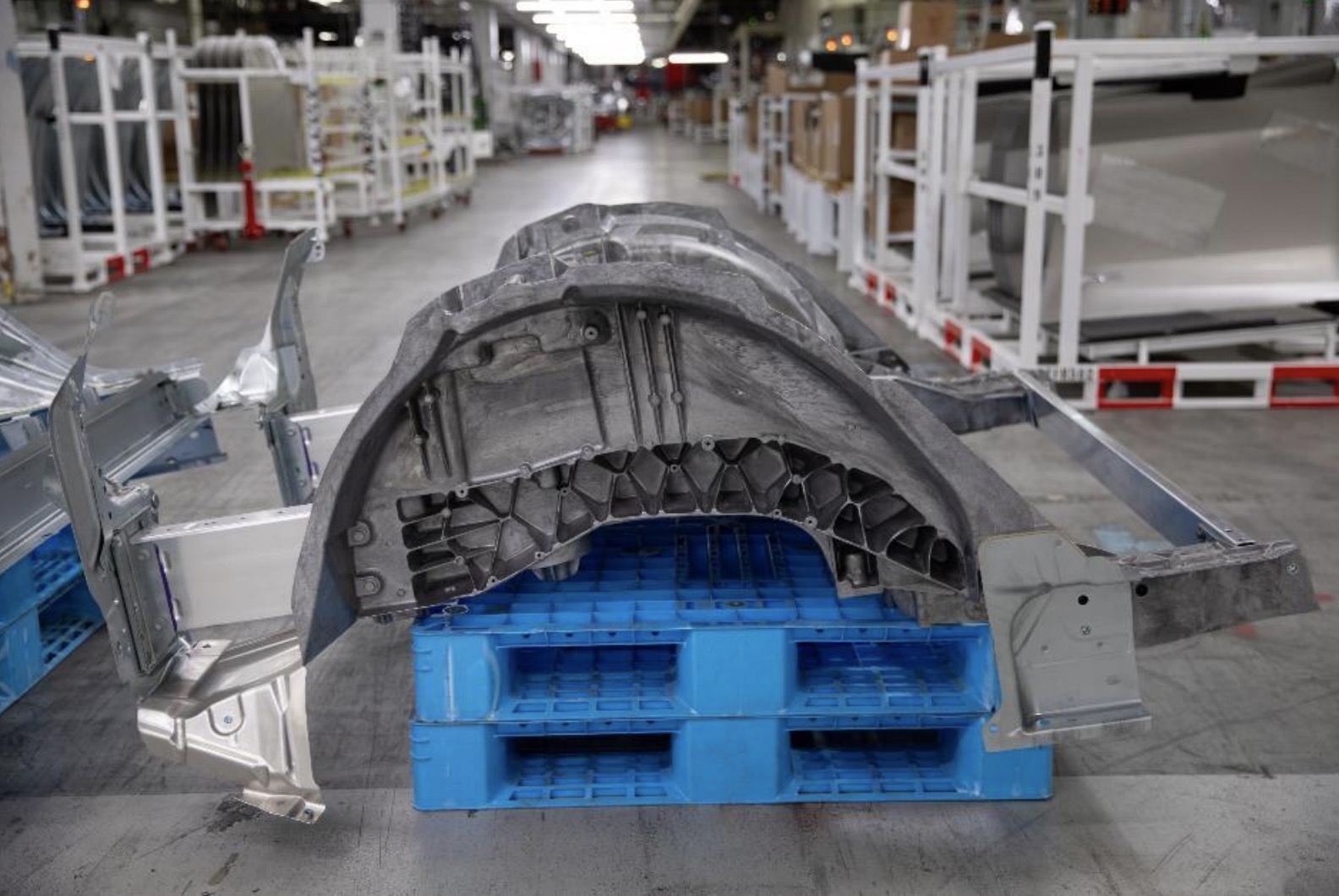
Not necessarily. Tesla actually developed a proprietary alloy for their giga casting that removed the need for heat treatment, as the large castings tended to deform during it. On the plus side, also meant they could remove that process step. Article didn't give any details how Toyota would handle it though.

Re: Toyota Will Adopt Tesla-Style Cast Bodies That Might Be Impossible to Fix

#114

“cast bodies might be more difficult to fix in the event of major damage, such as a crash.” Raise your hand if you’ve ever had a car NOT be written off after “major damage”. The industry already doesn’t bother to fix cars, they just get scrapped, so I don’t see what the actual difference is.

My car got written off. 11 years old but in good condition, got hit on the rear left corner, sheet metal work was damaged. The tier 1 body shop that the insurance company sent me to quoted about 3/4 of the car's (undamaged) value in repair costs, including replacing most of the left side, the back window among other things, and even $600 worth of paint.

Shopping for a replacement vehicle in the damaged one, various tier 2-3 dealer types said, oh, we could fix that up real nice for $3K, and one of them would have been happy to have the car at the insurance company's quoted value in damaged condition. So you can bet that that thing has by now been auctioned off, fixed up like that and sold, possibly with a "rebuilt" title, at a modest profit, and continues to be used. It was too good to scrap and the damage, while a PITA to fix, was not even remotely structural.

So it's not that insurance companies consign all these written-off cars to the scrap heap. It's just that they don't want to deal with the repairs, and possible post-repair complaints. So just like bad debts, it's sent down the pipe to the people best matched to the job. A broken cast frame would short-circuit this process, causing the car to be scrapped for real and thus raising costs for everyone.

Re: Toyota Will Adopt Tesla-Style Cast Bodies That Might Be Impossible to Fix

#115
> Car companies make their money from selling new cars, not keeping old ones on the road.

I'm interested in how this could be realistically changed. I'm convinced most of the environmental and societal problems caused by economic activity is inevitable at scale, where an organisation's behaviour becomes dominated more by underlying economic rules than any principles it's originators may have had at a younger age or smaller scale.

It also shouldn't necessarily be so specific as "must maximise vehicle life", it really depends, because it's not impossible that with the right manufacturing and recycling techniques shorter vehicle life could bring down the total environmental and societal cost. The question is how to make that economically interesting to the manufacturers, e.g what if each manufacturer was responsible, end-to-end, for the recycling of it's own vehicles... shorter vehicle life could mean more sales, but could also mean more recycling. If the process is optimised for that then it could be profitable and cheap for the consumer and good for the environment, but if not it will hurt their bottom line.

Re: Toyota Will Adopt Tesla-Style Cast Bodies That Might Be Impossible to Fix

#116
post #115

> Car companies make their money from selling new cars, not keeping old ones on the road. I'm interested in how this could be realistically changed. I'm convinced most of the environmental and societal problems caused by economic activity is inevitable at scale, where an organisation's behaviour becomes dominated more by underlying economic rules than any principles it's originators may have had at a younger age or s…

Part of the sale value of a car incorporates its resalabilty.

Re: Toyota Will Adopt Tesla-Style Cast Bodies That Might Be Impossible to Fix

#117
I think something missed in this discussion is the fact that an EV is so much simpler than an ICE vehicle* that costs will inevitably come down.

Many people believe that decent models will be considerably cheaper than today’s Tercels, Civics, Corollas, etc. in as little as 2-3 years.

Today you can buy a brand new Tesla Model 3 for $39,000 and with the U.S. tax credits that drops to $31,500. If you are in states like NY with additional credits, $26,500.

So it is already around the price levels of Accords, Camrys, etc. on the existing Tesla platform.

Tesla’s goal in their next platform is to cut the price to manufacture in HALF, and there is good reason to believe they will achieve that. The aspirational goals Toyota is claiming in this article, if achieved, will help them get closer to Tesla’s current architecture, which will be a great step forward.

As manufacturing becomes more efficient and prices drop, it will indeed make less and less sense to do major repairs, which are only getting more expensive.

* EVs are simpler when they have a proper hardware/software integration and over-the-air updates. Continuing the current industry practice of stringing together 150 off-the-shelf ECUs is one reason why most companies are losing money on their EVs and will never keep up with those who understand the software-defined car.

For a great deep dive on how Tesla has created their software-defined car architecture check out https://youtu.be/fUCgLCbX_18?si=X9-s_aNLyrunmGHi
Re: Toyota Will Adopt Tesla-Style Cast Bodies That Might Be Impossible to Fix

#118

Earlier quoted context omitted.

Indeed, when I heard about the gigapress, I was like that is pretty neat, but when I read it was just casting, and not forging, I was like oh, it's not the *best* solution. https://en.wikipedia.org/wiki/Forging

I assumed that the gigapress was a large stamping die. neither casting (melt the metal and pour it into a mold) or forging (shaping softened hot metal), but deforming cold metal in one or more steps using alot of pressure and a very hard mold.

Yes, but that's the way it is with Musk. Nothing is actually what it claims to be.

Re: Toyota Will Adopt Tesla-Style Cast Bodies That Might Be Impossible to Fix

#119

“cast bodies might be more difficult to fix in the event of major damage, such as a crash.” Raise your hand if you’ve ever had a car NOT be written off after “major damage”. The industry already doesn’t bother to fix cars, they just get scrapped, so I don’t see what the actual difference is.

My mum had a 2004 Sonata and it got T-boned with like 3,000km on the odometer. It was like a $17k car brand new, with and they put like $15k of body work (and then hiring a loaner car for a month while doing it) into it. Ran fine for another 150,000km before she traded it in, but I was baffled that the other driver's insurance didn't just say "we're writing it off, go get another one." OTOH, she was so pleased by their willingness to pay without hassle that she switched to that carrier.

Re: Toyota Will Adopt Tesla-Style Cast Bodies That Might Be Impossible to Fix

#120

If it turns out that in order to make EVs cheaper to build than combustion cars right now you have to switch to castings because batteries are expensive, then when batteries become much cheaper, will we switch back to the current non-casting-based 'strut and fastener' model? Also, because Tesla is so popular, is it possible that its attractions have far less to do with the environment and more to do with everything e…

No, casting is simply a better technology. Its better no matter what type of propulsion you use. Its just that other car companies, unlike Tesla, were not willing to make the massive investment it required to make truly huge castings. Smaller casting have been in use before on various cars, some Audi had a decently big one on the wheel well.

For Tesla to do this they had to work with a company that made the largest casting and task them with creating a massively larger casting. Tesla material teams also developed its own aluminum alloy that wouldn't bend as much during cooling. This allowed Tesla to not have to dip the castings into a fluid to cool them.

Castings had been used by car companies for a while, sometimes decent size ones around the wheel for example. But Tesla took the idea and put in the effort to take it way further.

They started with doing only half the back, and then bond the two sides. When the company finished development on the larger generation of machines they pioneered doing the whole back piece all at once.

See: https://electrek.co/wp-content/uploads/sites/3/2020/04/Tesla...

> Also, because Tesla is so popular, is it possible that its attractions have far less to do with the environment and more to do with everything else about the car?

This is clearly the case. People never by things 'just of the environment'. Tesla produces the arguable the best price to return for EVs. At least unless you want a much smaller shorter range car.

Post reply on HN