Note that the areas of the three largest deviations are, in order: Biosphere Integrity, Novel Entities (synthetic chemical & processes), and Biogeochemical Flows. The entire ecosystem on which we depend for sustenance is an extremely complex web of interlocking dependencies, from plankton to pollinators, to soil microbiota, to temperature & hydration, and so on, endlessly. This is the food web. If it collapses, we as…
One major contributor to the overshoot is our current agricultural practices, with animal agriculture being a primary offender.
It's responsible for a significant amount of greenhouse gases, it's a leading driver of biodiversity loss and deforestation, and it contributes to soil degradation and water pollution.
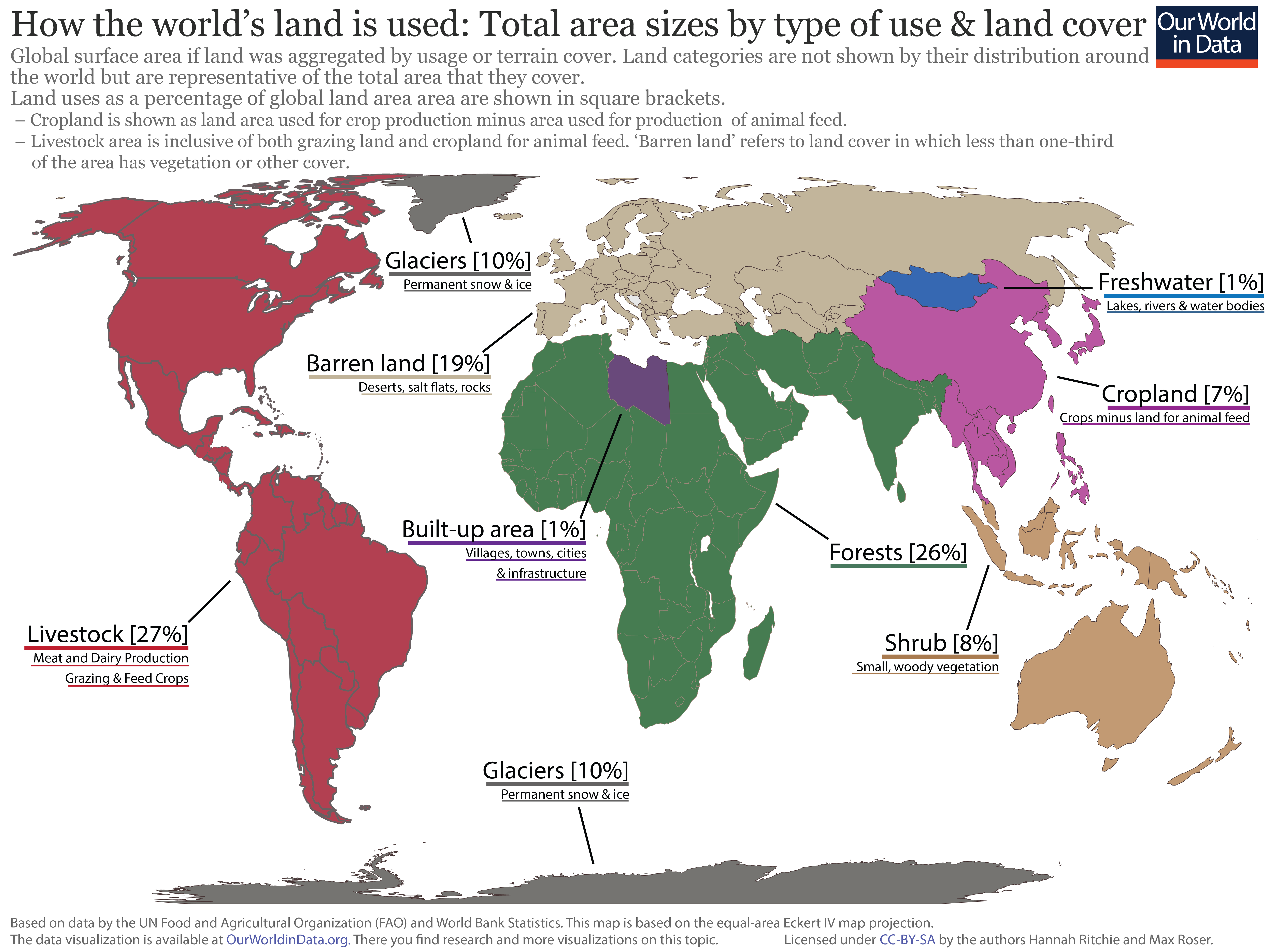
https://ourworldindata.org/land-use
https://ourworldindata.org/uploads/2013/10/World-Map-by-Land...
BIODIVERSITY LOSS
https://www.nature.com/articles/d41586-019-01448-4
Humans are driving one million species to extinction - UN backed report finds that agriculture is one of the biggest threats to Earth’s ecosystems
https://www.unep.org/news-and-stories/press-release/our-glob...
Our global food system is the primary driver of biodiversity loss
https://pubmed.ncbi.nlm.nih.gov/26231772/
Biodiversity conservation: The key is reducing meat consumption
DEFORESTATION
https://ourworldindata.org/drivers-of-deforestation
Drivers of Deforestation - combined, beef and oilseeds for animal feed account for nearly 60% of deforestation
https://www.ucsusa.org/resources/whats-driving-deforestation
Just four commodities — beef, soy, palm oil, and wood products—drive the majority of tropical deforestation.
Beef - 2.71 million hectares / year
Soy - 480,000 ha / year (77% for animal feed)
Palm Oil - 270,000 ha / year
Wood - 380,000 ha / year (but probably more)
GREENHOUSE GAS EMISSIONS
CO2 - 16.5+% animal agriculture (https://www.researchgate.net/publication/352100490_Emissions...)
Methane - animal agriculture leading driver, https://ourworldindata.org/emissions-by-sector#methane-ch4-e...
N20 - animal agriculture leads again, https://ourworldindata.org/emissions-by-sector#nitrous-oxide...
SOLUTIONS
We can significantly reduce our footprint by adopting plant-based diets, reforesting the pastures (more than 50% of which were originally forests), and allowing biodiversity to recover.
https://ourworldindata.org/land-use-diets
If the world adopted a plant-based diet we would reduce global agricultural land use from 4 to 1 billion hectares
https://www.nature.com/articles/s41893-020-00603-4
The carbon opportunity cost of animal-sourced food production on land - shifts in global food production to plant-based diets by 2050 could lead to sequestration of 332–547 GtCO2, equivalent to 99–163% of the CO2 emissions budget consistent with a 66% chance of limiting warming to 1.5 °C
https://www.eurekalert.org/news-releases/917471
Feeding 10 billion people by 2050 within planetary limits may be achievable