I'm not sure the author realized this, but they're actually making a statement about how crazy exponential growth is. Not about the sustainability of tidal power. This becomes obvious once you look closer at what that 2% growth rate (as assumed in the post) implies. Our global energy consumption in 2008 was estimated to be 474 exajoules. The total energy received by the earth from the sun during a year is about 5 mil…
Tidal energy is not renewable
61–70 of 350 posts
Re: Tidal energy is not renewable
#62Re: Tidal energy is not renewable
#63I'm not sure the author realized this, but they're actually making a statement about how crazy exponential growth is. Not about the sustainability of tidal power. This becomes obvious once you look closer at what that 2% growth rate (as assumed in the post) implies. Our global energy consumption in 2008 was estimated to be 474 exajoules. The total energy received by the earth from the sun during a year is about 5 mil…
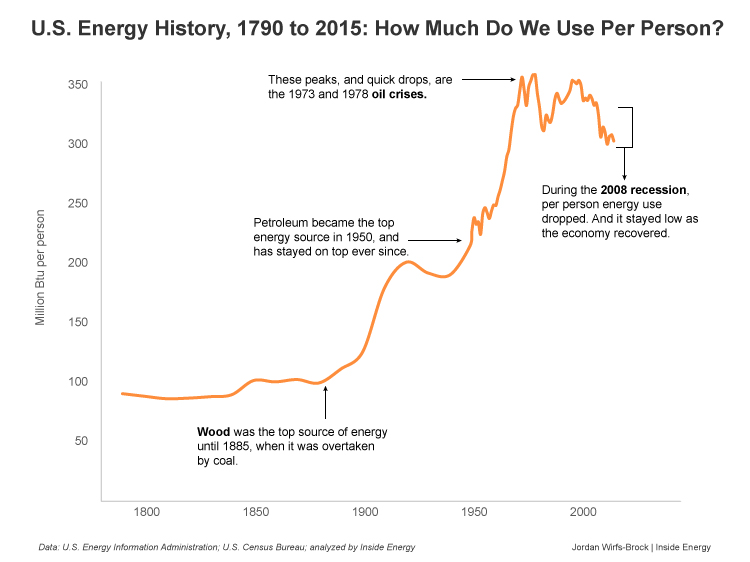
http://insideenergy.org/wp-content/uploads//2017/01/historic...
from:
Re: Tidal energy is not renewable
#64Re: Tidal energy is not renewable
#65Earlier quoted context omitted.
The UN has revised peak projections down several times; the peak is now expected at 10 billion.
More countries are now sub-2.0 replacement, China is down to 1.09 so the peak is unlikely to get much more than that.
Are you talking about something else ?
Re: Tidal energy is not renewable
#66I'm not sure the author realized this, but they're actually making a statement about how crazy exponential growth is. Not about the sustainability of tidal power. This becomes obvious once you look closer at what that 2% growth rate (as assumed in the post) implies. Our global energy consumption in 2008 was estimated to be 474 exajoules. The total energy received by the earth from the sun during a year is about 5 mil…
If my maths is right, that's about 40,000 kcal per person per day, or about 15 times the energy consumption of an average adult.
I'm trying to figure out if that's a lot or not. On the one hand, not: this ratio is not strictly bounded in any way, and the human energy consumption is an arbitrary denominator. Still, a very rough interpretation is to say, we consume daily, on average, the fruit of work of 15 people.
Of course, that is very skewed. I wonder what the ratio looks like for an average American or European - must be much more.
It goes to show what a gilded life we live (on average!!!). Before industrial revolution, all energy basically was muscle power, and it's like for every 1 person alive, we have 15 servants turning the generator for us. I suppose some of this number is literal service providers, fed by food produced by powered agriculture.
Is there a logical upper bound to this number? Is there some energy amount we can't use given sufficient supply? Ultimately, all energy we produce is spent on humans so our energy consumption is a yardstick for human energy needs.
But that's not quite right either; a lot of energy is wasted. I wonder how much of this number is clothes that go straight from factory to landfill, AC left overnight, inefficient engines and energy storage.
I don't really have a point, other than I think this is an interesting fraction to look at.
Re: Tidal energy is not renewable
#67Re: Tidal energy is not renewable
#68Earlier quoted context omitted.
That better be the case , we are already seeing that if the pie can't grow then we start fighting each other violently to enlarge one's piece of it.
Conflict over scarce resources is inevitable. When the violence starts, you should be prepared to win (from a nation state perspective). https://news.ycombinator.com/item?id=37122796 | https://www.mdpi.com/2673-4060/4/3/32 https://news.ycombinator.com/item?id=37313586 | https://medium.com/@samyoureyes/the-busy-workers-handbook-to... https://overshoot.footprintnetwork.org/newsroom/country-over... https://en.wikipedia.…
There are no systems that can ever be created to actually balance out / eliminate inequality, outside of very small communities operated via extreme authoritarianism.
See: modern Sweden. A formerly highly effective welfare state, increasingly brought to its knees by poor immigrants (and it's going to get a lot worse over the coming decades). They can't remotely handle what's happening to their country in terms of inequality, despite how good they have been historically at managing it. France - also historically effective at managing a high quality of life welfare state - has entirely failed at managing a similar scenario, and for the same reasons.
The exact same principle applies globally as it does locally. It can't be done under any scenario. So yes, vast inequality will persist forever, as it has forever.
The end of inequality is when there are one or fewer humans remaining.
We don't have to guess at likelihoods (will everyone live like a European). The answer is known and certain. Even within Europe half the population can't afford to 'live like a European.'
Re: Tidal energy is not renewable
#69Earlier quoted context omitted.
The UN has revised peak projections down several times; the peak is now expected at 10 billion.
More countries are now sub-2.0 replacement, China is down to 1.09 so the peak is unlikely to get much more than that.
Re: Tidal energy is not renewable
#70I'm not sure the author realized this, but they're actually making a statement about how crazy exponential growth is. Not about the sustainability of tidal power. This becomes obvious once you look closer at what that 2% growth rate (as assumed in the post) implies. Our global energy consumption in 2008 was estimated to be 474 exajoules. The total energy received by the earth from the sun during a year is about 5 mil…
If we're still around in 500 years and producing that much energy, I don't expect we'd be limited to Earth anymore!
But yeah I expect we’ll not make it 100 years let alone 500. Our ability to change our behavior to avoid obvious problems is poor bordering on suicidal.