Not many have mentioned policy here, just automation. How are we to create sustainable jobs if we keep taxing, regulating, etc... such that we increase the requirement for marginal productivity of labor in order to turn a profit? Basically, on-the-job training and low skills employment could be made more profitable by making it so that there is some room left for the free market. If they have lower non-employment cos…
I've never understood taxing of income, except that for the point of a taxing bureau it's a very convenient spot to impose taxes. Namely, taxing reduces whatever that is taxed. Taxing work makes work less desirable, and sometimes not worth to be done at all. Taxes should target things that are unnecessary or harming. Thus, income shouldn't be taxed at all. Conversely, consumption should be taxed with a VAT roughly eq…
Are jobs obsolete?
91–100 of 145 posts
Re: Are jobs obsolete?
#92Scarcity of a resource is the most profitable opportunity for those who own it. Scarcity of jobs is an opportunity for profit to some people.
Re: Are jobs obsolete?
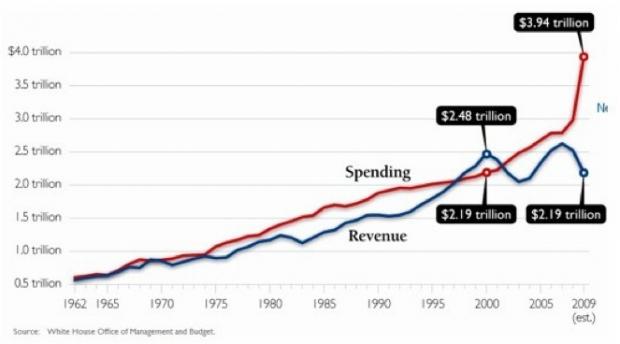
#93The US government is arguably going in the opposite direction of libertarianism.
http://theeconomiccollapseblog.com/wp-content/uploads/2010/0...
> would be to let those who can't capitalize on the bounty simply suffer.
I think most people don't want to let the poor "simply suffer". Libertarians simply argue it shouldn't be government's role to help the poor.
Re: Are jobs obsolete?
#94http://en.wikipedia.org/wiki/The_End_of_Work The End of Work: The Decline of the Global Labor Force and the Dawn of the Post-Market Era is a non-fiction book by American economist Jeremy Rifkin, published in 1995 by Putnam Publishing Group.[1] In 1995, Rifkin contended that worldwide unemployment would increase as information technology eliminates tens of millions of jobs in the manufacturing, agricultural and servic…
Peak Labor. Anyone that's ever argued this in the past 200 years has been called a luddite. Yet, in the past 40 years as computers have automated more work, both labor and white collar, it's become clear that the productivity gains are only making it into the pockets of the 20% or so that own investments.
It seems we have passed the tipping point for unskilled/blue collar and a good portion of white-collar labor. The future doesn't need the bottom 90% at all.
Re: Are jobs obsolete?
#95Earlier quoted context omitted.
I've never understood taxing of income, except that for the point of a taxing bureau it's a very convenient spot to impose taxes. Namely, taxing reduces whatever that is taxed. Taxing work makes work less desirable, and sometimes not worth to be done at all. Taxes should target things that are unnecessary or harming. Thus, income shouldn't be taxed at all. Conversely, consumption should be taxed with a VAT roughly eq…
we are taxed at consumption as well, I'm assuming you mean you want even higher sales tax than we currently have but no income tax? I have felt that the current sales tax of up to 10% in some places is already fairly high as is
Re: Are jobs obsolete?
#96Earlier quoted context omitted.
It's not so impossible to believe. The objection I often hear (and I recall that this is PG's stance as well) is that as old jobs disappear new ones will take their place. For example, as the article mentioned, the former toll booth operator could now repair the automated toll booth system. So far this general idea has been true. Before computers existed as we know them, "computers" were people who did lengthy comput…
> For example, as the article mentioned, the former toll booth operator could now repair the automated toll booth system. If the toll collector had the skills, or the ability or inclination to acquire the skills to do something like fixing automated toll booth systems, they probably wouldn't have taken a job as a toll collector.
Just like those self-scanner checkouts at the supermarket, where you've got one guy supervising five or ten checkouts, where previously he would have had five or ten colleagues working.
Re: Are jobs obsolete?
#97Earlier quoted context omitted.
I am using computers as an example of how productivity gains benefit everyone. I was replying to the claim that productivity gains only enrich the investors, which is patently false. I was not talking about jobs at all. My point is that the whole planet (as a whole) is getting richer, whether you realize it or not.
PCs dropping from $10000 to $300 are not representative of almost anything about the last 30 years. Holding up PC prices or CPU speeds as an example of general economics is particularly contrived.
What is an example of an industry where gains to productivity don't benefit everyone? Gains to productivity in farming enable the price of food to drop. Gains to productivity in housing enable the price of housing to drop. How does it only benefit the rich?
Even if the price does not drop directly as a first-order effect (such as if the company whose productivity is boosted keeps the difference as a profit), it will eventually through market pressure; a new price equilibrium will be established. In perfectly competitive market (such as food) a competitor will use the productivity boost to lower costs and undercut the first. The resulting competition will lower the market place. Productivity gains lower prices (real prices), benefiting everyone.
Re: Are jobs obsolete?
#98Charlie Stross brought this idea up on his blog recently; what does a post work-for-pay world look like? What would you do if you had a home, food, and health care as a basic right? Could we even get there with our current basic cultural value being that if you don't work, you have no value?
I think the major problems are:
- People like nicer food/nicer homes. Some (most?) of this is social signalling, some not. Some of the signalling issues could perhaps be addressed by raising the level of the basic provision, I'm unsure. (Basically, there will always be scarcity of some things and they can be used for signalling).
- Advanced human interaction/daily interest. For many/most people, working from home is in some ways less satisfying than working in an office environment (it may be better in other ways). I mean lack of social interaction in etc. Similarly full time mothers/fathers bemoan the lack of grown up contact/use of their higher mental faculties etc.
Lots of the issues are fixable with culture changes, but I suspect we'd need to be closer to full abundance before we could make much progress there.
Re: Are jobs obsolete?
#99Charlie Stross brought this idea up on his blog recently; what does a post work-for-pay world look like? What would you do if you had a home, food, and health care as a basic right? Could we even get there with our current basic cultural value being that if you don't work, you have no value?
Re: Are jobs obsolete?
#100"Jobs, as such, are a relatively new concept. People may have always worked, but until the advent of the corporation in the early Renaissance, most people just worked for themselves." I feel kinda stupid for saying this but I always thought people stopped producing their own "stuff" when we really got the hang of money. In other words, thanks to money, I can do one thing all day (and maybe get really good at it!) ins…