Gnu/Hurd strikes back: How to use the legendary OS in a (somewhat) practical way
1–10 of 273 posts
Re: Gnu/Hurd strikes back: How to use the legendary OS in a (somewhat) practical way
#2https://miro.medium.com/v2/resize:fit:4800/format:webp/1*HuH...
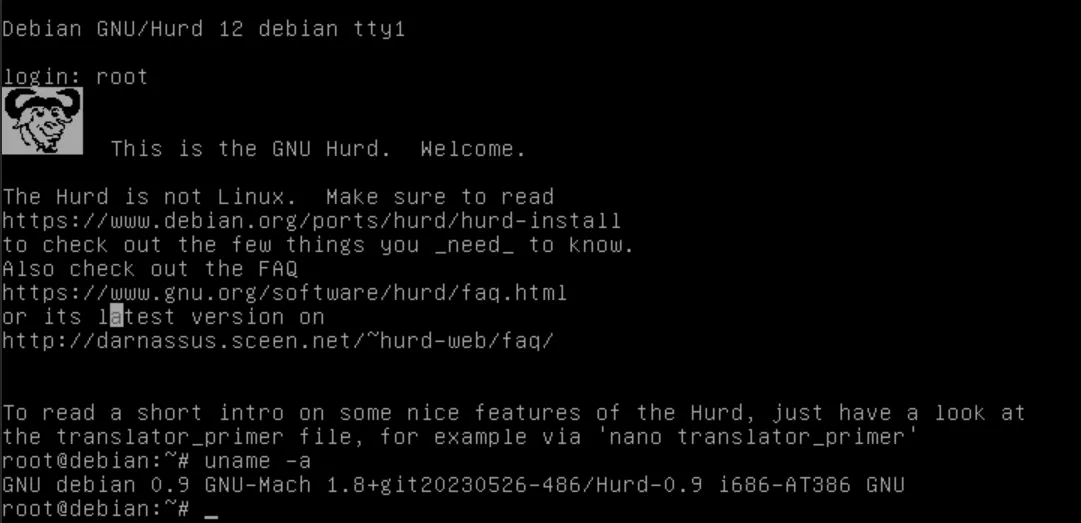
The GNU/Hurd default terminal can display a JPEG inside the terminal?
Re: Gnu/Hurd strikes back: How to use the legendary OS in a (somewhat) practical way
#3Kind of weird to see linux called out as too big, and then the ack that writing a ton of device drivers is hard and will take time. Isn't that a large part of the source tree? Realizing I haven't even tried compiling a kernel in a long long time. Feels oddly sad to say.
Re: Gnu/Hurd strikes back: How to use the legendary OS in a (somewhat) practical way
#4https://miro.medium.com/v2/resize:fit:4800/format:webp/1*HuH... The GNU/Hurd default terminal can display a JPEG inside the terminal?
Also in that same screenshot, hurd used to drop you into a shell as the nobody user where you could run the login binary... Curious if that was changed as part of debian, or changed for some other reason.
Re: Gnu/Hurd strikes back: How to use the legendary OS in a (somewhat) practical way
#5https://miro.medium.com/v2/resize:fit:4800/format:webp/1*HuH... The GNU/Hurd default terminal can display a JPEG inside the terminal?
Same with Linux:
https://en.wikipedia.org/wiki/Linux_framebuffer
XTerm can as well, if built with Sixel support:
Re: Gnu/Hurd strikes back: How to use the legendary OS in a (somewhat) practical way
#6Is it really alive? No SMP, no stable x64 port. No ARM port.
Re: Gnu/Hurd strikes back: How to use the legendary OS in a (somewhat) practical way
#7Kind of weird to see linux called out as too big, and then the ack that writing a ton of device drivers is hard and will take time. Isn't that a large part of the source tree? Realizing I haven't even tried compiling a kernel in a long long time. Feels oddly sad to say.
Hurd is a microkernel so it is lean by design. I suspect that statement was a dig on perceived architectural flaw of Linux.
Re: Gnu/Hurd strikes back: How to use the legendary OS in a (somewhat) practical way
#8Kind of weird to see linux called out as too big, and then the ack that writing a ton of device drivers is hard and will take time. Isn't that a large part of the source tree? Realizing I haven't even tried compiling a kernel in a long long time. Feels oddly sad to say.
I agree, it's odd.
I don't have anything recent, but back in 2004, the majority of the Linux kernel code was in its drivers: https://dwheeler.com/essays/linux-kernel-cost.html I expect that most of the current Linux kernel code is also for handling hardware (that is, drivers + the code to handle various architectures).
Re: Gnu/Hurd strikes back: How to use the legendary OS in a (somewhat) practical way
#9Kind of weird to see linux called out as too big, and then the ack that writing a ton of device drivers is hard and will take time. Isn't that a large part of the source tree? Realizing I haven't even tried compiling a kernel in a long long time. Feels oddly sad to say.
Hurd is a microkernel so it is lean by design. I suspect that statement was a dig on perceived architectural flaw of Linux.
I get that. But it is still an unfair dig when a large chunk of the code that is being pointed at is the code that they will have to write? (Granted, they can put an easier line in the sand on how far back they go on what they support hardware wise, but still...)
Re: Gnu/Hurd strikes back: How to use the legendary OS in a (somewhat) practical way
#10Is it really alive? No SMP, no stable x64 port. No ARM port.
Kinda wonder if the best approach for them at this point would be to target RISC-V and worry only really about running in a hypervisor, or very narrowly targeted open hardware, instead of futzing with implementing a pile of device drivers. Make it useful in that environment, and then go from there.
Hell, wouldn't it be cool if there was an official GNU GPL'd RISC-V board, running GNU Hurd?