Earlier quoted context omitted.
Wow, thank you. I’d always thought this a Pratchett things. I see it has a history in India and China too. https://en.m.wikipedia.org/wiki/World_Turtle
How could at least two cultures without a communication line between them both come up with such a quirky idea? There must be some underlying truth to it.. I'm sold. World turtle is the answer.
Edge detection doesn’t explain line drawing
81–90 of 174 posts
Re: Edge detection doesn’t explain line drawing
#82Earlier quoted context omitted.
Reasoning by analogy is one of the ways we solve the framing problem. So, when explaining the universe we imagine it's an act of will by a conscious entity (ie., like how we invent). When explaining the mind we suppose it's like one of our inventions. Absent an analogy of some kind it's quite hard to determine what features are salient. Objects have an essentially infinite number of properties.
> So, when explaining the universe we imagine it's an act of will by a conscious entity Unless I’m misunderstand you, that line of reasoning assumes one is religious.
Re: Edge detection doesn’t explain line drawing
#83Earlier quoted context omitted.
ah, someone who paid attention in lecture! (incidentally; there’s a fairly deep literature of historians of science that have carefully documented that we describe ourselves as analogous to the most sophisticated technology of the day: see “to lose one’s temper”, “to blow a gasket”, “i got my wires crossed”, “sorry, cache miss”, … as metaphors and idioms of mental state through the centuries that reflect the cool tec…
> to lose one’s temper Huh, never thought about that one before. Linguistic stuff like this is fun to find; these days I mostly spot it via learning German as a second language, so the artifice in artificial intelligence becomes “Künstliches Intelligenz” where “Kunst” is artist and “Kunststoff” is plastic, and in Middle Low German “kunst” is knowledge and ability. > coined Deliberate choice to exemplify your point, o…
Re: Edge detection doesn’t explain line drawing
#84An easy experiment to reproduce.
Re: Edge detection doesn’t explain line drawing
#851) edges are the only important features in images and 2) line drawings can only represent edges.
Who are these brainless absolutists that he is attacking?
Then he's acting like he is the only one with other bright ideas that nobody will listen to.
I think it is obvious to anyone who thinks about this that:
1) edges are a useful feature for recognizing objects in images but not the only useful feature 2) lines in line drawings can and often do represent edges, but there are a lot of other things they can represent. Light and shading and texture of various kinds.
It would be fine to write an article that goes in to depth on the different nuances, but it is annoying that this author pretends that most other experts have naive and simplistic views, with "uncritical certainty", and "no one seems to question it", and the author "has a hard time convincing them otherwise". It is a very condescending tone that comes off sounding like the author is presenting themselves as some brilliant but misunderstood outcast, and the only one who can see the light of truth.
we could do without the drama!
Re: Edge detection doesn’t explain line drawing
#86Ten years or so ago I was working on a video chip that had an upscaler feature. While prototyping and simulating it, we first started by applying a mathematically-correct (i.e. information preserving) FIR filter to do the upscale. Then we compared the result with other solutions and found that ours looked worse. We asked our colleagues to blind-test it and they all picked third-party-scaled images over ours. At first…
The difference between the data in the image, and the information? If for instance you upscaled text so large that it became blurry and unrecognizable, you lost information. Our cortext is all about interpreting what we see. Almost before our brain proper has the data, nerves have begun extracting information (edges etc). Probably because it was the difference between hitting and missing the animal with the spear. Or…
For instance when we want to subjectively make images more attractive we tend increase contrast and sharpness, whereas for sound we tend to compress it, effectively reducing "audio contrast".
Re: Edge detection doesn’t explain line drawing
#87Earlier quoted context omitted.
> turtles all the way down was literal Was it? What evidence do you have for that? If anything it sounds like the kind of verbal slapdown someone in authority would subject someone trying to be a smart alec. It is short. Easy to understand. And closes the kind of questioning. I would be very surprised if someone have considered it the literal truth, but of course have seen stranger things. > heavenly clockwork and co…
I believe the universe we live right now is no different than a simulation. Subtle difference in belief but I think it might have a big implication.
But it’s even worse than it sounds at first, because you need to spend energy not just on calculating the interactions which is super linear with the number of objects, you must also spend the energy to make it possible for the objects to interact in the first place.
Re: Edge detection doesn’t explain line drawing
#88Re: Edge detection doesn’t explain line drawing
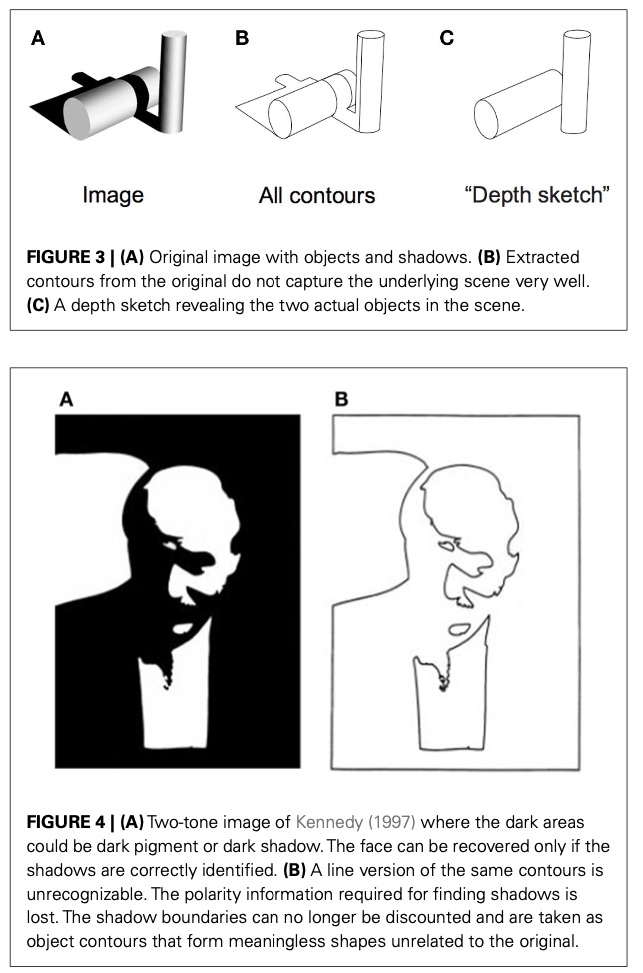
#89What A has that B lacks is shapes. There is obviously a rotund shape of the face that is reconstructed by the brain, that one can almost see, although technically it's not actually present in A. Not present, yet visible. Same for the eyes, smile, cheekbones.
It must trigger some kind of pattern-matching in the brain.
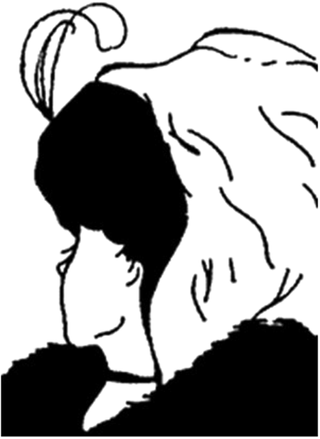
This problem seems to be similar to the famous optical illusion of the old woman / young woman [2] that works well also in strict black and white.
In this optical illusion there is surprisingly little information on the image, yet it can trigger two very different representations (that one can see alternatively, but never at the same time).
I think the brain tries to fit the shapes it sees in one box or another, and when it finds a box it builds a whole concept around it.
I also think that boxes have to pre-exist or be learned: they can't be inferred from an image, if one has never encountered the original representation in the wild.
One evidence for this is children are completely blind to optical illusions that have one "innocent" representation and one involving some kind of nudity or sexual activity, while adults tend to see the NSFW version first.
And so, to come back at the original question of why line drawing works, I think it's because it triggers concepts. The word "square" or "circle" are unambiguous and designate precise geometric shapes (provided one has learned the relevant concepts of square and circle).
Same with shapes, except that there are an infinite amount of different shapes that we can "discuss" using the language of line drawings.
[1] https://aaronhertzmann.com/images/howtodraw/sayim.jpg
[2] https://cdn.mos.cms.futurecdn.net/rQkQZ6pDZbEHz23rxckWPm-320...
Re: Edge detection doesn’t explain line drawing
#90Ten years or so ago I was working on a video chip that had an upscaler feature. While prototyping and simulating it, we first started by applying a mathematically-correct (i.e. information preserving) FIR filter to do the upscale. Then we compared the result with other solutions and found that ours looked worse. We asked our colleagues to blind-test it and they all picked third-party-scaled images over ours. At first…
Surely if you're upscaling pixel art you're loosing information when you create gradients between pixels. It doesn't seem to me that your metric of information loss was ideal.
But of course you're correct that in this case it may be the desirable outcome. I still think that this idea of creating information using algorithms in order to get a subjectively more pleasant result is really one of the biggest issues of our time. Not a day passes where I don't see AI-colorized pictures, AI-extrapolated video footage, AI-cleaned family portraits, AI-improved smartphone footage etc...
It's both amazing and a bit scary, because in a certain way we rewrite history when we do this, and since the information is not present in the original it's very difficult to ascertain how close we truly are to reality. We're creating a parallel reality, one Instagram filter at a time. Maybe that's the true metaverse.