Live data from Hacker News

First new US nuclear reactor in decades enters commercial operation in Georgia

apnews.com

201–210 of 361 posts

Re: First new US nuclear reactor in decades enters commercial operation in Georgia

#201
post #174

Earlier quoted context omitted.

The US Navy seems to be able to do it

The navy uses nuclear reactors for tactical reasons, not economic reasons. Nuclear-powered ships are significantly more expensive.

The US Navy builds many reactors for the price of this power plant.

A Virginia class submarine in 2023 costs $4.3 billion (that's for the whole submarine), it has a 210MW S9G reactor.

The Vogtle Unit 3 was $17 billion over budget, for a $30 billion total budget, for 1,100 MW.

$204MM / MW for the US Navy vs $273MM / MW for Georgia Power et. al.

This project makes nuclear submarines look like a bargain!

Sources:

* https://en.wikipedia.org/wiki/Virginia-class_submarine

* https://apnews.com/article/georgia-power-co-southern-climate...
Re: First new US nuclear reactor in decades enters commercial operation in Georgia

#202

Earlier quoted context omitted.

Incorrect, demand peaks right as night starts and the sun goes down. See that peak [1] at 9pm? Battery backed solar is not even remotely feasible. To put this in perspective, the USA alone uses ~11.5 TWh of electricty each day. A battery to last through the night is over 5,000 GWh. 1. https://b698061.smushcdn.com/698061/wp-content/uploads/2023/...

That's 'net load', so the graph doesn't show rooftop or grid solar or wind's contribution. You can see the difference here for today (choose a previous day if it's near the start of the day in California): https://www.caiso.com/TodaysOutlook/Pages/default.aspx#secti... The non-grid PV and wind peak is lowered, and shifted a couple of hours later. And that graph still doesn't show consumer and behind the meter commerc…

The peak still occurs in the evening around 8-9pm. The chart I linked shows a drop in net demand around midday, due to solar's contribution. But my point is the mismatch between peak electricity demand and solar production, which is the same regardless.

Re: First new US nuclear reactor in decades enters commercial operation in Georgia

#203
post #174

Earlier quoted context omitted.

The navy uses nuclear reactors for tactical reasons, not economic reasons. Nuclear-powered ships are significantly more expensive.

The US Navy builds many reactors for the price of this power plant. A Virginia class submarine in 2023 costs $4.3 billion (that's for the whole submarine), it has a 210MW S9G reactor. The Vogtle Unit 3 was $17 billion over budget, for a $30 billion total budget, for 1,100 MW. $204MM / MW for the US Navy vs $273MM / MW for Georgia Power et. al. This project makes nuclear submarines look like a bargain! Sources: * http…

Following the references from the Wikipedia article, I found that the S9G reactor is rated for 210 megawatts of thermal output. The AP1000 reactor that this article is about has a 3415 megawatt thermal output:

https://www.westinghousenuclear.com/energy-systems/ap1000-pw...

The naval reactor is more expensive per unit of output.

Re: First new US nuclear reactor in decades enters commercial operation in Georgia

#204

Earlier quoted context omitted.

If the NRC is the problem, then why do we see identical cost overruns and schedule delays for France, Finland, and the UK? I don't think we can blame the NRC for this. There's something deeper.

Similar regulatory regimes started by the same groups of people, which work in similar ways? AKA think of every possible thing that could go wrong and mandates designs with have engineering margins far in excess of what the a reasonable analysis of the risks/etc would call for. We could do similar things to renewables by simply mandating that they have carbon free backup sources sufficient to guarantee four of five n…

So you think this is a realistic possibility for France, a nation that loves nuclear?

Have any evidence of these regulations? What regulations can we change?

I've looked and looked and never found somebody saying "these regulations are unnecessary" but it's trivial to find examples of management not taking the regulations seriously and then paying for it when they cut corners (basically all the welding for the AP1000s in Georgia and South Carolina).

It's also easy to find management errors that ballon costs and cause massive delays.

I'm completely unconvinced that we can pin this on the NRC.

Re: First new US nuclear reactor in decades enters commercial operation in Georgia

#205
post #141

Earlier quoted context omitted.

People are naturally allowed to invest in what ever technology they think will fit the role best, such as green hydrogen. No one is investing in that, there exist no hydrogen-burning turbines that burn green hydrogen, but someone could become the first and do that. Producers of green hydrogen are currently more interested in delivering green steel, which pays much better than hydrogen-burning turbines. The general id…

The ACES project for green hydrogen and electricity production is currently under construction in Utah: https://www.deseret.com/2022/5/9/23046910/green-hydrogen-ene... The project will take that excess solar and wind capacity and through a process called alkaline electrolysis it will separate oxygen and hydrogen from water through 220 megawatt electrolyzers, producing up to 110 tons of hydrogen a day. It is called gr…

And note that these storage caverns are only a small fraction of the potential of that salt formation.

Re: First new US nuclear reactor in decades enters commercial operation in Georgia

#206
post #21

One project in 30 years doesn't benefit from economies of scale. Nuclear is the only hope we have to make up for the gaps in generation for solar and wind. Solar and Wind should be used whenever possible, but they are not 100% of our solution mix, even if they are the majority. If we want to mitigate the impact of climate change, we need to invest in decreasing Nuclear costs and building many more plants in the US.

Large infrastructure projects (and nuclear is certainly one) don't benefit from economies of scale. Half of a nuclear power plant is essentially the same as a coal plant and they have not gone down in price either. The reality is even assuming that we can not overcome shortages in solar and wind by overprovisioning and storage (and studies say otherwise), it does not make any sense to build nuclear instead of solar/w…

If half is the same as a coal plant could existing coal plants be converted to nuclear? They would be in the right places for power generation and it would be a win by reducing coal and not having to build a whole new plant.

Re: First new US nuclear reactor in decades enters commercial operation in Georgia

#207
post #149
post #73

Earlier quoted context omitted.

The NRC was established just about when the first nuclear buildout collapsed under the weight of its own foolishness. Massive cost overruns did nuclear no favors whatsoever, clearly inadequate safety (especially on those first generation BWRs; hello Fukushima), and (most devastatingly) the deregulation of the US electricity grid, with PURPA (in 1978) and later steps opening grids to non-utility providers. Nuclear pro…

Fukushima shows that even early nuclear reactors are incredibly safe. You take an aging plant based on an outdated design, construct it in an unsafe location, then hit it with the fifth-largest earthquake ever recorded, then hit it with a 20 foot high tsunami, and then it explodes ... and what were the casualties? One worker and maybe 50 early deaths due to cancers. A typical coal power plant kills more people every…

Maybe, but i think the argument in this thread seems to be that NRC creation basically killed the whole industry. Which is complicated, because you still want safety improvements over Fukushima, but not at the cost of basically halting any new development for decades if not ever.

Re: First new US nuclear reactor in decades enters commercial operation in Georgia

#208
post #157
post #7

Earlier quoted context omitted.

That's a major oversimplification. The reason the US is mostly (entirely) running Gen 2 reactors is because we simply lost interest in building new reactors for a long time. There were regulatory hurdles that caused this, but there were tons and tons of other factors that were (IMO) more important. Especially economic factors related to the cost and mismanagement of large nuclear projects, public opinions shifting ov…

Are costs and mismanagement directly related to regulations? Genuine question. This is impression I get from nuclear advocates like Mark Nelson and doomberg.

Yeah that's the complicated part. The regs are responsible for some of the mess, but far from all. It's a complicated subject, probably too much to get into here but you can look at the history of Vogtle as a start. Blaming the NRC is justified at parts, but it really only tells part of the story.

Re: First new US nuclear reactor in decades enters commercial operation in Georgia

#209

Earlier quoted context omitted.

That's 'net load', so the graph doesn't show rooftop or grid solar or wind's contribution. You can see the difference here for today (choose a previous day if it's near the start of the day in California): https://www.caiso.com/TodaysOutlook/Pages/default.aspx#secti... The non-grid PV and wind peak is lowered, and shifted a couple of hours later. And that graph still doesn't show consumer and behind the meter commerc…

The peak still occurs in the evening around 8-9pm. The chart I linked shows a drop in net demand around midday, due to solar's contribution. But my point is the mismatch between peak electricity demand and solar production, which is the same regardless.

That's all from the grids perspective, they only count their own solar and wind.

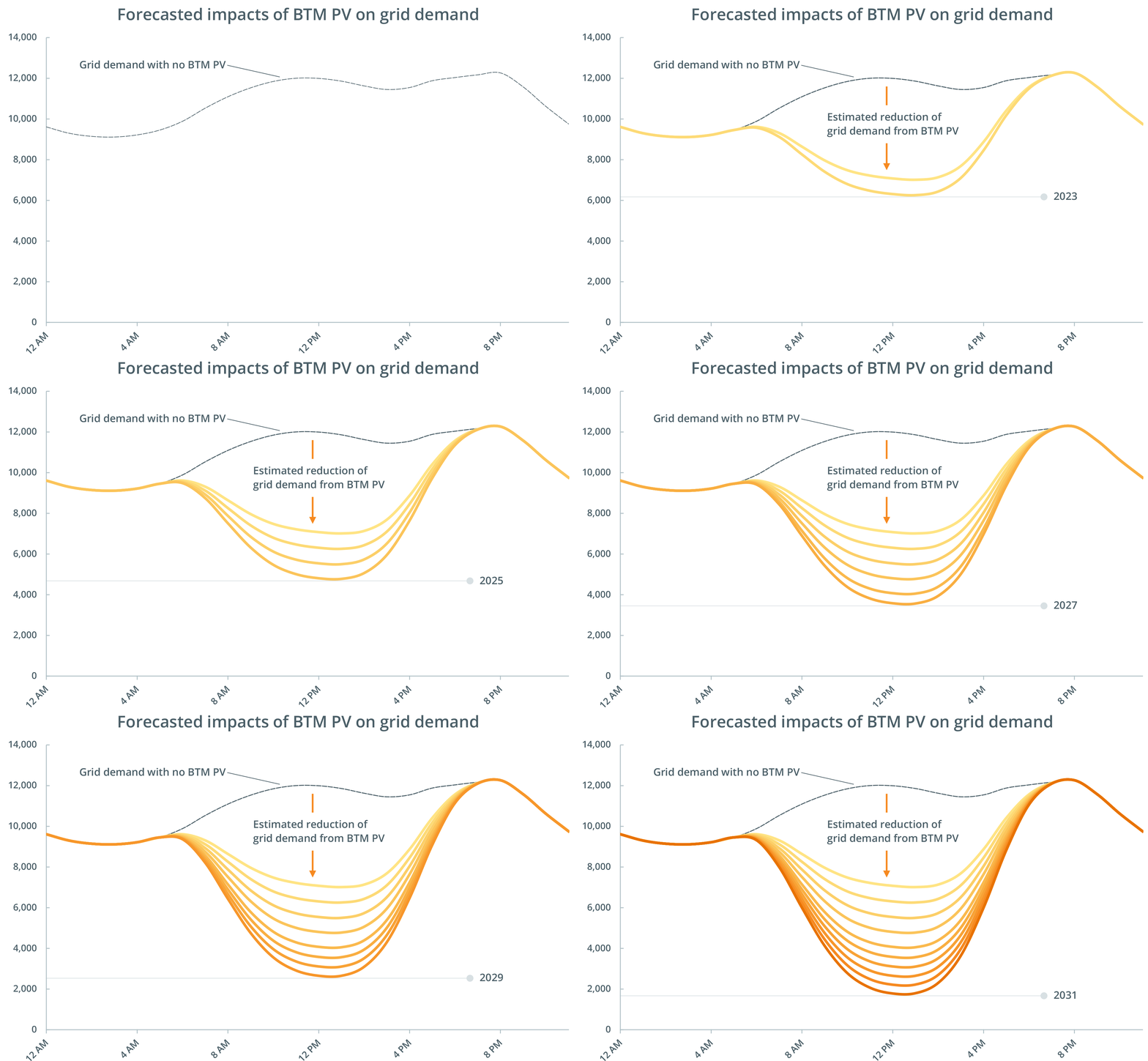
Here's an animated diagram that explicitly calls out BTM (behind-the-meter) solar:

https://isonewswire.com/wp-content/uploads/2023/02/btm_forec...

Re: First new US nuclear reactor in decades enters commercial operation in Georgia

#210

Earlier quoted context omitted.

Coal contains no significant radioactive carbon. All the radioisotopes of carbon have half life many orders of magnitude smaller than the age of coal deposits. Coal contains other radioactive elements, though. However, the quantity of these is still usually less than the quantity that needs to be mined to power a light water reactor.

Yes but the nuclear fuel is carefully contained during and after use. Not so much for coal.

The decay products of uranium are not well contained at uranium mines. They are in massive tailing piles, just as the radioactive elements in coal end up in ash.

Less gets said about these mine-related radioactive elements because they are typically in other countries, often countries where the people have darker skins.

Post reply on HN