Live data from Hacker News

If we want a shift to walking we need to prioritize dignity

streets.mn

551–560 of 713 posts

Re: If we want a shift to walking we need to prioritize dignity

#551
post #545

Earlier quoted context omitted.

[flagged]

From my comment: "Now, you could argue that global warming is bad / enough freeways cannot be built / etc., sure. Maybe we cannot have nice things. But don't argue that people want to live in urban paradise and some contrived system is simply not giving them what they want. " I just don't like the hypocrisy. However, it's the comments like this that make me think that for any equivalent level of far-, left is worse t…

I'm sorry this person was rude to you, but I think you're extrapolating far too much. People on the right have their own infuriating comments they make, I would hazard a guess you may not notice them because they aren't directed at you.

One I've had tossed at me during a discussion is, "if you aren't a socialist when you're 20, you have no heart, but if your still a socialist when you're 50, you have no head." This isn't "holier than thou" per say, but it serves the same rhetorical role, it's smug nonsense from someone thinking that they just know so much better than you that time's steady march will make their argument for them (and so they don't have to address what you've said or treat you ).

Frankly, I also see people using the same tropes as in your comment mischaracterize substantive points as being whining or moralizing.

I would say the problem is that as a society, we don't understand how to conduct a productive discourse. I'm pretty sure we never have and have just been muddling through for millenia.

Believe me, I'd love it if being left wing meant the people I disagreed with online weren't frequently rude or vindictive, but I'm afraid I share your experience.
Re: If we want a shift to walking we need to prioritize dignity

#552
post #502

Earlier quoted context omitted.

It's a tradeoff - the argument is about car vs walking infrastructure, and while it's nice to have both I'd prefer to lose the latter if I had to make a choice. Driving in Amsterdam is... inconvenient. At least in central areas, I've never been far out. They have handles, it's still just inconvenient to carry and makes a nice walk into a chore, vs driving with much more groceries per trip.

Problem is, current level of car usage is absolutely unsustainable with current co2 emissions targets, even with electric cars if they use coal.

What about electric cars with nuclear power or renewables? In any case the argument is not about that. It's one thing to say "we cannot sustain the CO2 emissions / we cannot build enough highways for everyone so sorry, we cannot have some of the nice things anymore", but that's not what the above says.

It is also ok to express an opinion that car-free living is better for some people, or argue that most people prefer it, although I think that is self-evidently incorrect, cause as per IMF data I linked somewhere here, one of the first things people all over the world do when they get any richer (like, $2.5k-10k per capita income) is buy a lot of cars.

But the above is saying it's OBJECTIVELY better. Other than just being wrong, that betrays the kind of "I know exactly how everyone should live their lives, and I would make them if I could" attitude that I hate.

Re: If we want a shift to walking we need to prioritize dignity

#553

Earlier quoted context omitted.

How is increase of drunk driving suicides a bad thing? I hate this argument. Let's cut the trees because certain people just can't help themselves. Infuriating for all sorts of reasons

Cmon brah, people committing suicide isn't good

When the choices are:

1. Save drunk drivers but kill trees

2. Save drunk drivers but kill innocents

3. Let the drunk driver die before they kill anything/anyone else

I will always pick 3. I don't understand where the sympathy for this reckless behaviour comes from

Re: If we want a shift to walking we need to prioritize dignity

#554
post #548

Earlier quoted context omitted.

I fail to see how this accounts for difference in car vs bike infrastructure.

Countries at "income of about 2,500 per capita" are not exactly known for their car infrastructure. Moreover, by necessity with low car ownership they cannot have car-centric cities - most people don't have cars. I mean have you been to Hanoi or Belize City, or some place similar? Yet, despite crappy roads, short distances and chaotic traffic (and good climate, in many cases), people get cars as soon as they can affo…

Those places are freaking deathtraps. It's basically what the article is talking about! Those cities are _extremely_ anti-pedestrian. They may not be car-centric, but they are definitely moped centric.

There are usually no sidewalks, or the sidewalks are full of parked mopeds or you'll be walking along and the sidewalk will just end abruptly.

You are usually forced to walk along the road. Nobody will stop when you're crossing the road, they just weave.

A quick Google search shows that Vietnam has 29.81 per 100,000 of population deaths from traffic accidents.

These places are awful examples of safe bike/pedestrian cites. Of course people prefer cars there, it's much safer!

Re: If we want a shift to walking we need to prioritize dignity

#555

Earlier quoted context omitted.

> my chance of getting killed in a traffic accident are so astronomically low Are they really? You have a higher chance of being killed by a car while you are inside a building, than you are of being killed by a cyclist.

Yes, they are. A city of 8 million had ~200 fatalities last year. Also, I'm not concerned about getting killed by a cyclist. I'm concerned about getting hit by one. Those are not the same thing.

NYC averages less than 1 pedestrian killed by bikes every year.

https://www.nyc.gov/html/dot/downloads/pdf/nycdot-pedestrian...

There are ~300 pedestrian injuries caused by bikes every year vs 10,000 caused by cars.

https://www.nytimes.com/2018/11/27/nyregion/elderly-pedestri...

Your feelings about bikes are in direct contradiction with the data.

Re: If we want a shift to walking we need to prioritize dignity

#556

Earlier quoted context omitted.

> Even a lot of the anti-cycling stance comes down to, “What am I, poor?” When you are using transportation infrastructure that’s designed with contempt for you, you know, and you don’t want to be there. I grew up in close contact with a large urban poor population and I think the view of bikes was the exact opposite of this. Biking in the city is considered the purview of affluent white people

Thank you! OP's view is a naive outsider's view. Anyone who actually lives in the US knows you need to be rich enough to not be car dependent. https://grist.org/cities/black-chicago-biking-disparities-in... In reality, only rich (and white) folks can afford to live in areas that are not car-dependent. https://granfondodailynews.com/2020/01/17/is-north-american- ... > From 2001 to 2017 the number of people cycling inc…

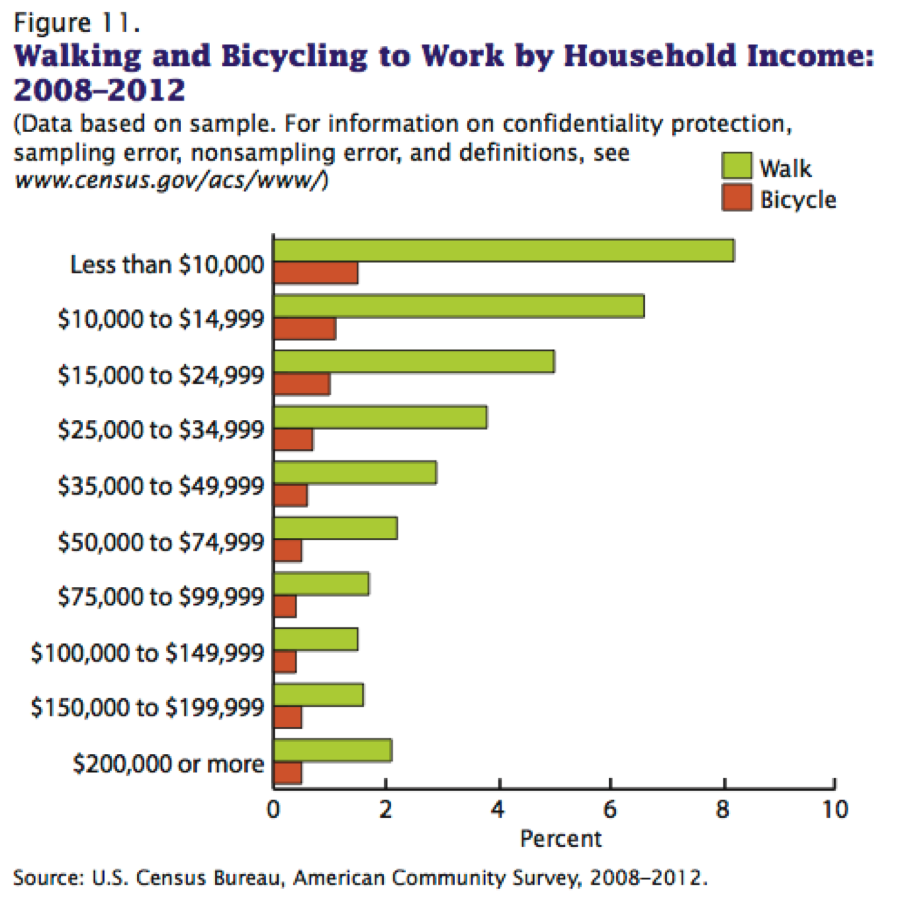
You are wrong. The poorest decile of people are the most likely to bike because they cannot afford a car.

https://lede-admin.usa.streetsblog.org/wp-content/uploads/si...

Re: If we want a shift to walking we need to prioritize dignity

#557
post #493

Earlier quoted context omitted.

I don't think this is very relevant. I would prefer to live in a 3x bigger house, but it would still be walkable. A reverse (also not very relevant) thought experiment - would you prefer to live in one room that is office/bedroom/bathroom/kitchen, just because you don't have to walk at all, everything is so close, why sprawl? :)

European and asian cities pretty much feel like a 10x - 20x bigger house for many. You walk down 2 blocks to get some milk and bread for the breakfast, post office is 3 blocks in the other direction, 1 block another way and you have fruits and vegetable. Basically you can treat the immediate surroundings as an extension of your house where you just "go" without a modal distinction of getting into a car, parking, back…

I dunno, I used to feel this friction (I didn't use to drive until I was ~30), how driving is a thing and not driving is frictionless, but I think it was just psychological. It feels reverse now - the only frictionless places for ~everyone are grocery stores and such, cause they are everywhere. And maybe things you consciously live next to, like if you decide to live next to an olympic pool facility or a nightclub. Transit has pretty high fixed cost of getting anywhere, even in transit friendly placed like Munich or Moscow.. everything takes at least 30-40 minutes given to/from and wait times, any time of day. And that's if you don't have any transfers. I used to take it for granted but now when I look up transit directions it just weird to think it used to take so long and I thought it was normal.

Whereas if you drive you can choose when to go and so make it convenient - like I go to a climbing gym at 6am in winter, no traffic and less people. Also, many things you don't even need to leave the house for - even with a relatively small house (1100sqft) I have room for a weight rack and home office, no need to go to a real office or to a gym.

Re: If we want a shift to walking we need to prioritize dignity

#558
post #404

This lens is underutilized in the discourse, but people feel it acutely. Even a lot of the anti-cycling stance comes down to, “What am I, poor?” When you are using transportation infrastructure that’s designed with contempt for you, you know, and you don’t want to be there. See also: rail slow zones, buses that shimmy and rattle violently on imperfect pavement, how Muni trains close their doors and pull one foot out…

The cause and effect might be reversed. 1) Most people prefer to drive... look at any country that is getting richer - people want to buy cars. 2) It is only when people cannot afford to drive or driving is too inconvenient (traffic, or narrow streets/lack of parking in Europe, or outright restrictions ), they will use alternative modes of transportation. 3) The more people are thus inconvenienced, the more public su…

> Most people prefer to drive

> It is only when people cannot afford to drive or driving is too inconvenient (traffic, or narrow streets/lack of parking in Europe, or outright restrictions ), they will use alternative modes of transportation.

This is literally a tautology. "People find driving more convenient, except when driving is less convenient".

> But don't argue that people want to live in urban paradise and some contrived system is simply not giving them what they want. Most people everywhere, when they can, want to drive and live in houses.

Price signals are real. The fact that millions of people choose to pay large amounts of money to live in big cities and not drive instead of moving out to the sticks is proof that it is an extremely desirable lifestyle for a large fraction of the population.

Re: If we want a shift to walking we need to prioritize dignity

#559
post #554
post #548

Earlier quoted context omitted.

Countries at "income of about 2,500 per capita" are not exactly known for their car infrastructure. Moreover, by necessity with low car ownership they cannot have car-centric cities - most people don't have cars. I mean have you been to Hanoi or Belize City, or some place similar? Yet, despite crappy roads, short distances and chaotic traffic (and good climate, in many cases), people get cars as soon as they can affo…

Those places are freaking deathtraps. It's basically what the article is talking about! Those cities are _extremely_ anti-pedestrian. They may not be car-centric, but they are definitely moped centric. There are usually no sidewalks, or the sidewalks are full of parked mopeds or you'll be walking along and the sidewalk will just end abruptly. You are usually forced to walk along the road. Nobody will stop when you're…

Well they don't have much car infrastructure either, and operating a car there is much less convenient than a moped or a bicycle, not to mention extremely expensive relative to income. Plus the car is not necessary by definition since most people don't have one. So it's not really massive spending on car infrastructure, or distances created by car-centric lifestyle that's driving the adoption. It really feels like moving the goalposts, these cities are more convenient for bikes and mopeds than cars by any standard (faster, much cheaper, easier to park etc.). I don't think safety is a primary driver either...

Or you can also just take middle-income cities, like Moscow. It wasn't built with many cars in mind, and there's severe lack of parking in particular. People used to have fistfights over public parking spots when I was a kid :) Yet, they still buy cars until traffic becomes completely unreasonable, it used to be that transit across the city (where I was going) tool ~1 hour, and my co-worker who drove a similar route would take 2 hours thru traffic, and he would still drive. Obviously so did all those other suckers stuck in traffic, that's how much they wanted to drive :)

Re: If we want a shift to walking we need to prioritize dignity

#560

This lens is underutilized in the discourse, but people feel it acutely. Even a lot of the anti-cycling stance comes down to, “What am I, poor?” When you are using transportation infrastructure that’s designed with contempt for you, you know, and you don’t want to be there. See also: rail slow zones, buses that shimmy and rattle violently on imperfect pavement, how Muni trains close their doors and pull one foot out…

> Even a lot of the anti-cycling stance comes down to, “What am I, poor?” When you are using transportation infrastructure that’s designed with contempt for you, you know, and you don’t want to be there. I grew up in close contact with a large urban poor population and I think the view of bikes was the exact opposite of this. Biking in the city is considered the purview of affluent white people

The lowest income group of people is the demographic most likely to bike.

https://lede-admin.usa.streetsblog.org/wp-content/uploads/si...

The chart of income vs percent who commute by bike is u-shaped but with a higher left side. Rich people bike more than middle class people but poor people bike more than either the rich or middle class. People who are on the right half of the distribution think biking is affluent-coded because they only see the right tail where it curves up and they don't know anyone on the left side of the distribution where the gradient goes the other way.

Post reply on HN