Live data from Hacker News

Rethinking Window Management

blogs.gnome.org

151–160 of 272 posts

Re: Rethinking Window Management

#151
I've converted to a tiling window manager person after using Amethyst on MacOS. It's buggy and crashes but I absolutely love using a tiling manager to handle the common scenarios of two windows side by side, or a primary window + multiple windows tiled on the second half.

Once you find a setup that works for you, this ends up being super easy to work with.

Re: Rethinking Window Management

#152
post #114

I'd love to chat with the gnome guys. They miss so much and I'm not sure why. 1) The WM must remember where my windows were and put them back when reopened. Never mind how X apps took on this responsibility, under Wayland the app should not know its context. It's also not right to put the burden on every app when it could be in the WM to provide consistency and unburden all the other devs. 2) I use a 55" screen where…

> Workspaces are for small screens with maximized windows, which don't really need other layout methods anyway. Strong disagree here. I use a 38" Ultrawide and I have 10 workspaces open at the moment. All of them dedicated to a single in-flight task. If a workspace is a desktop multiple workspaces is a workshop.

I have keybindings that go directly to the workspace that I am interested in. Fifteen years ago I dedicated 10 workspaces to fullscreen tasks I do daily and now I can go to my browser with a keybinding or to my code editor with another. I have been on workmates computers with tens to a hundred windows open and I am dumbfounded on how they get anything done.

A task should operate on one workspace and there should be keybindings to go directly to that task. Of course I am a pro power user and normies would be horrified at my workflow. Gnome devs try to consider everyone and sometimes miss the mark and make everyone unhappy. So I am going to volunteer to use their concept and provide feedback.

Re: Rethinking Window Management

#153

Earlier quoted context omitted.

Some people like beer, some people like wine, some people like sugary drinks. Why don't people just drink water?

I'm not saying that everyone should be like me. I am genuinely asking what the use cases are for something else.

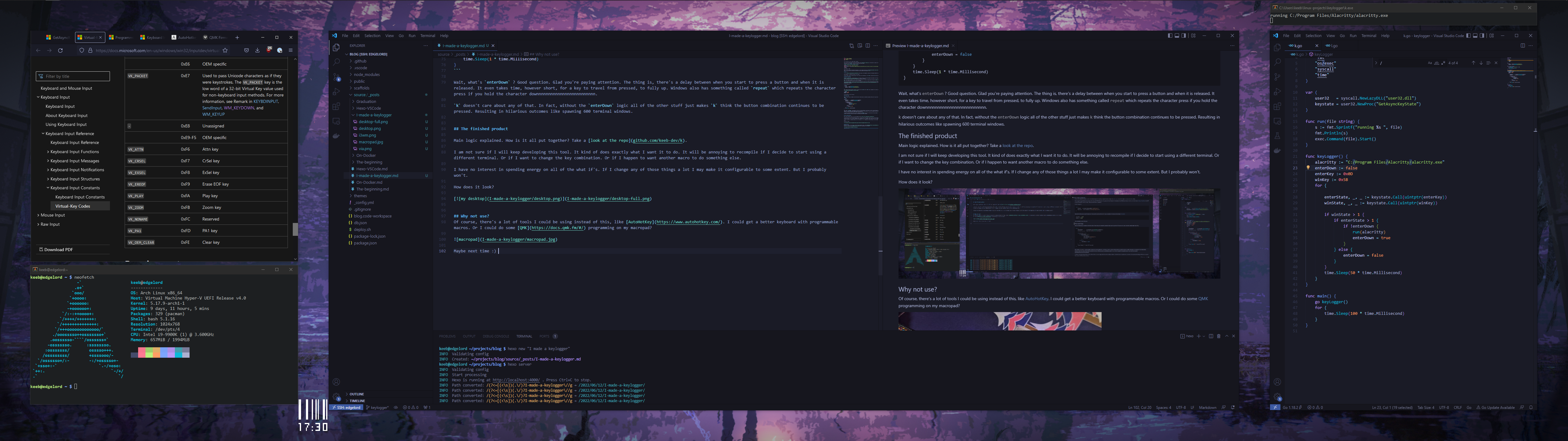
My screen is 4 and a half feet wide. I use Windows Power Toys on Win and a Tiling windows manager on Linux. Each app goes to their specific location. The center 1920x1080 is for the main focus and the rest is for peripheral/supporting apps.

Here's what my development desktop looks like[1]

1: https://keeb.dev/2022/06/12/I-made-a-keylogger/desktop-full....

Re: Rethinking Window Management

#155

Earlier quoted context omitted.

It does, true, but it feels like a dead end.

Maybe that's because it's finished. It doesn't need any more revolution, just maintenance and polishing.

And for caja to stop being so buggy.

Re: Rethinking Window Management

#156
The native Windows 11 windows management feature (called "snap layouts") was great for me. I get it instantly and use it easily with the pointer or the keyboard. One of the best features of the 11 version to me.

I think that for regular users is a great entry point to have a more power user experience, of course it will not be enough for everyone and a lot of power users will demand more specific behaviors.

Demo: https://youtu.be/t-hgwhYu0nU

Re: Rethinking Window Management

#157

People generally have pretty good spatial sensibilities, and I feel like modern OS designers seem to forget this. You feel this especially on iPadOS. Physically arranging windows allows for a much more solid multi-tasking experience, and encouraged direct manipulation of content e.g. drag and drop. Transient "palette" or "panel" windows allow for a short term buffer (think a find/replace panel). To me, this is what m…

> (If you've only ever got comfortable with a windows-style "maximised window" approach, you'll probably disagree with me, however). Windows-style? Microsoft's APIs and design paradigms are as floating-window focused as they are maximized-focused. And I don't think I've had a window open maximized since the XP days. Multiple document interfaces were a first class citizen for a decade and a half, so clearly they under…

Yeah. Also:

Windows 10 brought in some decent tiling/snapping, and windows 11 greatly expanded the tiling options for windows.

It’s not i3 or bspwm or anything, but Microsoft does at least seem to understand desire for the window manager to help you nicely place several windows in to nice places.

Re: Rethinking Window Management

#158

People generally have pretty good spatial sensibilities, and I feel like modern OS designers seem to forget this. You feel this especially on iPadOS. Physically arranging windows allows for a much more solid multi-tasking experience, and encouraged direct manipulation of content e.g. drag and drop. Transient "palette" or "panel" windows allow for a short term buffer (think a find/replace panel). To me, this is what m…

I would take issue with your first claim. People, in general, have very mixed spatial sensibilities. Is why it takes herculean efforts to keep dishes organized in a family. Some people have organizations they want. Some have different and incompatible organizations they want. Some people just don't care.

Seriously, look at the insane amount of effort that a grocery store has to go through to keep things organized. Keeping things spatially coherent is just not a thing that people do for things they don't care about.

To get even crazier, look at the vast differences in how different clothing stores spatially organize each other. Each is organized. Each is fairly incompatible with the others. Even department stores have a great deal of variability in the different departments.

So, any attempt at rethinking window management with the idea that you can find a superior form of management is so doomed to failure that it is kind of comical.
Re: Rethinking Window Management

#159

People generally have pretty good spatial sensibilities, and I feel like modern OS designers seem to forget this. You feel this especially on iPadOS. Physically arranging windows allows for a much more solid multi-tasking experience, and encouraged direct manipulation of content e.g. drag and drop. Transient "palette" or "panel" windows allow for a short term buffer (think a find/replace panel). To me, this is what m…

Conversely I regard modal dialogs as one of the worse sins a ui designer can commit. Sometimes necessary, but they should never willingly interfere with interactivity. This then sort of leads into the next point.

Overlapping windows. It lets you put more applications on the screen at once but it does not really do much for the user in terms of workflow. The window underneath is obscured so I can't really use it without fishing for it. When I am working I ether want to see a few windows at once(documentation|editor) (reference|photoshop) (chat|web) or I want to only see one application, I never go "Oh boy I am glad I can only see half this window". So tiling window managers are close to the end game for desktop productivity. It is a shame that windows/mac are so entrenched in mediocrity and make implementing them fiddly and awkward.

Re: Rethinking Window Management

#160

Earlier quoted context omitted.

If you have used GNOME 2 for an extended period of time and then moved to GNOME 3, I think you'd find the shorter list of what wasn't removed. The idea was a vast plugin ecosystem which would allow development of desktop features to be more distributed. The problem was, some of the most basic features (like a taskbar for displaying open windows, or panels, or applets, or sane window management tools) were left out. A…

For more context Linux Torvalds moved back to GNOME in 2013, a year after that article was posted. From https://www.phoronix.com/news/MTMxNj : > He says that GNOME 3.x has been improving and that when pairing the desktop with the right extensions, it's a rather pleasant desktop. He specifically points out Frippery and GNOME Tweak Tool as making a huge difference to his experience.

I stayed for a long time on Gnome Flashback, the Gnome 2 look alike. I moved to Gnome 3 when I was sure that there were enough extensions to recreate a sane Gnome 2 desktop. Did they waste all their work? Mostly. Did they waste the time of the people that had to undo their work? Definitely.
Post reply on HN