This article is against multithreaded executors by default and that synchronous code is easier to read and more practical than async code. I completely understand this.
My hobby and main interest is multithreading, async, coroutines, parallelism so I love articles like this so thank you.
I am trying to design a solution that lets us have our cake and eat it to. I want multithreaded coroutines or multithreaded async executors by default. I am trying to design a server and runtime that is largely parallel, concurrent, efficient, easy to understand, easy to reason about, async and easy to read and maintain. I want:
* Tokio is not bad but I think a codebase that uses async rust requires a high level of skill, cognitive load and understanding. It's not straightforward!
* synchronous straight-line flow code is the easiest to read and follow
* promises and callbacks aren't easy to read or follow control flow
* making a single threaded program parallel after writing it is almost a complete rewrite
* work stealing thread pools solve the starvation problem, so they're good!
* IO shouldn't block CPU and CPU shouldn't block IO
* I am trying to design a syntax that is data orientated that means programs can be parallelised after writing them, so parallelisation comes for free
* we can use the LMAX Disruptor pattern for efficient cross-thread communication. I use a lockfree multiconsumer multiproducer ringbuffer in my programs.
I have an epoll-server which multiplexes clients/sockets over threads, this is more efficient than a thread-per-socket/client. I need to change it into a websocket server.
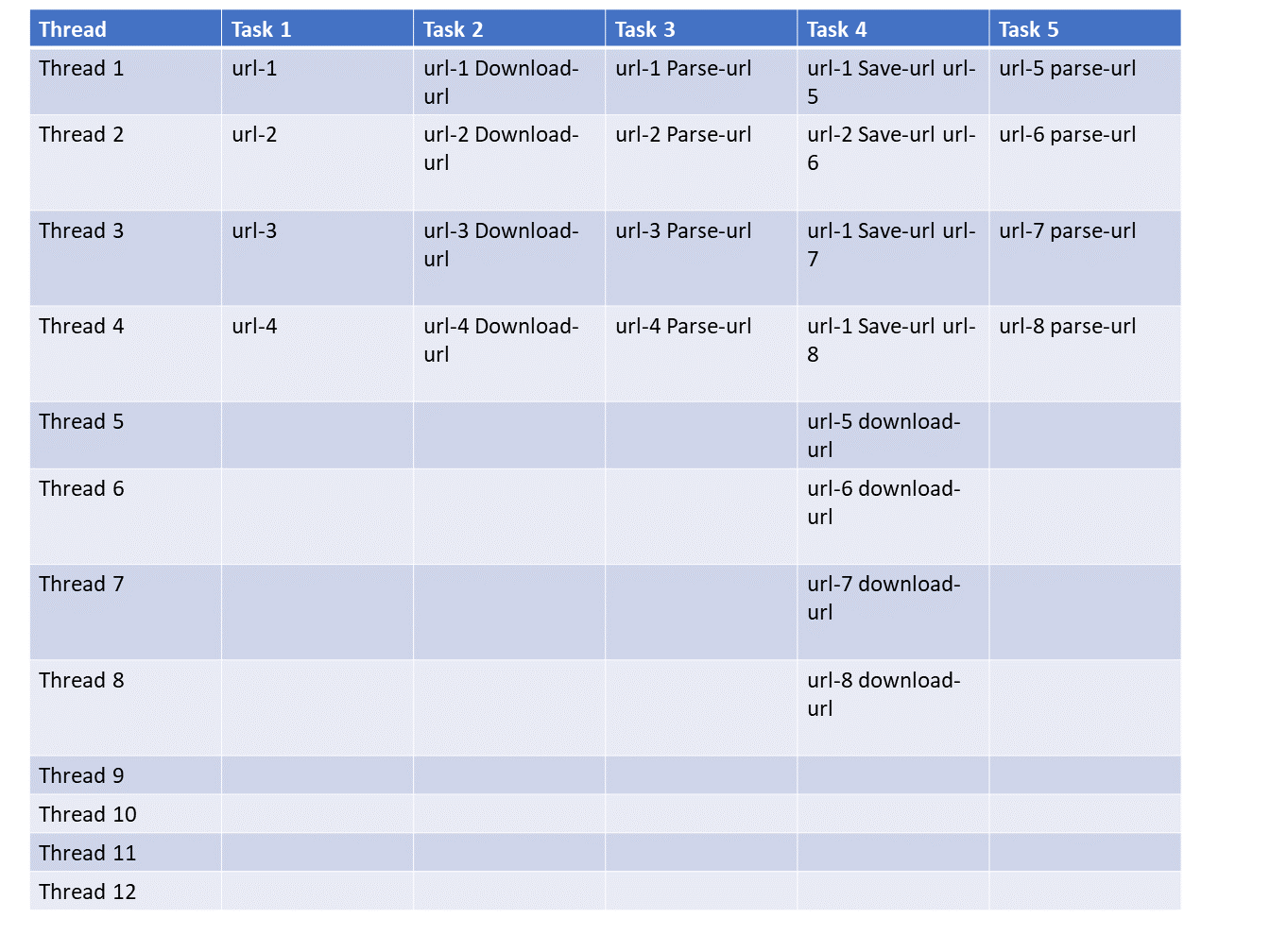
Imagine you're a search engine company and you want to index links between URLs. How would you model this with async rust and thread pools?
  task download-url
   for url in urls:
    download(url)

  task extract-links
   parsed = parse(document)
   return parsed

  task fetch-links
   for link in document.query("a")
    return link

  task save-data
   db.save(url, link)
How would you do control flow and scheduling and parallelism and async efficiently with this code?
`db.save()`, `download()` are IO intensive whereas `document.query("a")` and `parse` is CPU intensive.
I think its work diagram looks like this: https://github.com/samsquire/dream-programming-language/blob...
I've tried to design a multithreaded architecture that is scalable which combines lightweight threads + thread pools for work + control threads for IO epoll or liburing loops:
Here's the high level diagram:
https://github.com/samsquire/ideas5/blob/main/NonblockingRun...
The secret is modelling control flow as a data flow problem and having a simple but efficient scheduler.
I wrote about schedulers here and binpacking work into time:
https://github.com/samsquire/ideas4#196-binpacking-work-into...
I also have a 1:M:N lightweight thread scheduler/multiplexer:
https://github.com/samsquire/preemptible-thread