Live data from Hacker News

In the Asian Flu of 1957-58, they rejected lockdowns (2021)

aier.org

91–100 of 312 posts

Re: In the Asian Flu of 1957-58, they rejected lockdowns (2021)

#91

Earlier quoted context omitted.

Personal freedom can be a bad idea in crisis situations. Selflessness and following procedure can be better for the collective. This is why crisis operators follow checklists rather than giving each individual absolute personal freedom.

Absolutely false. If the government is going to abridge my rights, such as forcing lockdowns or vaccinations, they better show me the necessity and efficacy of those abridgements. The government can't just come in and say, "This is a crisis, we get to do whatever we want." Fuck that. That's how authoritarians are born. Many closet authoritarians took advantage of covid to become dictators without any evidence of effi…

[deleted]

Re: In the Asian Flu of 1957-58, they rejected lockdowns (2021)

#92

This article immediately claims that the Asian Flu in question was far deadlier than COVID. This is categorically false. In fact, it's not even close. The article claims 116k US deaths attributable to the Asian flu. Meanwhile, there were 10x that number of excess US deaths during the COVID pandemic. https://ourworldindata.org/excess-mortality-covid As others have pointed out, the AIER is a conservative think-tank. I…

> We were second in the world in COVID deaths as a percentage of the population.

I am not trying to change your argument in anyway but that specific statement is not correct or its using different numbers than direct COVID deaths. The US is 15th. Peru was #1, and EU members Hungary (#3), Croatia (#6), Slovakia (#10), Greece (#13) and Romania (#14) are all ahead of us.

(Sorry I am pedantic about covid numbers) =)

Re: In the Asian Flu of 1957-58, they rejected lockdowns (2021)

#93

Linked article claims that a vaccine was developed late and had minimal impact. Elsewhere, the case has been made that the vaccine was developed and deployed rapidly before the virus took full hold, and halted the pandemic in its tracks. https://daily.jstor.org/how-america-brought-the-1957-influen...

I'm reasonably certain that if we picked apart the article's logic piece by piece, we'd find that it was mostly (or entirely) based on bullshit.

Thanks for digging up that bit of info.

Re: In the Asian Flu of 1957-58, they rejected lockdowns (2021)

#94

This article immediately claims that the Asian Flu in question was far deadlier than COVID. This is categorically false. In fact, it's not even close. The article claims 116k US deaths attributable to the Asian flu. Meanwhile, there were 10x that number of excess US deaths during the COVID pandemic. https://ourworldindata.org/excess-mortality-covid As others have pointed out, the AIER is a conservative think-tank. I…

> We were second in the world in COVID deaths as a percentage of the population. I am not trying to change your argument in anyway but that specific statement is not correct or its using different numbers than direct COVID deaths. The US is 15th. Peru was #1, and EU members Hungary (#3), Croatia (#6), Slovakia (#10), Greece (#13) and Romania (#14) are all ahead of us. (Sorry I am pedantic about covid numbers) =)

[deleted]

Re: In the Asian Flu of 1957-58, they rejected lockdowns (2021)

#95

Earlier quoted context omitted.

Personal freedom can be a bad idea in crisis situations. Selflessness and following procedure can be better for the collective. This is why crisis operators follow checklists rather than giving each individual absolute personal freedom.

and there's the temptation to govern in a permanent crisis mode. there is no end to reasons why there is a crisis. or, is there a scientific definition of "crisis"?

If anything COVID demonstrated the opposite - governments were all too eager to get back to BAU despite the situation still being severe, resulting in notably high excess death rates.

Re: In the Asian Flu of 1957-58, they rejected lockdowns (2021)

#96

For the mathematically-minded, it is worth noting that the Asian flu had an R naught of 1.7 while Covid had an R naught of a bit more than 2. Keeping in mind these are fat-tailed distributions. So an R naught of 2 is a estimate of a true R naught, and because using sample averages to estimate means (true R naught is a mean) is unstable (the fatter the tail, the less moments of the distribution there are), once the re…

For those that are interest in the nuances of modelling infections, I'm going to leave a Wikipedia extract here. "R_{0} is not a biological constant for a pathogen as it is also affected by other factors such as environmental conditions and the behaviour of the infected population. R_{0} values are usually estimated from mathematical models, and the estimated values are dependent on the model used and values of other…

> it is recommended not to ... compare values based on different models

i.e. R0 numbers are worthless. You can't compare these values between pathogens, you can't even compare them between different academic groups studying the same pathogen or between outbreaks of the same pathogen as modeled by different versions of the same software. There's no agreed way to measure this value empirically.

Instead they write a program to simulate the spread of a virus through population and then (in effect) brute force one or more of the inputs until the results of the simulation match what happened so far. These variables are often given names that sorta reflect an intuition about what they're supposed to do, but they're just names. The actual values are arbitrary and there's no effort to ensure the computed values connect to the names in any plausible way.

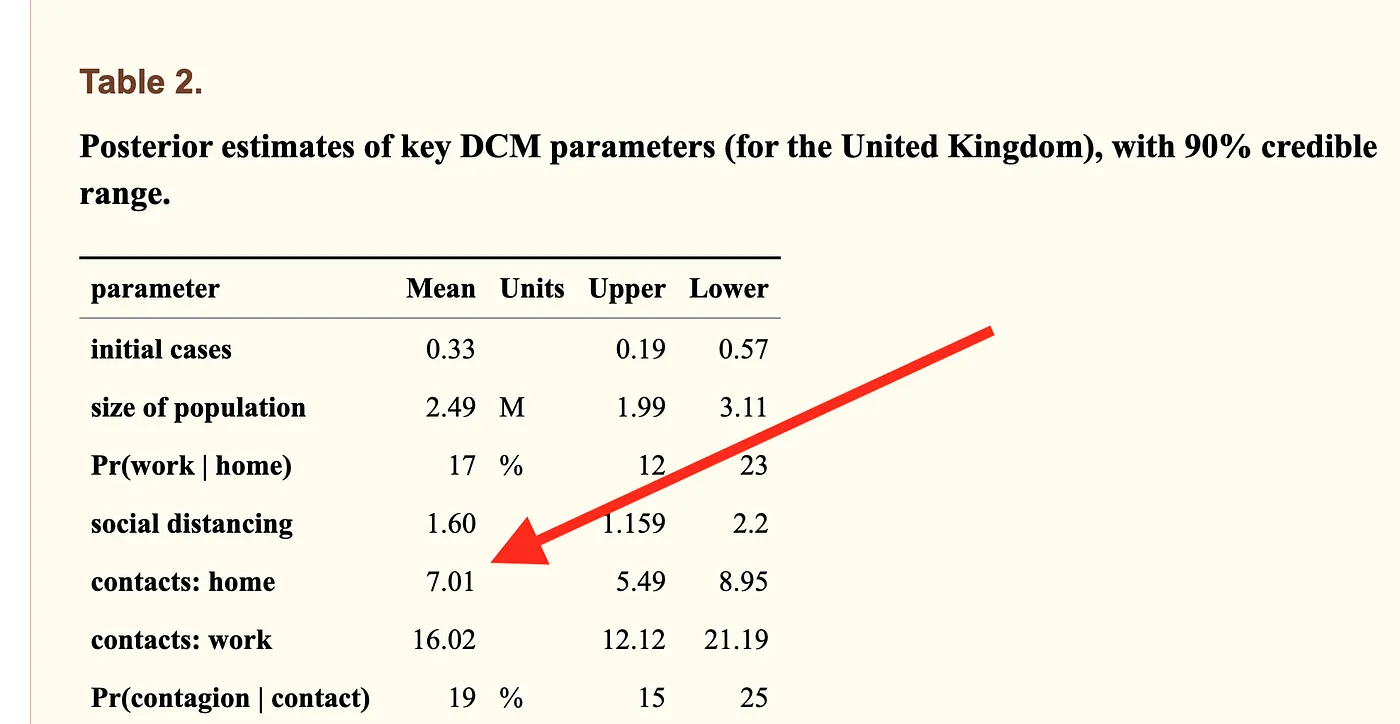
A funny example of this was a COVID model from University College London that used household size as a free variable. The model used this value to achieve curve fit for each country in the study, so they reported that the average Brit lives with seven other people (the paper has 73 citations).

https://miro.medium.com/v2/resize:fit:1400/format:webp/1*sEv...

More seriously, estimates of R0 for SARS-CoV-2 have ranged from 1.5 to nearly 6, maybe even higher. It's not even clear what the definition is because it's not time bounded in any way. So not a value that's really knowable, like the speed of light is.
Re: In the Asian Flu of 1957-58, they rejected lockdowns (2021)

#97

Besides the economic harm and potential developmental harm induced by closing schools for kids, I think lockdowns did incalculable social harm to society. It gave huge swaths of the population a grudge against the system, a chip on their shoulder that won't go away anytime soon. It burned up goodwill and trust for experts and politicians (who generally didn't have much to spare in the first place.) And coupling this…

You can agree with that and still accept that without lockdowns the outcome would have been far far worse.

And it's not like nothing good came out of lockdowns either, particularly the much greater willingness of employers to embrace remote work.

Re: In the Asian Flu of 1957-58, they rejected lockdowns (2021)

#98

This article immediately claims that the Asian Flu in question was far deadlier than COVID. This is categorically false. In fact, it's not even close. The article claims 116k US deaths attributable to the Asian flu. Meanwhile, there were 10x that number of excess US deaths during the COVID pandemic. https://ourworldindata.org/excess-mortality-covid As others have pointed out, the AIER is a conservative think-tank. I…

> We were second in the world in COVID deaths as a percentage of the population. I am not trying to change your argument in anyway but that specific statement is not correct or its using different numbers than direct COVID deaths. The US is 15th. Peru was #1, and EU members Hungary (#3), Croatia (#6), Slovakia (#10), Greece (#13) and Romania (#14) are all ahead of us. (Sorry I am pedantic about covid numbers) =)

Thank you for the correction! I see now that the full dataset is available in the table at the bottom of the page. I was referring to the chart at the top of the page, which (for some reason) leaves out the 14 countries between Peru and the USA. I wish they wouldn't do that.

Re: In the Asian Flu of 1957-58, they rejected lockdowns (2021)

#99
post #81

Earlier quoted context omitted.

Not everything is purely about money. People are highly motivated by a sense of power or prominence, by a sense of belonging in the "correct group", and by a sense of being useful or productive at their profession. A barber as much as money will believe their haircut will make you look good.

As a thought exercise, I wonder to which group an epidemiologist would need to belong to have a sense of power? The group that says that there is a dangerous disease or the group that says that it's not particularly dangerous? PS: For people who wonder, the H factor-style ranking mechanisms for researchers means that your rank is higher (which tends to translate to more interesting work and/or more money) if you're h…

I'd think in this case it's about the response. What group of epidemiologists wouldn't get a sense of power, prestige than having daily Whitehouse meetings, continual press coverage, and effectively setting public policy based solely on their subject of expertise? That essentially hits on all three points I gave.

The issue is that they'll fail to appropriately consider the broader long-term effects of lockdowns. Most of the advice and policy also wasn't scientifically based in that the effectiveness wasn't well researched, so H-factor scores wouldn't play much of a role.

Re: In the Asian Flu of 1957-58, they rejected lockdowns (2021)

#100
post #80

Earlier quoted context omitted.

> So Ebola virus is not as deadly as COVID because fewer people have died from it? Yes? That's the definition, no? Cows are deadlier than sharks, cars are deadlier than planes, even though you're more likely to survive a cow attack or a car crash?

Which is deadlier, being shot in the head with a .50 cal, or catching the flu? The former is much deadlier - it's basically guaranteed death - but the latter is so much more frequent that it claims more lives even though the vast majority of people survive it. Usually "deadlier" refers to the chances a given event will kill you if it happens, not normalized for the frequency of those events. The flu most certainly cl…

But now you're comparing individual outcomes to population outcomes.

Yes, getting shot in the head is deadlier than (catching) the spanish flu.

But the Spanish flu was deadlier than firearms/WW1.

That's often the limit of analogies.

Post reply on HN