There is no point to distributing music in 24-bit/192kHz format.
1–10 of 326 posts
Re: There is no point to distributing music in 24-bit/192kHz format.
#2This is a really convincing article that makes me want to set up a double blind test for myself with my own equipment.
In my own tests I believed that I couldn't tell the difference between 16/44 and 24/96 on high quality loudspeakers, but I could with high quality headphones. The studies cited all seem to use loud speakers in testing.
Also worth noting, the article states that obtaining 24/96 source material sometimes means you get better mastered material, which still sounds better after down-sampling back to 16/44.
Re: There is no point to distributing music in 24-bit/192kHz format.
#3Huh, I think people truly advocating 192 as a distribution format will be few and far in between, a really good and cheaper sampling system can be put together at 96. Still, a lot of things in this article perplex me.
Human hearing is limited to 20k because frequencies higher than that are perceived as painful? Dont agree with that one.
24 bit doesn't offer any advantages to sound quality? Sheesh.
And the crux of the argument is intermodulation distortion increases when you try to represent more frequencies? Isn't that an argument for a faster power amp?
Re: There is no point to distributing music in 24-bit/192kHz format.
#4There's a lot of scientific-sounded content in this, but unfortunately most of it couldn't be further from the truth. I'm an ex-audio engineer and studied digital and analog audio engineering; this has been debated to death over the last 15 years.
Digitally recording a triangle is the best example of why 48kHz is very limiting. The distinct sound of the triangle constitutes of a high fundamental frequency, ballpark 5kHz and of many very high-pitch harmonics. Most of these harmonics are above 20kHz. The harmonics are what makes it sound like a triangle, not the frequencies below 20kHz. This is why the triangle is one of the hardest instruments to digitally record. It always sounds like crap.
In theory, it's true that the human hear can't hear above ~18kHz, but it can hear the influence of the very high pitch harmonics on a lower frequency.
EDIT: here's more data backing what I said http://www.cco.caltech.edu/~boyk/spectra/spectra.htm
EDIT 2: typos, frequency mistake
Re: There is no point to distributing music in 24-bit/192kHz format.
#5Huh, I think people truly advocating 192 as a distribution format will be few and far in between, a really good and cheaper sampling system can be put together at 96. Still, a lot of things in this article perplex me. Human hearing is limited to 20k because frequencies higher than that are perceived as painful? Dont agree with that one. 24 bit doesn't offer any advantages to sound quality? Sheesh. And the crux of the…
"Don't agree with that one" and "Sheesh" are pretty weak counters to detailed, objective arguments based on extensive research and decades of test data.
Re: There is no point to distributing music in 24-bit/192kHz format.
#6There's a lot of scientific-sounded content in this, but unfortunately most of it couldn't be further from the truth. I'm an ex-audio engineer and studied digital and analog audio engineering; this has been debated to death over the last 15 years. Digitally recording a triangle is the best example of why 48kHz is very limiting. The distinct sound of the triangle constitutes of a high fundamental frequency, ballpark 5…
Hey cmer, thanks for posting
I don't think I understand quite what you're saying and wondered if you could explain more. You and the article both say that humans can't hear above about 20kHz. If there are higher frequencies that create a harmonic at a lower frequency (e.g. a 33kHz harmonic that produces a sound at 16.5kHz) then surely that lower harmonic (16.5kHz in this case) will be recorded by the original recording equipment assuming it is recording at a frequency at least twice that of the highest audible frequency (let's say that this would be 48kHz, although there might be other DAC-related reasons to go higher).
I'm possibly being very daft here!
Re: There is no point to distributing music in 24-bit/192kHz format.
#7He raises a lot of valid points. However...
192 kHz is clearly overkill for listening. Not so for further editing of the data.
Same goes for 16/24 bit, however, the difference between 16 and 24 bit is actually audible.
44100 is not a bad sampling rate, but it necessitates very sharp aliasing filters, which are audibly bad. A bit more headroom is well needed there.
That bit about intermodulation distortion is complete bogus. He talks about problems when resampling high-fs audio data. However, you would never do that. You would digitally process 192kHz all the way. Only your loudspeakers or ears would introduce a high-pass filter, and a rather bening (flat) one at that. There is certainly no aliasing going on there unless you resample (wrongly). Intermodulation distortion is not the fault of the sample rate.
I mayored in hearing technology. Calling 192/24 worse than 44.1/16 is total BS. How useful it is is a different debate.
Re: There is no point to distributing music in 24-bit/192kHz format.
#8There's a lot of scientific-sounded content in this, but unfortunately most of it couldn't be further from the truth. I'm an ex-audio engineer and studied digital and analog audio engineering; this has been debated to death over the last 15 years. Digitally recording a triangle is the best example of why 48kHz is very limiting. The distinct sound of the triangle constitutes of a high fundamental frequency, ballpark 5…
The article doesn't suggest only using 48kHz for recording and mixing. I don't think the author would disagree that recording triangles is difficult. He would argue that once you've decided what final audible frequencies you want to present to the listener, the best way to distribute them is at 16-bit 44.1/48kHz. It's a compelling case.
Re: There is no point to distributing music in 24-bit/192kHz format.
#9So, presuming we take this example:
http://people.xiph.org/~xiphmont/demo/jaggy2.png
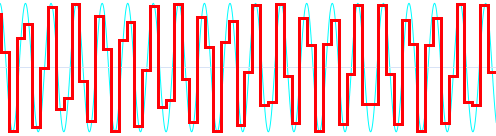
The key to reproducing the original signal from the digital signal is a low-pass filter that rejects everything above the sampling rate, correct?
That is to say, what I am getting at is while the original signal can be reproduced, it requires properly tuned, and probably reasonably high performance, hardware to remove the higher frequency components of that square wave. Can you count on consumer grade hardware to do this well?
Re: There is no point to distributing music in 24-bit/192kHz format.
#10There's a lot of scientific-sounded content in this, but unfortunately most of it couldn't be further from the truth. I'm an ex-audio engineer and studied digital and analog audio engineering; this has been debated to death over the last 15 years. Digitally recording a triangle is the best example of why 48kHz is very limiting. The distinct sound of the triangle constitutes of a high fundamental frequency, ballpark 5…
> Digitally recording a triangle is the best example of why 48kHz is very limiting
The article's about distribution, not recording. I don't think anybody disputes the usefulness of higher sampling rates when recording.
> In theory, it's true that the human hear can't hear above ~18kHz, but it can hear the influence of the very high pitch harmonics on a lower frequency.
...and 48kHz audio contains those lower frequencies.