Live data from Hacker News

Microwaved plastic containers release microplastics into food

pubs.acs.org

291–300 of 320 posts

Re: Microwaved plastic containers release microplastics into food

#291
post #286

Earlier quoted context omitted.

There is no evidence in the linked text that possible "reproductive issues" from sperm count reduction would be something overall bad. One possibility is that the total number of humans born will decrease somewhat and that global population will be somewhat lower compared to an alternative scenario with less microplastics. Every human has needs that require energy and resources so a scenario with lower global populat…

I imagine the individuals affected might care. It’s also unlikely a destructive buologically change will only affect a single system. And unlikely that this same cause would spare animals while only affecting humans. We do want animals to reproduce too…..

True, possible, possible, depends. But on the other hand current levels of global resource and energy use have harmful effects on existing humans and animals. For example climate change increases the frequency and intensity of wildfires that kill billions of animals. Increasing the human population by billions more, which is the path we're on unless some factor or other decreases population growth, likely increases such effects. That matters if we want to investigate if the consequences of microplastics are overall bad or good.

Re: Microwaved plastic containers release microplastics into food

#292

Earlier quoted context omitted.

It will be made out of Tritan -- a type of plastic, not glass.

The Aeropress Clear is made out of Tritan. The Premium (from the link) "will feature a construction of glass, stainless steel, and aluminum instead of the usual plastic."

Ah missed that part my bad.

Re: Microwaved plastic containers release microplastics into food

#293
post #41

Earlier quoted context omitted.

Maybe I'm in the minority but we (and everyone else we seem to interact with) use pyrex.

Dishes marketed under the Pyrex name are no longer borosilicates. The brand name was sold off (and in fact the company that bought it was recently discussed in HN as they also bought Instant Pot, and have gone bankrupt).

Not as good but they still work, been using it for years. It's especially safe for microwaving.

Re: Microwaved plastic containers release microplastics into food

#294
post #180

Earlier quoted context omitted.

Oh it's worse than that. Unlike steel, cast iron generates dust when abraded. Dust that is really bad for you. Known to cause lung issues, etc. I machine it all the time (both ductile and non). It is usually is machined dry with vacuum because it will clog coolant systems. It basically turns into a horrible mud when mixed with coolant or water I happen to filter the coolant system so i can machine it wet, but that's…

Some of what your saying makes sense, but it sounds like you're carrying experience in metal working too far into cooking. > though it is non stick in the same sense that things are harder to stick to burned things :) The usual way I've heard this explained, which seems reasonable, is that steel and iron are porous, and what causes sticking is the contraction of those pores when heated. A smooth covering prevents tha…

OK, but the flip side of this is: why would you ever opt for cast iron over carbon steel? There are reasons --- cast iron retains heat better (though both retain heat better than all other cookware, and the reason cast iron retains more heat is that it's stupid heavy). But most things people use cast iron for in cooking, they should be using carbon steel for (or enamelware) instead. It's just way better.

Pushing back on 'DannyBee though: the narrative about cast iron vs. nonstick is easy to understand: nonstick pans are shitty, expensive, and overused; lots of people cook in nonstick exclusively (:scream-emoji:) and don't realize their pans have been worthless for years because the coating is all scuffed up. It's not a health thing so much as a "nonstick pans are evil" thing.

Re: Microwaved plastic containers release microplastics into food

#295
post #11

I am shocked! shocked! Well, not that shocked. Still, don't heat stuff for the infants in a plastic.

I wonder if silicone has any of the same issues. It seems that the "safe" trend.

https://www.nontoxu.com/plastics-silicone/silicone-toxicity

Re: Microwaved plastic containers release microplastics into food

#296
post #180

Earlier quoted context omitted.

Some of what your saying makes sense, but it sounds like you're carrying experience in metal working too far into cooking. > though it is non stick in the same sense that things are harder to stick to burned things :) The usual way I've heard this explained, which seems reasonable, is that steel and iron are porous, and what causes sticking is the contraction of those pores when heated. A smooth covering prevents tha…

OK, but the flip side of this is: why would you ever opt for cast iron over carbon steel? There are reasons --- cast iron retains heat better (though both retain heat better than all other cookware, and the reason cast iron retains more heat is that it's stupid heavy). But most things people use cast iron for in cooking, they should be using carbon steel for (or enamelware) instead. It's just way better. Pushing back…

I mostly use carbon steel. But putting on my cooking nerd hat, there's one situation where I pull out cast iron, because it's annoyingly heavy:

It has more thermal momentum, thus when I am pulling stuff out of my sous vide cooker, it's better at quickly adding char (because the temperature drops less than in carbon steel or anything else).

(The only other reason I use cast iron is for the cases where the pan size is just more practical than my carbon steel pans.)

I will admit that I'm conflicted by this since there's also a distinctive way that my 3.5 kW induction wok cooker chars stuff in a very limited amount of time, but that involves me removing the smoke detectors from my kitchen and the two rooms adjacent.

Re: Microwaved plastic containers release microplastics into food

#297

Earlier quoted context omitted.

Oh it's worse than that. Unlike steel, cast iron generates dust when abraded. Dust that is really bad for you. Known to cause lung issues, etc. I machine it all the time (both ductile and non). It is usually is machined dry with vacuum because it will clog coolant systems. It basically turns into a horrible mud when mixed with coolant or water I happen to filter the coolant system so i can machine it wet, but that's…

When during normal cooking am I going to be abraiding the surface of my cast iron to the point I'm aerosolizing significant amounts of dust off the pan?

Uh, if you scrape it at all with anything?

Re: Microwaved plastic containers release microplastics into food

#298
post #87

Earlier quoted context omitted.

The main reason I like it is beacause after it is "seasoned", or after some regular use, it has a lot of the qualities of non-stick yet has none of the chemical coating.

Look, i know it's a very popular thing to do, but A. it's a layer of burned, polymerized cooking oil. It is in fact a plastic. It is not particularly better for you. It's only non-stick in a weird sense that anything else that hasn't been cleaned is non-stick. B. it does not really prevent rust - if it did, we would use this instead of rust protectants :) C. Cast iron, unlike steel, generates mostly dust when it abra…

[dead]

Re: Microwaved plastic containers release microplastics into food

#299

Earlier quoted context omitted.

When during normal cooking am I going to be abraiding the surface of my cast iron to the point I'm aerosolizing significant amounts of dust off the pan?

Uh, if you scrape it at all with anything?

I don't even normally scrape it enough to significantly wear down the seasoning. When am I going to scrape it so much I'm going to scrape off a significant amount of the actual pan?

How hard do you scrape your pans when you cook?! Does your pan end up half a gram lighter every time you cook or something?

And even then, if I am scraping it enough to actually abraide some of it, it's not being aerosolized. It's gonna get worked into the fats and oils I've got in the pan. Which, sure, some small amount eventually flings out, but by that point it's such a tiny minute amount.

Maybe if I was a chef it might be enough to actually care a tiny slight bit. But like, cooking with it a few times a week, I can't imagine I'm getting much of any bits of the pan in my lungs. I'd be more worried about the stuff burning in the pan over the bits of the pan being a problem.

Re: Microwaved plastic containers release microplastics into food

#300
post #180

Earlier quoted context omitted.

Oh it's worse than that. Unlike steel, cast iron generates dust when abraded. Dust that is really bad for you. Known to cause lung issues, etc. I machine it all the time (both ductile and non). It is usually is machined dry with vacuum because it will clog coolant systems. It basically turns into a horrible mud when mixed with coolant or water I happen to filter the coolant system so i can machine it wet, but that's…

Some of what your saying makes sense, but it sounds like you're carrying experience in metal working too far into cooking. > though it is non stick in the same sense that things are harder to stick to burned things :) The usual way I've heard this explained, which seems reasonable, is that steel and iron are porous, and what causes sticking is the contraction of those pores when heated. A smooth covering prevents tha…

"The usual way I've heard this explained, which seems reasonable, is that steel and iron are porous, and what causes sticking is the contraction of those pores when heated. A smooth covering prevents that sticking, and polymerized cooking oil provides that."

Not blaming you, but this is just wrong and a fundamental misunderstanding of steel and iron.

Cast iron (and steel) does not have pores. It is not like wood. SAE 304 (stainless steel commonly used in cheap pans) does have micro-cracks in the surface. These can be removed through honing or surface polishing, and the substructure is weird. Let's put it aside for a second, and stick with cast iron, carbon steel, and other stainless because 304 is just super strange stuff at the microscopic level.

Cast iron simply has no pores at all, just surface roughness. The average surface roughness is not that high (125 microinches or better)

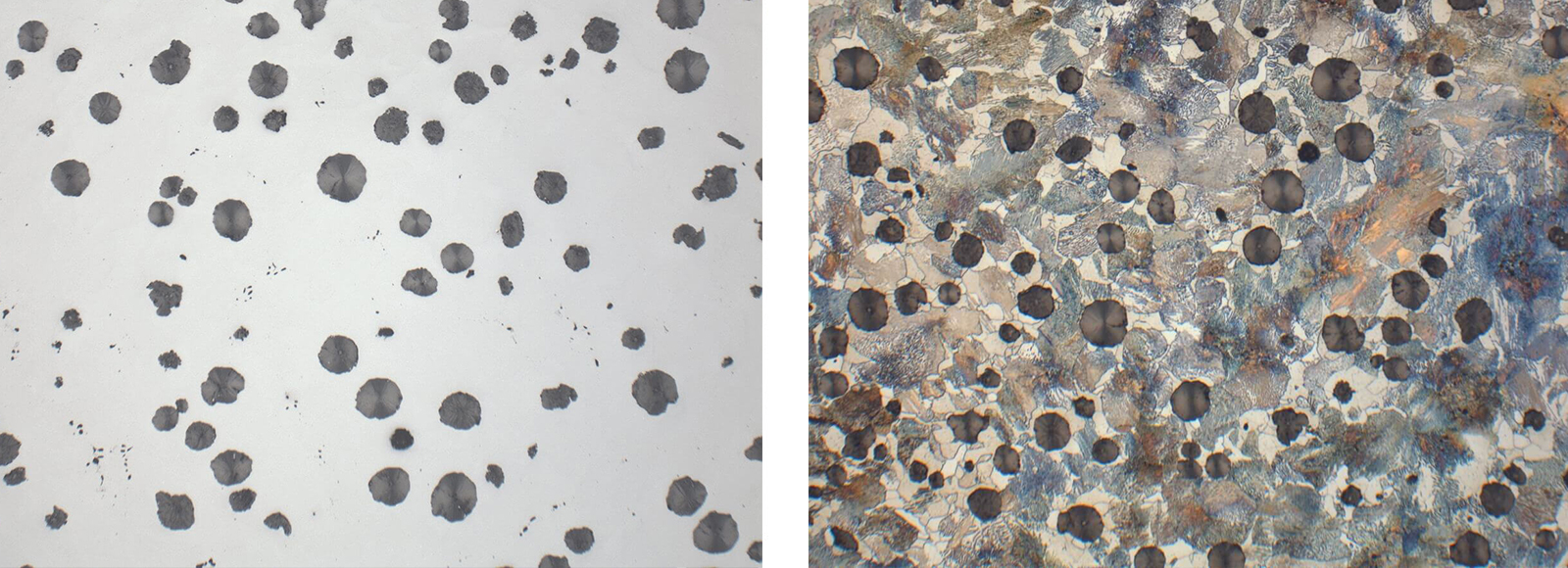
Here is a high magnification photo of cast iron with the different microstructures pointed out: https://www.researchgate.net/publication/325977459/figure/fi...

here's one colored a little nicer: https://www.struers.com/-/media/Struers-media-library/Knowle...

You can see there are no holes and no pores. There are just some different types of microstructures.

Here is normal stainless steel: https://www.researchgate.net/publication/327401795/figure/fi...

(the one on the right is after sandblasting :P)

Liquids theoretically fill the surface roughness of either but not like massively. You can see on the stainless there just isn't a lot to even fill.

For all of them the overall flatness changes when heated, and the surface roughness changes slightly, but that's it. Not a lot. it definitely does not expand pores, or change the surface roughness by a factor of 10, or any of this.

This is why cast iron is used to make precision laps - to surface things like lab grade surface plates to like 0.000005 inches and such: it stays flat once machined and surfaced, it has lots of thermal inertia, and doesn't get screwed up by things sticking to it once polished[1].

If your goal is to make it so nothing sticks, by adjusting the surface roughness, you could also just sand it outside with a respirator on to like 2000 grit or 4000 grit and never worry about it. This would cost you about 5 minutes of time, maybe 10, and you can do it by hand if you want (though it's like 1 minute with an ROS).

I can show you a non-seasoned, "polished once 8 years ago to 8000 grit" cast iron griddle that has 0 rust, and is quite non-stick.

Manufacturers would do this except now they get you to do it for them, because people won't buy it unless they can season it to "add flavor" and such.

The whole thing has become a silly cargo cult honestly. The number of people who now think that like cast iron and steel have pores is also way too high :)

Besides sanding, there are other ways to change surface roughness that don't involve burning cooking oil onto something that doesn't need it. They also last much longer.

Also note that depending on temperature that people season at, they can release really toxic stuff. 300C (572F) is totally achievable on most stoves, by people just leaving them on to season, and will generate some very toxic byproducts.

"Funnily enough, I have. I built a bookshelf that uses raw steel beams, and I seasoned it to protect it from rust. 3 years in, it's still rust free (amusingly, except for the inside of the pipes)."

Visibly, or did you check under the coating? Most seasoning just hides rust. It's still rusted, and as it gets removed it's just taking the iron oxide with it so it looks like it's not.

[1] Here's a fun side video of someone making precision laps out of cast iron using nothing but the 3 plate method, timecoded to when he puts the optical flat on it: https://www.youtube.com/watch?v=Whyw5v7L70c&t=810s

The lines are straight because this cast iron is flat and not rough to at 1/10th or 1/20th the wavelength of light used here, which translates into an average roughness below 25-50nanometers.

You do not need to go this far to get a non-stick pan out of cast iron :)

Post reply on HN