Live data from Hacker News

Apple M2 Ultra SoC isn’t faster than AMD and Intel last year desktop CPUs

wccftech.com

61–70 of 448 posts

Re: Apple M2 Ultra SoC isn’t faster than AMD and Intel last year desktop CPUs

#61

50% slower than the absolute best of class NVIDIA discrete GPU offering that consumes massively more wattage is hardly a damning statement.

Most consumers don't care about wattage on a desktop, and when you compare the prices they are similar and it loses.

I wonder how long you have to run the Apple chip to save enough on electricity to make the price difference worthwhile? Does it only drop to one human lifetime in places where energy cost is insanely high?
Re: Apple M2 Ultra SoC isn’t faster than AMD and Intel last year desktop CPUs

#62
The comments here are strange.

So many people making claims that power utilization doesn't matter. Perhaps not to them, but it does for many.

Energy prices are getting higher and higher in many parts of the country, heck in the world.

Devices that consume more power generate more heat. So now one is likely using more electricity to keep their home or office cool and comfortable.

Noise matters for many people using workstations. Running a system at full tilt can be irritating, distracting, because of the active cooling.

Some people are just simply conscious of how much electricity they use and want to have a lower environmental impact.

And then there's the large scale matter. One workstation might not be a big deal in terms of energy usage, but millions of them absolutely is.

Saying no one cares how much power a workstation uses is disingenuous.

Re: Apple M2 Ultra SoC isn’t faster than AMD and Intel last year desktop CPUs

#63

50% slower than the absolute best of class NVIDIA discrete GPU offering that consumes massively more wattage is hardly a damning statement.

I think a useful way of thinking about this is it has something like $300-400 worth of discrete GPU equivalent performance assuming that the article's claims are correct (not exactly a given...) as it will get you something similar to a 3060 ti or 4060 ti.

Re: Apple M2 Ultra SoC isn’t faster than AMD and Intel last year desktop CPUs

#64
post #44

Definitely have to adjust for TDP. The new gen Intel processors match the M2 performance for $100-150. TDP is triple but still relatively low. There isn't really anything available from non-niche retailers that approaches the TDP of Apple chips. And what does tends to be a binned just to be sold as mobile. Better to buy the standard chip and limit clock speed. What also shocks me is more expensive chips that offer in…

>Definitely have to adjust for TDP

Considered certainly, adjust less so.

If you want to adjust for something price makes more sense than TDP

Re: Apple M2 Ultra SoC isn’t faster than AMD and Intel last year desktop CPUs

#65

This and the introduction of the new slower less expandable - at least with respect to GPUs and memory - is indicative that it was a mistake for Apple to completely transition to ARM and should have kept high end options on Intel until they had a better GPU story to tell. They already had the Mac Studio, they could have kept the Mac Pro on Intel.

The Intel Mac pro was too slow, unless you mean refreshing it, which I doubt is possible, because apple doesn't want to do anything related to X86 anymore.

You could add GPUs to it at least. For many high end workloads, you need GPU horsepower.

How is not wanting to do x86 on the high end? The article says just as much.

Re: Apple M2 Ultra SoC isn’t faster than AMD and Intel last year desktop CPUs

#66
post #32

Earlier quoted context omitted.

Since when was TDP a deciding factor in desktop purchasing decisions? Sure M SOCs are great on laptops, but there are no reasons to get them on the desktop, slower, more expensive and with less compatibility.

Where and when electric energy is $0.51/kWh, one might care quite a bit.

Whoever is doing the caring should reconsider their life choices at that price. At 51 cents per kilowatt hour, personal solar + batteries are a vailable alternative. If you cared about the planet, you'd move

Re: Apple M2 Ultra SoC isn’t faster than AMD and Intel last year desktop CPUs

#68
post #32

Earlier quoted context omitted.

Where and when electric energy is $0.51/kWh, one might care quite a bit.

I doubt the target customers of the M2 ultra aren't going to be able to cover extra energy costs for a cheaper and more performant device.

Oh sure, but I was responding to the comment above saying that desktop users in general shouldn't care about power consumption. That's too broad.

Re: Apple M2 Ultra SoC isn’t faster than AMD and Intel last year desktop CPUs

#69

The comments here are strange. So many people making claims that power utilization doesn't matter. Perhaps not to them, but it does for many. Energy prices are getting higher and higher in many parts of the country, heck in the world. Devices that consume more power generate more heat. So now one is likely using more electricity to keep their home or office cool and comfortable. Noise matters for many people using wo…

Because Workstation, by a lot of people's definition, are suppose to be the power hungry in exchange for absolute performance?

Re: Apple M2 Ultra SoC isn’t faster than AMD and Intel last year desktop CPUs

#70
post #34

Earlier quoted context omitted.

> even when Intel TDP was 20x worse than today. When has Intel's real, advertised, or specified CPU power consumption or TDP ever been 20x that of the i9-13900KS?

Core i9-13900KS consumes 150W with 24 cores (8P+16E) so an average of 6.25 watts per core which is less than a Pentium 90, a 1994 CPU running at 90Mhz in absolute is not a 20x worse TDP, but it is relatively to the gain in frequency and performances (more than 20x actually)

> Core i9-13900KS consumes 150W with 24 cores (8P+16E)

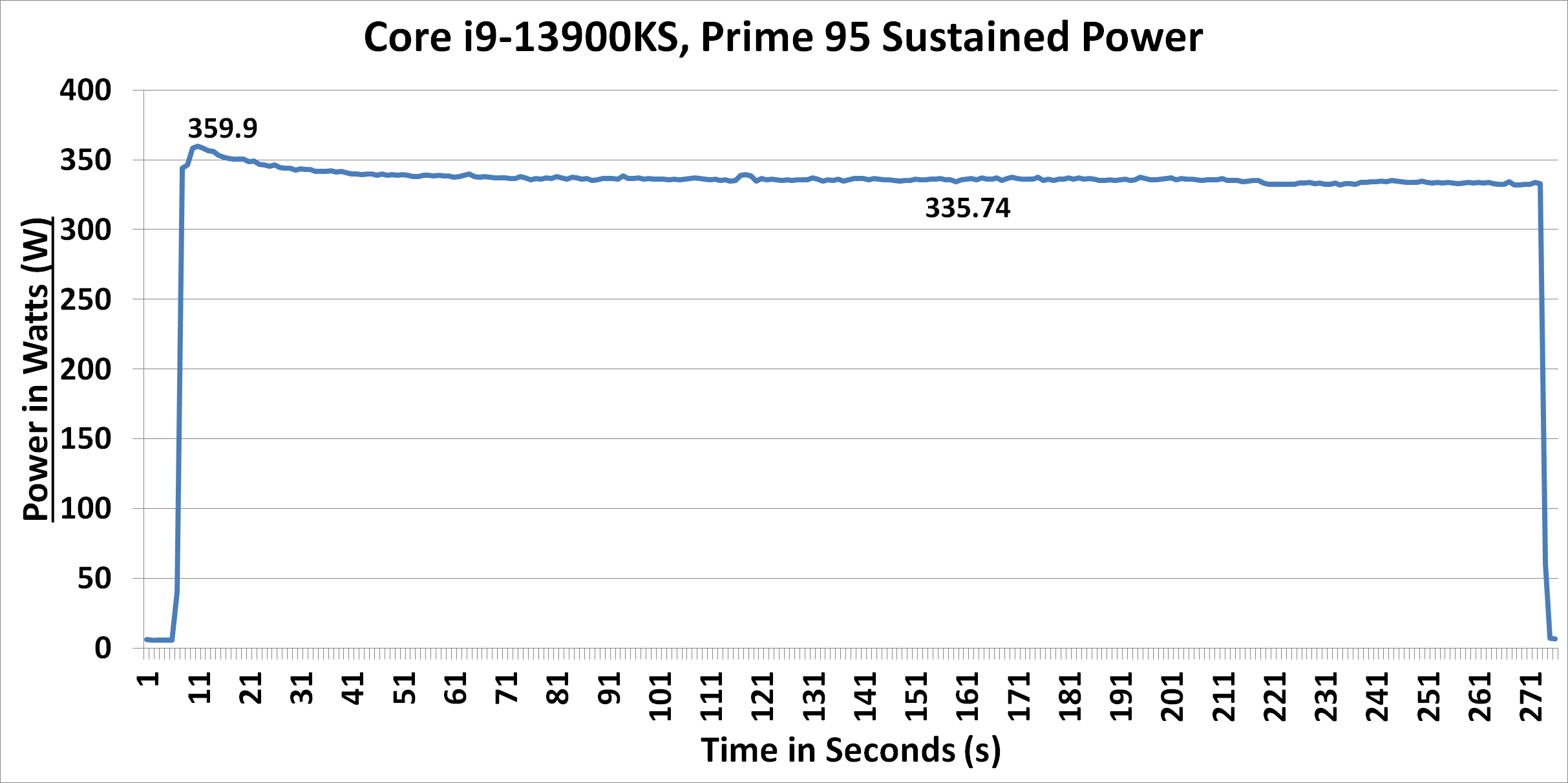
No, the 13900KS has a nominal "TDP" of 150W. That's a marketing number, not a measurement and not even a control target parameter for the default boost management settings. Out of the box, a 13900KS in a typical desktop motherboard will happily draw more than twice that, indefinitely, if you can cool it and have a workload that can actually keep all of those cores busy: https://images.anandtech.com/doci/18728/13900KS%20Power%20Gr...

If you want to compare per-core power, you either have to use a power number for a workload that's actually loading all the cores, or divide the measured power by the number of cores actually in use.

Post reply on HN