Math Puzzle: Lion in Circular Cage Puzzle
pratikpoddarcse.blogspot.in
Math Puzzle: Lion in Circular Cage Puzzle
1–10 of 45 posts
Re: Math Puzzle: Lion in Circular Cage Puzzle
#2For those curious about the mathematical objects involved:
http://mathworld.wolfram.com/PursuitCurve.html
https://en.wikipedia.org/wiki/Pursuit_curve
If you model this, you will probably get very different answers based on how well you discrete-ize (is there a better word for that idea?) the time and movement.
Also, it's not a turn based game, i.e. the man doesn't move and then the lion moves. They move together at the same time. I think if you could answer what happens if the man has his back to wall and the lion is as close as possible without catching him, then you would solve the problem. Because the lion has to predict where the person is going to move next, it feels like you won't ever know for sure what will happen. As time tends towards infinity, the lion will probably eat the guy due to sheer chance of both of them going the same direction at the right time.
Re: Math Puzzle: Lion in Circular Cage Puzzle
#3For those curious about the mathematical objects involved: http://mathworld.wolfram.com/PursuitCurve.html https://en.wikipedia.org/wiki/Pursuit_curve If you model this, you will probably get very different answers based on how well you discrete-ize (is there a better word for that idea?) the time and movement. Also, it's not a turn based game, i.e. the man doesn't move and then the lion moves. They move together at t…
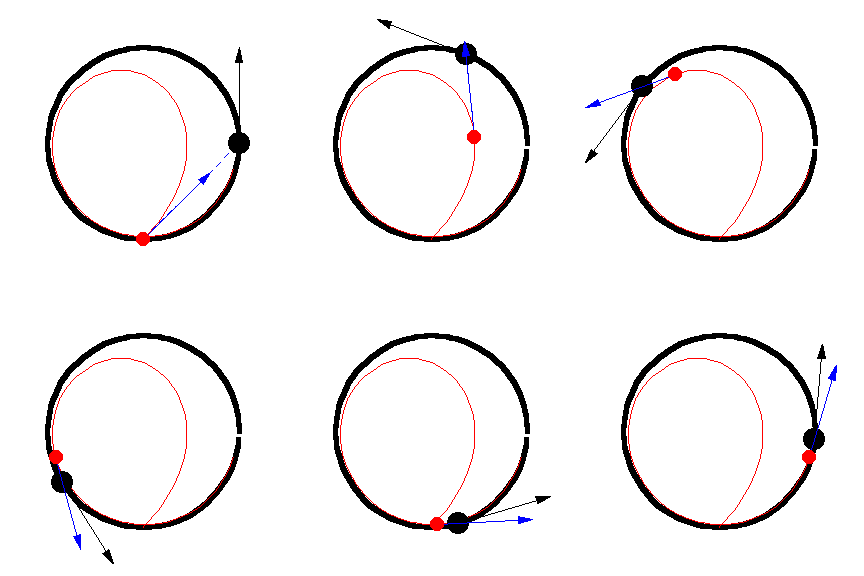
Related image from your first link http://mathworld.wolfram.com/images/gifs/purscir4.gif
Re: Math Puzzle: Lion in Circular Cage Puzzle
#4For those curious about the mathematical objects involved: http://mathworld.wolfram.com/PursuitCurve.html https://en.wikipedia.org/wiki/Pursuit_curve If you model this, you will probably get very different answers based on how well you discrete-ize (is there a better word for that idea?) the time and movement. Also, it's not a turn based game, i.e. the man doesn't move and then the lion moves. They move together at t…
Letting time go to infinity won't affect the answer - if the tamer has a strategy that allows him to avoid getting eaten, he's going to implement it all times, rather than risk making random movements.
Re: Math Puzzle: Lion in Circular Cage Puzzle
#5For those curious about the mathematical objects involved: http://mathworld.wolfram.com/PursuitCurve.html https://en.wikipedia.org/wiki/Pursuit_curve If you model this, you will probably get very different answers based on how well you discrete-ize (is there a better word for that idea?) the time and movement. Also, it's not a turn based game, i.e. the man doesn't move and then the lion moves. They move together at t…
The pursuit curve assumes that the lion always moves directly towards the tamer.
The better strategy for the lion is your back-to-the-wall position. The lion should be able to get infinitesimally close to the tamer. Pragmatically and finally, the delta will be smaller the reach of the lion's pawns. Lion wins.
Re: Math Puzzle: Lion in Circular Cage Puzzle
#6For those curious about the mathematical objects involved: http://mathworld.wolfram.com/PursuitCurve.html https://en.wikipedia.org/wiki/Pursuit_curve If you model this, you will probably get very different answers based on how well you discrete-ize (is there a better word for that idea?) the time and movement. Also, it's not a turn based game, i.e. the man doesn't move and then the lion moves. They move together at t…
Related image from your first link http://mathworld.wolfram.com/images/gifs/purscir4.gif
My problem with this representation is that it assumes the pursuer is unable to "lead" its target. The pursuit curve, as modeled in mathematical representations constrains the pursuer to traveling only on a path that points directly at the pursued.
Lions are highly adapted hunters that frequently take down prey that are much faster than them. It would seem that they would have to develop strategies for optimizing the distance-to-intercept in order to be successful as a species.
Thus, I believe the man is eaten rather quickly, even if the two are equal in speed.
Re: Math Puzzle: Lion in Circular Cage Puzzle
#7For those curious about the mathematical objects involved: http://mathworld.wolfram.com/PursuitCurve.html https://en.wikipedia.org/wiki/Pursuit_curve If you model this, you will probably get very different answers based on how well you discrete-ize (is there a better word for that idea?) the time and movement. Also, it's not a turn based game, i.e. the man doesn't move and then the lion moves. They move together at t…
Letting time go to infinity won't affect the answer - if the tamer has a strategy that allows him to avoid getting eaten, he's going to implement it all times, rather than risk making random movements.
I was thinking in terms of the man making random movements at some point. I don't really believe there is a strategy that allows him to avoid getting eaten so the best thing he could do is random movements.
Re: Math Puzzle: Lion in Circular Cage Puzzle
#8For those curious about the mathematical objects involved: http://mathworld.wolfram.com/PursuitCurve.html https://en.wikipedia.org/wiki/Pursuit_curve If you model this, you will probably get very different answers based on how well you discrete-ize (is there a better word for that idea?) the time and movement. Also, it's not a turn based game, i.e. the man doesn't move and then the lion moves. They move together at t…
The pursuit curve assumes that the lion always moves directly towards the tamer. The better strategy for the lion is your back-to-the-wall position. The lion should be able to get infinitesimally close to the tamer. Pragmatically and finally, the delta will be smaller the reach of the lion's pawns. Lion wins.
"...back-to-the-wall position."
Can you expand on this? My thought was that if the lion 'zig-zagged' somewhat, it would effectively force the tamer to constantly change direction[1] and ultimately the lion would catch up. Is that what you meant by back-to-the-wall?
[1] Assuming that the tamer's only strategy is to maximise distance from the lion.
Re: Math Puzzle: Lion in Circular Cage Puzzle
#9This is a problem you can be sure you've solved, only to find a twist in the road.
It's problem 1 in The Art of Mathematics by Béla Bollobás, a challenging puzzle book for serious math junkies. The solution in that book has a good explanation of (a) what you probably didn't think of, and sounds right; and (b) why it's wrong.
And just when you think Bollobás's book had the final word, you found out there are versions of the puzzle when both players can win. What? Don't take my word for it:
Re: Math Puzzle: Lion in Circular Cage Puzzle
#10Earlier quoted context omitted.
Related image from your first link http://mathworld.wolfram.com/images/gifs/purscir4.gif
My problem with this representation is that it assumes the pursuer is unable to "lead" its target. The pursuit curve, as modeled in mathematical representations constrains the pursuer to traveling only on a path that points directly at the pursued. Lions are highly adapted hunters that frequently take down prey that are much faster than them. It would seem that they would have to develop strategies for optimizing the…
My problem with this representation is that it assumes the pursuer is unable to "lead" its target.
How can the pursuer lead the target when the target moves randomly? At best, he can adjust his lead with an infinitesimal delay, but its not clear this allows him to catch the target in finite time.