As the article points out, having a choice, and not being pressured by society into having kids one doesn't want, certainly is a good thing. On the other hand, as the article notes: > [...] cannot afford to have more children, or because of other policy failures, such as housing shortages [...] the financial aspect is a huge blocker for those who want to have children. We live in a world where the majority of young p…
What’s most concerning is that this might be a negative spiral. I think one reason young people these days get so squeezed financially is that proportionately more retirees/near retirees in the population means that, structurally, economic output needs to be taxed or otherwise transferred (from rents, dividends, capital gains) from those who are working to those who are retired. If this squeezing causes people to red…
Global fertility has collapsed, with profound economic consequences
171–180 of 273 posts
Re: Global fertility has collapsed, with profound economic consequences
#172Earlier quoted context omitted.
In Japan (where I live) at least it doesn't seem like a carrying capacity problem, but a general lack of desire among young people to start families.
I've thought about this, and I'm no expert, but I've come to be convinced this is how reaching carrying capacity is meant to feel. It's easy to imagine it as some sort of famine, where there isn't enough food to feed children, or overcrowding so extreme that everyone lives in slums and it's simply impossible to have kids. If it ever reached that point, a population graph would show a sharp fall, not a steady leveling…
In other words, we are like a mouse population. If a cap is reached, fertility sinks (but for mice also mortality rises as well. We humans are lucky in a way compared to mice.)
Re: Global fertility has collapsed, with profound economic consequences
#173Earlier quoted context omitted.
Overpopulation is the real inconvenient truth that no one wants to address.
It's not. We can sustain many more, probably 10B+. The problem is everyone wants to live in the same few places. This is mainly driven by economics (workplaces). The WFH revolution will solve a lot of this if it can be sustained. Imagine if you can dig a well, get solar or any type of non-grid energy, and internet. There are no limits to where you can live, and most of the acreage in the US is cheap . You don't need…
Re: Global fertility has collapsed, with profound economic consequences
#174Earlier quoted context omitted.
> In this table, poverty is being measured as the percent of the population falling below one half of a particular country’s median household income. That is a measure of income inequality... not poverty. Here is a measure of inflation adjusted household income over time for to address the original point[1]. People are not getting poorer [1] https://fred.stlouisfed.org/series/MEHOINUSA672N
> That is a measure of income inequality... not poverty. Same thing? What is a measure of poverty if not a measure of income inequality? The concept of poverty categorizes people who do not earn enough to live in society. How are these different?
A country in which 100% of people earn exactly $1 a day is not somehow less poor than the United States
Re: Global fertility has collapsed, with profound economic consequences
#175Earlier quoted context omitted.
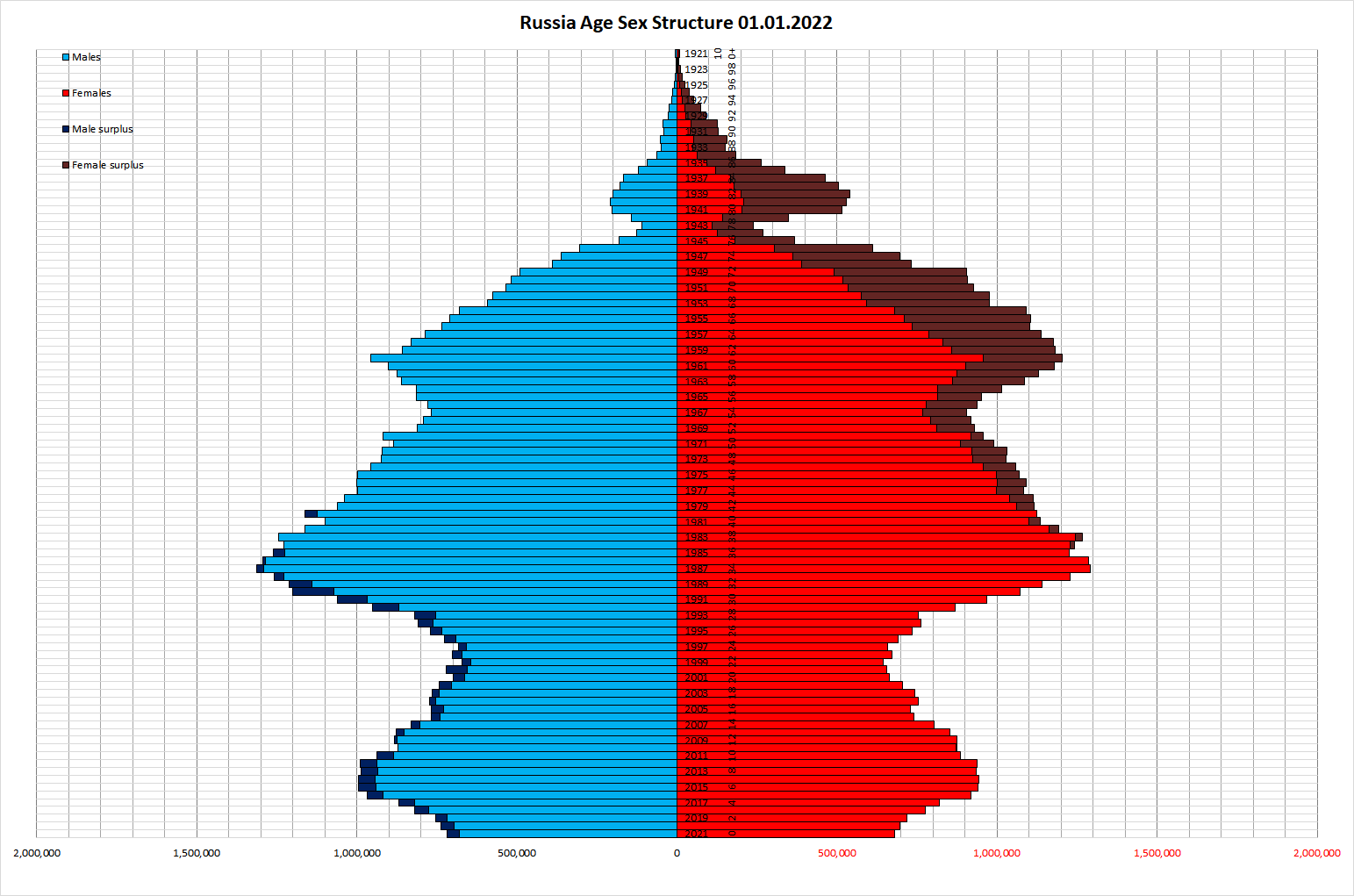
IMO this is getting a bit too ahead of ourselves. IIRC, Russia and Japan are the countries with the most population shrinkage, and they've just lost 5 million and 2.5 million people off their peak. - 5 million / 148 million is 3% down from peak for Russia. - 2.5 million / 128 million is 2% down from peak for Japan. Most importantly, Russia's population decline (which started before Japan's) has leveled off. It hit a…
Unless Japan's birthrate picks up, its population is slated to fall by a lot more than 2% from its peak. Try 50% or more. A birthrate below 2.1 children per woman leads to extinction.
[1]: https://en.wikipedia.org/wiki/Demographics_of_Japan#/media/F...
[2]: https://upload.wikimedia.org/wikipedia/commons/e/e8/Russian_...
Re: Global fertility has collapsed, with profound economic consequences
#176Earlier quoted context omitted.
Yeah most people saying they can't afford to have children probably are in the richest 10% of the world's population. They can absolutely afford a child.
The cost they don't want to pay isn't monetary, it's time/commitment. And to avoid the time/commitment, you need lots and lots of money, and even then you still lose control of your life; suddenly there's other forces that require you to do things you don't want to do.
Re: Global fertility has collapsed, with profound economic consequences
#177Earlier quoted context omitted.
IMO this is getting a bit too ahead of ourselves. IIRC, Russia and Japan are the countries with the most population shrinkage, and they've just lost 5 million and 2.5 million people off their peak. - 5 million / 148 million is 3% down from peak for Russia. - 2.5 million / 128 million is 2% down from peak for Japan. Most importantly, Russia's population decline (which started before Japan's) has leveled off. It hit a…
Russian population decline has been compensated for with a great number of immigrants from Central Asia (plus occupied Crimea; that's not recognized internationally but is obviously a factor for their economy). It'd probably be more like 138 million modulo those and their children, perhaps less.
[1]: https://data.worldbank.org/indicator/SP.POP.TOTL?locations=R...
Re: Global fertility has collapsed, with profound economic consequences
#178Earlier quoted context omitted.
IMO "AI" and Robotics will completely destroy any chance of this happening. Imagine armies of robots working 24/7 strip mining everything, logging everything, way faster and way smarter than people ever could. This is what we're making, this is what capitalism will absolutely love. There is no sign of any regulation here from governments, they will want it even more, "GDP! GDP! GDP!". I was really hopefully we'd actu…
Your vision is unrealistic. Society would eventually distill down to two bots trading increasingly large amounts of money between eachother until the end of time after first jettisoning themselves into space.
Re: Global fertility has collapsed, with profound economic consequences
#179Earlier quoted context omitted.
IMO this is getting a bit too ahead of ourselves. IIRC, Russia and Japan are the countries with the most population shrinkage, and they've just lost 5 million and 2.5 million people off their peak. - 5 million / 148 million is 3% down from peak for Russia. - 2.5 million / 128 million is 2% down from peak for Japan. Most importantly, Russia's population decline (which started before Japan's) has leveled off. It hit a…
Russia: Eh, no. That's just a temporary blip caused by a lot of the people born before 1945 not having made it that far, so the population was unnaturally skewed young. Few elderly to be dying off at the time because a large portion of those people died off 50-60 years prior. They're set for sharp decline going forward, and changes in geopolitics look likely to dry up or outright reverse their modest immigrant flows…
Russia's population pyramid does seem to suggest a big dip once the generation born in the 80s passes away, but it doesn't look like a reversed pyramid just yet. The generation born in 2021 doesn't seem considerably smaller than the one born 20 years ago [3].
[1]: https://en.wikipedia.org/wiki/Demographics_of_Japan#/media/F...
[2]: https://data.worldbank.org/indicator/SP.DYN.TFRT.IN?location...
[3]: https://upload.wikimedia.org/wikipedia/commons/e/e8/Russian_...
Re: Global fertility has collapsed, with profound economic consequences
#180There are quite a few comments here about "you need money to raise kids". There are similar statements made about housing size, cost, etc. and those end up on "but you don't need 8,000 sq ft to live!" These are, frankly IMHO, bizarre arguments that seem conditioned on socio-commercial training along the lines of "you need a diamond to propose!". Absolutely none of these are true: - People had sex and stable relations…
Isn't the fact that mothers are expected to drop their career and 100% focus on their children also a factor? Women instead decide not to have babies at all so they can have a career of their own.