According to Jim Keller, not dead:
https://www.youtube.com/live/oIG9ztQw2Gc?feature=share
This isn’t the best recording on YouTube but it’s late and I couldn’t quickly find the other one.
21–30 of 94 posts
https://www.youtube.com/live/oIG9ztQw2Gc?feature=share
This isn’t the best recording on YouTube but it’s late and I couldn’t quickly find the other one.
Earlier quoted context omitted.
"5 nm" does not correspond to any physical dimension, so it is nonsensical to compare to size of atom.
A nanometer is a well defined physical dimension. If we split a milimeter in a million parts, each one is a nanometer
People have been predicting its end for a long time.
Note also that it's about transistor cost, not about cpu performance - people sometimes think it is because performance used to be more correlated with transistor count.
According to Jim Keller, not dead: https://www.youtube.com/live/oIG9ztQw2Gc?feature=share This isn’t the best recording on YouTube but it’s late and I couldn’t quickly find the other one.
Earlier quoted context omitted.
"5 nm" does not correspond to any physical dimension, so it is nonsensical to compare to size of atom.
A nanometer is a well defined physical dimension. If we split a milimeter in a million parts, each one is a nanometer
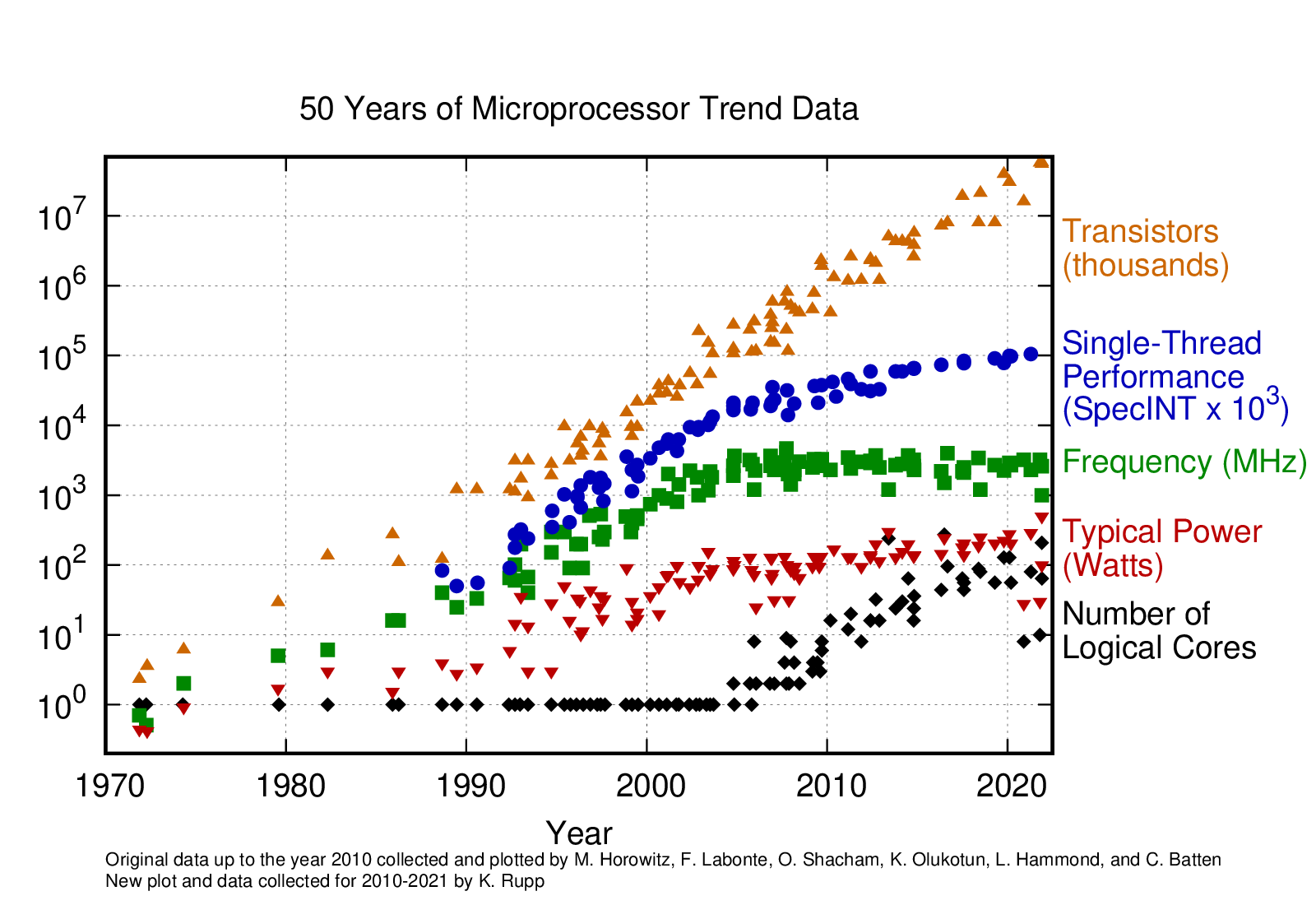
This graph to me show that while yes technically Moore's law of doubling transistor per "thing Intel or AMD sells you" is still holding, it has ended for single threaded workloads. Moore's law is only holding due to core count increase.
For everyday use of users running multiple simple programs/apps, that's fine. But for truly compute heavy workloads (think a CAD software or any other heavy processing), developers turned to GPUs to get the compute power improvements.
Writing amazing programs taking full advantage of the core count increase is simply impossible (see Amdahl's law). So even if one wanted to rearchitect programs to take full advantage of the overall transistor count from ~2005 to now, they won't be able to.
Compare with pre-2005, where one just had to sit & wait too see their CPU-heavy workloads improve... It's definitely a different era of compute improvements
In its original form as in "transistors double every two years" it certainly already seems over. Apple silicon is at 5mn today, and Intel claims they'll conquer 3mn by 2030, so even these facts and theoretical statements already don't fit anymore. We'll probably have a couple more innovations and might get to making a transistor out of a single atom (silicon atom is 0.262nm; carbon atom is 0.3). 5nm / (2*2*2*2) =~ 0.…
Really dumb question from someone who barely knows this stuff, but does quantum computing in theory reduce that size again if it takes off in the future?
Nvidia thinks that Moore's Law is dead. https://arstechnica.com/gaming/2022/09/do-expensive-nvidia-g... Intel, by contrast, says that Moore's Law is still alive. But Intel is technologically behind, and it is easier to improve when there is someone to learn from, so maybe there is a wall that they haven't yet hit. Regardless, it is a very different law than when I was young, when code just magically got faster each y…
Jensen aims to charge more for more GPU computing power into the future.
This is because Nvidia has close to monopoly power this is able to break Moores Law single handedly.
In its original form as in "transistors double every two years" it certainly already seems over. Apple silicon is at 5mn today, and Intel claims they'll conquer 3mn by 2030, so even these facts and theoretical statements already don't fit anymore. We'll probably have a couple more innovations and might get to making a transistor out of a single atom (silicon atom is 0.262nm; carbon atom is 0.3). 5nm / (2*2*2*2) =~ 0.…
Really dumb question from someone who barely knows this stuff, but does quantum computing in theory reduce that size again if it takes off in the future?