Live data from Hacker News

Language models can explain neurons in language models

openai.com

201–210 of 497 posts

Re: Language models can explain neurons in language models

#201

Seems like OpenAI is grasping at straws trying to make GPT "go meta". Reminds me of this Sam Altman quote from 2019: "We have made a soft promise to investors that once we build this sort-of generally intelligent system, basically we will ask it to figure out a way to generate an investment return." https://youtu.be/TzcJlKg2Rc0?t=1886

I have a similar feeling, they’ve potentially built the most amazing but commercially useless thing in history.

I don’t mean it’s not useful entirely, but I mean. It’s not useful in that it’s not deterministic enough to be trustworthy, it’s dangerous and really hard to scale therefore it’s more of an academic project than something that will make Altman as famous as Sergey Brin.

I personally take people like Hinton seriously too and think people playing with these things need more oversight themselves.
Re: Language models can explain neurons in language models

#202

Even if we can explain the function of a single neuron what do we gain? If the goal is to reason about safety of computer vision in automated driving as an example, we would need to understand the system as a whole. The whole point of neural networks is to solve nuanced problems we can't clearly define. The fuzziness of the problems those systems solve is fundamentally at odds with the intent to reason about them.

I have to agree.

I often think, “maybe I should use ChatGPT for this” then I realise I have very little way to verify what it tells me and as someone working in engineering, If I don’t understand the black box, I just can’t do it.

I’m attracted to open source, because I can look at the code understand it.

Re: Language models can explain neurons in language models

#203
post #178

Earlier quoted context omitted.

This is not a good take. Yes there is a lot more going on in brains than just neuronal activity, we don’t understand most of it. But understanding neurons and their connections is necessary (but not sufficient) to understanding what we consider intelligence. Also, 250k is a lot of neurons! Individual ants, as well as fruit flies which have even fewer neurons, show behavior we may consider intelligent. Source: I am no…

What's the argument that understanding neurons is necessary? Perhaps intelligence is like a black box input to our bodies (call it the "soul", even though this isn't testable and therefore not a hypothesis). The mind therefore wouldn't play any more of a role in intelligence than the eye. And I'm not sure people would say the eye is necessary for understanding intelligence. Now, I'm not really in a position to argue…

Why would you doubt neurons play a roll in intelligence when we've seen so much success in emulating human intelligence with artificial neural networks? It might have been an interesting argument 20 years ago. It's just silly now.

Re: Language models can explain neurons in language models

#204
post #178

Earlier quoted context omitted.

This is not a good take. Yes there is a lot more going on in brains than just neuronal activity, we don’t understand most of it. But understanding neurons and their connections is necessary (but not sufficient) to understanding what we consider intelligence. Also, 250k is a lot of neurons! Individual ants, as well as fruit flies which have even fewer neurons, show behavior we may consider intelligent. Source: I am no…

What's the argument that understanding neurons is necessary? Perhaps intelligence is like a black box input to our bodies (call it the "soul", even though this isn't testable and therefore not a hypothesis). The mind therefore wouldn't play any more of a role in intelligence than the eye. And I'm not sure people would say the eye is necessary for understanding intelligence. Now, I'm not really in a position to argue…

The other comments have pretty much covered it. We can pretty clearly demonstrate that neurons in general are important to behavior (brain damage, etc) and we even have some understanding about specific neurons or populations/circuits of neurons and their relation to specific behaviors (Grid cells are a cool example). And this work is all ongoing, but we're also starting to relate the connectivity of networks of neurons to their function and role in information processing. Recently the first full connectome of a larval fruit fly was published - stay tuned for the first full adult connectome from our lab ;)

Again, IANA neuroscientist, but this is my understanding from the literature and conversations with the scientists I work with.

Re: Language models can explain neurons in language models

#205

Earlier quoted context omitted.

What's the argument that understanding neurons is necessary? Perhaps intelligence is like a black box input to our bodies (call it the "soul", even though this isn't testable and therefore not a hypothesis). The mind therefore wouldn't play any more of a role in intelligence than the eye. And I'm not sure people would say the eye is necessary for understanding intelligence. Now, I'm not really in a position to argue…

Brain damage by physical trauma, disease, oxygen deprivation, etc. has dramatic and often permanent effects on the mind. The effect of drugs (including alcohol) on the mind. Of note is anesthesia which can reliably and reversibly stop internal experience in the mind. For a non-physical soul to hold our mind we would expect significant divergence from the above. Out of body experiences and similar are indistinguishabl…

“For a non-physical soul to hold our mind we would expect significant divergence from the above.”

This sounds like it assumes a physical mind could access a non-physical soul. All we probably know is that we have to be using an intact mind to use free will.

Re: Language models can explain neurons in language models

#206

Earlier quoted context omitted.

We know that complex arrangements of neurons are triggered based on input and generating output that appears to have some intelligence to many humans. The more interesting question is why are intelligence/beauty/consciousness emergent properties that exist in our minds.

Nature created humans to understand nature. We created GPT4 to understand ourselves.

Humans are the universe asking who made it.

Re: Language models can explain neurons in language models

#207
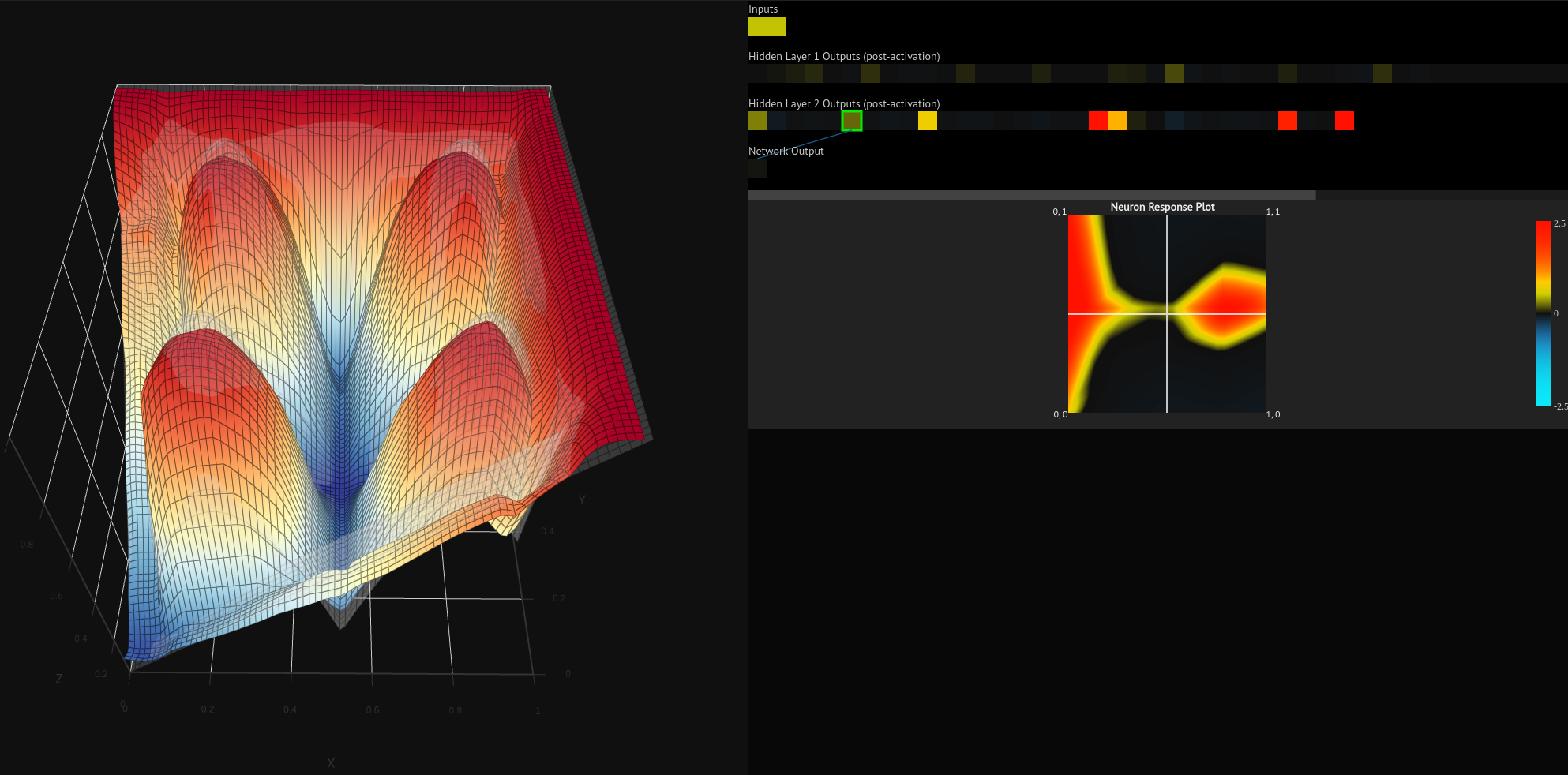
I built a toy neural network that runs in the browser[1] to model 2D functions with the goal of doing something similar to this research (in a much more limited manner, ofc). Since the input space is so much more limited than language models or similar, it's possible to examine the outputs for each neuron for all possible inputs, and in a continuous manner.

In some cases, you can clearly see neurons that specialize to different areas of the function being modeled, like this one: https://i.ameo.link/b0p.png

This OpenAI research seems to be feeding lots of varied input text into the models they're examining and keeping track of the activations of different neurons along the way. Another method I remember seeing used in the past involves using an optimizer to generate inputs that maximally activate particular neurons in vision models[2].

I'm sure that's much more difficult or even impossible for transformers which operate on sequences of tokens/embeddings rather than single static input vectors, but maybe there's a way to generate input embeddings and then use some method to convert them back into tokens.

[1] https://nn.ameo.dev/

[2] https://www.tensorflow.org/tutorials/generative/deepdream

Re: Language models can explain neurons in language models

#209
post #102
post #89

Of note: "... our technique works poorly for larger models, possibly because later layers are harder to explain." And even for GPT-2, which is what they used for the paper: "... the vast majority of our explanations score poorly ..." Which is to say, we still have no clue as to what's going on inside GPT-4 or even GPT-3, which I think is the question many want an answer to. This may be the first step towards that, bu…

> Which is to say, we still have no clue as to what's going on inside GPT-4 or even GPT-3, which I think is the question many want an answer to. Exactly. Especially: > ...the technique is already very computationally intensive, and the focus on individual neurons as a function of input means that they can't "reverse engineer" larger structures composed of multiple neurons nor a neuron that has multiple roles; This pa…

[deleted]

Re: Language models can explain neurons in language models

#210
post #89

Of note: "... our technique works poorly for larger models, possibly because later layers are harder to explain." And even for GPT-2, which is what they used for the paper: "... the vast majority of our explanations score poorly ..." Which is to say, we still have no clue as to what's going on inside GPT-4 or even GPT-3, which I think is the question many want an answer to. This may be the first step towards that, bu…

Funny that we never quite understood how intelligence worked and yet it appears that we're pretty damn close to recreating it - still without knowing how it works.

I wonder how often this happens in the universe...

Post reply on HN