Live data from Hacker News

Perennial rice: Plant once, harvest again and again

npr.org

71–80 of 296 posts

Re: Perennial rice: Plant once, harvest again and again

#71

I know Chinese harvest their rice up to three times a year. I don't see how perennial rice could compete. Harvesting normal rice is just grabbing entire plants, as many as you can grab at a time. I may know nothing about how harvesting perennial rice is supposed to work, but I grew up as a farmer and I have imagination. You have to leave some part of the plant for it to keep growing crop which means you can't just gr…

According to this quote:

> Perennial cultivars are strongly preferred by farmers; growing them saves 58.1% of labour and 49.2% of input costs in each regrowth cycle. In 2021, perennial rice was grown on 15,333 ha by 44,752 smallholder farmers in southern China.

Seems like it makes sense to them. The increased labor in harvest is probably offset by the decrease in labor for planting.
Re: Perennial rice: Plant once, harvest again and again

#72

(disclaimer that I manage a climate group, but not a rice expert) They touch on, but don't get into the details on one of the more interesting aspects of perennial rice. Rice fields are actually a huge emitter of methane. Depending on the accounting, they contribute as much to global warming as the aviation sector. The fields emit methane when flooded, the stagnant water gets oxygen depleted, and the biomass in the s…

> Depending on the accounting, they contribute as much to global warming as the aviation sector.

Methane's contribution to global warming is proportional to the rate of change on a window of ~20 years. Emitting methane doesn't warm the world. What warms the world is increasing its emission.

That focus on non-fossil fuel related methane emission is a huge piece of propaganda that people keep repeating. Most of those emissions were stable for decades. It's mostly fossil fuel related emissions that grew recently.

(But yeah, reducing the emissions will lead to a cooling of the world that can compensate some amount of CO2 emissions for a short term.)

Re: Perennial rice: Plant once, harvest again and again

#73

Earlier quoted context omitted.

Well, they've got fancy procedures in there, too: > So what our colleague Duyan Tao did - he, at an early stage, around 10 days after the [by-human-hand] pollination, went in there and dissected out the very young embryo that was developing and put it in tissue culture and gave it nutrients to help it grow. And then he rescued one of these seedlings. And that was the beginning of it. Also, the "old-fashioned genetic…

Arr we saying that cattle today are 4 times the weight of 400yrs ago?

Domestic animals in the Middle Ages were definitely smaller than today, you can see it in illustrations that depict agricultural work.

For people who lived in swampy areas (e.g. north of England), having lighter animals with longer legs was actually preferrable. Meat-and-fat balls of today would get stuck and drown in mires.

Re: Perennial rice: Plant once, harvest again and again

#74
post #65

Earlier quoted context omitted.

Can you elaborate on this? Do you mean that rice plants are actually absorbing methane earlier on, so they're just releasing the same amount? Or are they actually producing methane from other molecules, like water and carbon dioxide? Because yes, methane breaks down in the atmosphere into H2O and CO2 so you could view it as a cycle, but the more rice there is the higher the steady state methane in the atmosphere is,…

Yes, the whole point is that it is a cycle. The fields don’t affect by much the total number of carbon atoms in the atmosphere. Without the fields, other plants would grow there, then die, decay, and release carbon into atmosphere. At best, growing rice and flooding fields might affect the balance between the amount of methane and amount of CO2 in the steady state, but this is of no practical consequence, because the…

> but this is of no practical consequence, because the methane will not accumulate year over year, like the emissions from fossil fuels do.

Methane still takes 12 years to break down in the atmosphere, and it's more than 25 times as potent of a greenhouse gas than CO2.

CO2 concentrations are currently ~420 ppm, while methane is ~1866 ppb, or 1.9 ppm. If we assume methane is 25 times worse than CO2, that 1.9 ppm is the equivalent of 48 ppm CO2. Which is gigantic.

Doubling steady-state methane levels in the atmosphere would be a major problem. It would be like CO2 levels going from 468 to 516, yes a 10% increase. I don't know how you can call that "almost unobservable" when we're doing our absolute best to stop any increases. The fact that it's steady state doesn't really matter if it's still a major contributor, and/or if that steady state is increasing.

Re: Perennial rice: Plant once, harvest again and again

#75

(disclaimer that I manage a climate group, but not a rice expert) They touch on, but don't get into the details on one of the more interesting aspects of perennial rice. Rice fields are actually a huge emitter of methane. Depending on the accounting, they contribute as much to global warming as the aviation sector. The fields emit methane when flooded, the stagnant water gets oxygen depleted, and the biomass in the s…

"Rice is the national dish of the Philippines" -- A relative who worked in the Philippine government on RICE specifically His other quote was "we have this department because Rice needs to be on every plate, every meal" The flooding isnt to prevent weeds, its to prevent INSECTS, and rice is very water tolerant. --- So, wouldnt it be sane to say that perennial rice in a small growing area would be good.... also, have…

You could just give the rice a haircut. Plants do pretty well getting reasonably mowed.

Re: Perennial rice: Plant once, harvest again and again

#76
post #61
post #42

Earlier quoted context omitted.

Depends on the action. Gluing oneself to the street in order to prevent 5% of 2% of an industry that is rapidly shifting to EVs is questionable, for example.

Heard about someone who glued themselves to rails before a coal plant. Allegedly that prevented the equivalent of 800 years of average western european lifestyle emissions. Here I'm trying to get my own climate warming impact to be at least close to zero (and failing), and this dude has a 10x impact by doing nothing but sitting on rail for a bit. The cost is losing 9 months of their life on jail time. (Definitely an…

Is the idea that downstream consumers had an easier time retooling their processes to an entirely different power source than buying from a different coal plant? Questionable, at best.

Re: Perennial rice: Plant once, harvest again and again

#77

(disclaimer that I manage a climate group, but not a rice expert) They touch on, but don't get into the details on one of the more interesting aspects of perennial rice. Rice fields are actually a huge emitter of methane. Depending on the accounting, they contribute as much to global warming as the aviation sector. The fields emit methane when flooded, the stagnant water gets oxygen depleted, and the biomass in the s…

I am not convinced (I grew up on a farm). It is usually harder to get rid of any weeds when your crop is growing on the field. After harvest, you just get rid of everything, turn the soil (but I don't know anything about rice farming) and you kinda get a fresh start. ON THE OTHER HAND, we already have robots that can easily identify weeds with a camera and zap them with lasers or other shit. Which just seems so much…

With typical rice farming in Asia, you see manual transplanting of each seedling in to small fields by women and children. This is back-breaking work and extremely slow. I can't think of another crop both this widely cultivated and painstaking. Therefore, not having to do this is a huge win.

China has a multitude of climatic areas. Some harvest rice once per year, others two or three times per year. Even within Yunnan, the province in which tests are being made, all such areas exist.

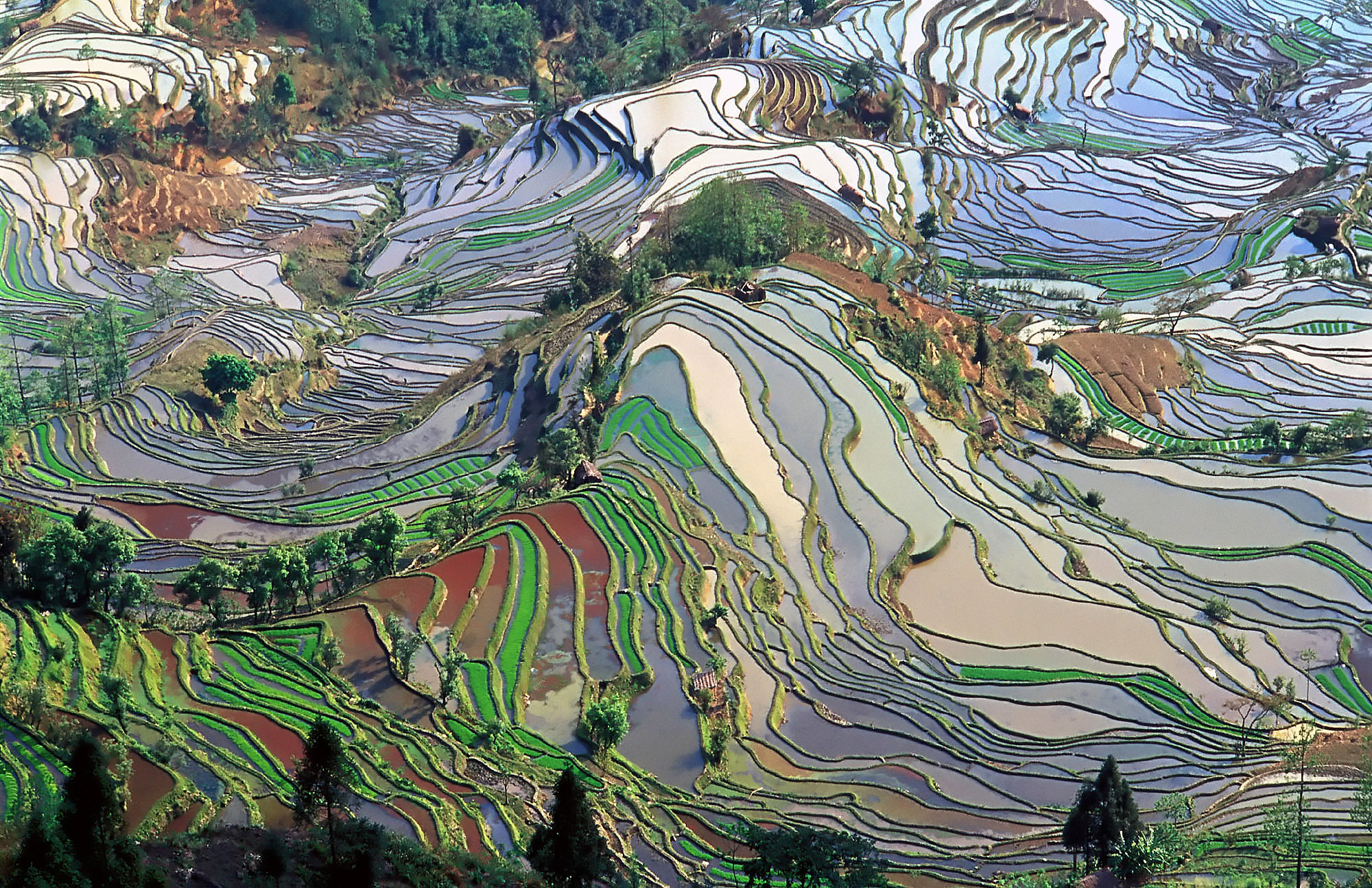
Many rice farms are small scale and on inaccessible land at the bottom of river valleys, terraced up hillsides, or otherwise inaccessible locations which would provide substantial scale-related and physical challenges to ease of automation. Try running an automated robot over this topography: https://upload.wikimedia.org/wikipedia/commons/7/70/Terrace_...

Re: Perennial rice: Plant once, harvest again and again

#78

(disclaimer that I manage a climate group, but not a rice expert) They touch on, but don't get into the details on one of the more interesting aspects of perennial rice. Rice fields are actually a huge emitter of methane. Depending on the accounting, they contribute as much to global warming as the aviation sector. The fields emit methane when flooded, the stagnant water gets oxygen depleted, and the biomass in the s…

I am not convinced (I grew up on a farm). It is usually harder to get rid of any weeds when your crop is growing on the field. After harvest, you just get rid of everything, turn the soil (but I don't know anything about rice farming) and you kinda get a fresh start. ON THE OTHER HAND, we already have robots that can easily identify weeds with a camera and zap them with lasers or other shit. Which just seems so much…

I am a farmer.

It is quite close to impossible for weeds to establish once many crops reach a certain stage, this is pretty consistent with the perennial idea.

Stripper headers are quote commonly used all over the world:

https://youtu.be/nppu5OfjisQ?t=90

The assertion that a perennial plant "cannot be damaged" is also incorrect, many perennial crops benefit agronomically from a "trim", even non-perennials have economic circumstances where it makes sense to "damage" the crop, e.g. grazing winter crops in the late fall.

https://extension.okstate.edu/fact-sheets/dual-purpose-wheat...).

Post reply on HN