Earlier quoted context omitted.
Google translate lets you correct a translation, right? Did people stop doing this at some point? Maybe after the advent of massively addictive social media, people more often ended up screenshotting it and sharing it for likes instead of correcting it. I'm sure Google have stats on this but no idea whether they're public.
I haven't seen the option to correct a translation in years.
Anyone else witnessing a panic inside NLP orgs of big tech companies?
441–450 of 527 posts
Re: Anyone else witnessing a panic inside NLP orgs of big tech companies?
#442Earlier quoted context omitted.
Why? Do you prefer magical "handwavy" thinking? A lot of things just fall in place if you accept an obvious fact that the brain is just a powerful enough function with certain inputs and outputs. Neurons are not that complicated. There are interesting consequences here though: no stable grammars, no truly uniform thinking, no singular way to understand people.
The 'handwavey' thinking here is from those who state as a 'fact' that the human brain is an LLM
So in this particular case of LLMs we've managed to optimise our way around having specialised brain structures using a powerful enough math function. Next steps require improvements in how the model is trained, how we can reduce the amount of training data, what additional machinery might be necessary, etc...
But, damn it, this very thing that makes humanity possible - our language - is solved now. Natural language is a solved problem now. That very thing that makes complex societies possible - it's done. This is the fact. And it is crazy.
EDIT: typos
Re: Anyone else witnessing a panic inside NLP orgs of big tech companies?
#443Earlier quoted context omitted.
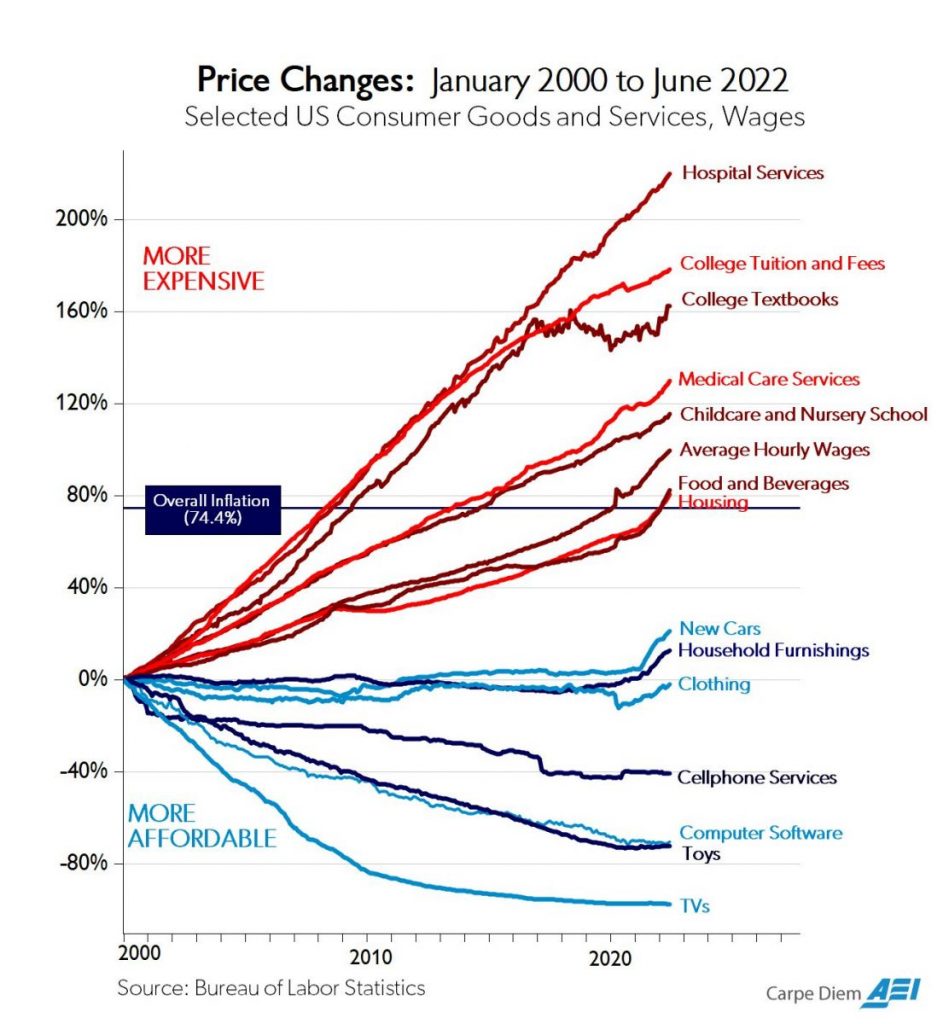
I think you and the one you're replying to are both very right. Yes, more of this money is going, instead of middle-class workers, straight to the capital class who own the "machines" that do the work people used to do. Except instead of it being a factory that makes industrial machines owned by some wealthy industrialist, the machines are things like Google and AWS and the owners are the small number of people with…
Look .. I am one of the working class here. But I gotta point out. Our standard of living is far superior to someone living in 1970 when it comes to stuff/technology. The stuff is cheaper because of China/globalization. The tech is there because we outsourced production and kept specializing the work force. I don't think UBI is the solution. Nor is squeezing people more than they are being squeezed. Efficiency and pr…
I'm pretty sure the latter 3 are more important to standard of living than the former.
Ergo, I believe your claim that standard of living is superior to 1970 is false. Having a shiny iPhone to distract you from the fact that you're homeless, sick and starving is not a step up.
[0] https://mpost.io/wp-content/uploads/975d2151-7def-45a4-8c52-...
Re: Anyone else witnessing a panic inside NLP orgs of big tech companies?
#444Earlier quoted context omitted.
I've just started testing GPT-4 on translation from Japanese to English, but it seems to blow Google Translate out of the water. It was particularly good with a novel excerpt. I encourage people to try it with a variety of languages and texts to see if those results hold up.
It would be useful to know whether you know both languages or just English. Not trying to poke holes, just clarifying.
Re: Anyone else witnessing a panic inside NLP orgs of big tech companies?
#445Earlier quoted context omitted.
The 'handwavey' thinking here is from those who state as a 'fact' that the human brain is an LLM
Well, I didn't say a brain is just an LLM. It's more complicated than just this. But what LLM showed is that it works using the same simple building blocks + specialised parts of the brain: memory, constant relearning and world input, etc. So in this particular case of LLMs we've managed to optimise our way around having specialised brain structures using a powerful enough math function. Next steps require improvemen…
(I did feel excitement while following the development of AlphaZero and its played Go matches, but that was because it was revealing greater depths and beauty in the human created game of Go. And I maintain some interest in following the development of self-driving, particularly by Tesla.)
With regard to LLMs I can see how they could be useful. I think more particularly useful when they work from a constrained corpus, so the user can know what they're drawing from (and thus the limitations of that knowledge base). The example site that been posted by its maker to HN [1] where you can ask questions against a particular book is a good one for showing the use of the tool I think. But it's just a tool and it's not in any way a breakthrough in our understanding of ourselves, of cognition or anything like that. I think the people who are making these claims can't distinguish science fiction from actual reality. They are fantasists and I think they are leading themselves and others into delusion.
Re: Anyone else witnessing a panic inside NLP orgs of big tech companies?
#446Earlier quoted context omitted.
Uh-huh. How's them NFTs and Blockchain doing the watershed world changin these days?
Your comment seems almost intentionally obtuse... How's them internet and smartphones doing the watershed world changing these days?
Same for the internet - things changed, but the breathless predictions that retails stores are dead and everyone will be WFH haven't happened. It became a tool.
So will ChatGPT - I look forward to good autocomplete and a nice bullshitter-in-a-box tool to generate these HN comments. But most jobs aren't improved or more productive by adding a faster bullshit generator. The bullshit generators in suits are already really good at that.
Re: Anyone else witnessing a panic inside NLP orgs of big tech companies?
#447Earlier quoted context omitted.
It would be useful to know whether you know both languages or just English. Not trying to poke holes, just clarifying.
No problem. My first language is English, but I worked as a Japanese to English translator for twenty years and have written books in Japanese. My personal website is linked from my user page.
Re: Anyone else witnessing a panic inside NLP orgs of big tech companies?
#448Earlier quoted context omitted.
I think you and the one you're replying to are both very right. Yes, more of this money is going, instead of middle-class workers, straight to the capital class who own the "machines" that do the work people used to do. Except instead of it being a factory that makes industrial machines owned by some wealthy industrialist, the machines are things like Google and AWS and the owners are the small number of people with…
Look .. I am one of the working class here. But I gotta point out. Our standard of living is far superior to someone living in 1970 when it comes to stuff/technology. The stuff is cheaper because of China/globalization. The tech is there because we outsourced production and kept specializing the work force. I don't think UBI is the solution. Nor is squeezing people more than they are being squeezed. Efficiency and pr…
Well, we (in the US), have slowly been privatizing them and it’s bad! If you look at test results though, it’s great! Because private charter schools can drop underperforming students before the end of the term and artificially inflate their numbers. There are many more reasons that education with a profit motive isn’t better than without. I suggest maybe reading up on this before casually suggesting how you think we should radically erode our institution.
Re: Anyone else witnessing a panic inside NLP orgs of big tech companies?
#449Earlier quoted context omitted.
I'm interested to hear what these techniques are. Decreasing the generality will help, but I fail to see how that scopes the output. At best that mitigates the errors to an extent.
Requiring the answers to automatically verifiable, or having answers be inputs to a reliable query system?
Re: Anyone else witnessing a panic inside NLP orgs of big tech companies?
#450Earlier quoted context omitted.
I developed a new static analysis (a type system, to be precise) to guarantee statically that a concurrent/distributed system could fail gracefully in case of (D)DoS or other causes of resource exhaustion. Other people in that field developed comparable tools to statically guarantee algorithmic space or time complexity of implementations (including the good use of timeouts/resource sandboxes if necessary). Or type sy…
Is there a good resource (a review paper maybe?) to get an overview over such programming language / type system topics?
Perhaps looking at the proceedings of ICFP and POPL can help?