Live data from Hacker News

Can the West’s perplexing employment miracle continue?

economist.com

251–260 of 298 posts

Re: Can the West’s perplexing employment miracle continue?

#251

Earlier quoted context omitted.

For reference, my mortgage from 13 years ago was 4.85%, the one I got 6 months ago was 4.25%, about 1.5 years ago we got 2%. When I was born in the early 80's, my parents were doing 12%. Of course, housing prices adapt so that banks always extract a nice, steady amount from the people. Even more nowadays, when there's more to extract because more women started working. More to the daycare, more to the banks, the Amer…

Maybe a hot take but I feel like high(er) interest rates for homes should be the standard. This allows for demand to be modulated, and puts up a barrier to rent seekers from flooding the market. The problem is that over the past 5-10 years a lot of property has already been snapped up by investors at minimal interest rates, so as long as rents stay somewhat stable, they investors will be raking in the returns. I gues…

The easiest ways to put up barriers to rapacious landlords are:

- prevent corporations from owning residential property

- tax property rental income at a substantially higher rate than income and exempt it from other deductions

- tax residential property which is empty for more than de minimis periods at an eye-watering rate (perhaps 5-6x standard property taxes).

None of this requires higher interest rates, but it will result in a transfer of wealth away from aging boomers and corporations, which apparently must be avoided at all costs.
Re: Can the West’s perplexing employment miracle continue?

#252

Earlier quoted context omitted.

Maybe a hot take but I feel like high(er) interest rates for homes should be the standard. This allows for demand to be modulated, and puts up a barrier to rent seekers from flooding the market. The problem is that over the past 5-10 years a lot of property has already been snapped up by investors at minimal interest rates, so as long as rents stay somewhat stable, they investors will be raking in the returns. I gues…

Nitpick: Rent-seeking is a specific economic activity that doesn’t mean “buying property with the intent to rent it out”. Rent-seeking is an activity where the perpetrator creates legal barriers that result in them collecting money without providing anything of value. Many people hate on landlords, but unless they’re also actively restricting new supply, they’re not rent-seeking as the term is defined.

To be fair, I'm sure those investors are NIMBYs for new housing.

But I agree with your point.

Re: Can the West’s perplexing employment miracle continue?

#253

Earlier quoted context omitted.

I agree with most of this, but birth rates are not relevant. Note that Japan has had a very low fertility rate for years but still has folks for all those make-work jobs. In the U.S. what changed over the past 5 years is legal immigration: it was drastically cut and has not been restored. So as citizens and existing long-term residents pursue better jobs or time at home, there are far fewer new residents eager for lo…

Immigration is a method of wage suppression. The issue is that the businesses don't want to cut into their profits to raise wages to attract native/local workers.

The government can of course "attract native/local workers" and curb this immigration via means such as raising the minimum wage. When the state doesn't want to, it means that the state and business are working together on this against such native workers. It's of course never as simple as "Immigration is this". You might as well say that "low minimum wage" is the sole root cause.

Re: Can the West’s perplexing employment miracle continue?

#254
post #233

Earlier quoted context omitted.

It depends on a person's financial situation, from my understanding: if you have a lot of debt(which the average USA household does), you benefit greatly the more inflation goes up. If you have money sitting in the bank, you're basically getting eaten alive. If you have assets, they typically should be tracking inflation somewhat(real estate, some stock categories, TIPS, etc...). People will be in between any of the…

how is a saver getting eaten alive when high yield savings accounts and short term t-bills are paying 5% holding cash is paying something for the first time in more than a decade

Because you don't care about the number in your bank account, you care about what you can buy with that number.

Park your cash in a 5% instrument for a year and you can still afford 3-4% less stuff than you could at the beginning of the year.

That's fine for me with a mortgage, but less retirement headroom for many older people.

Re: Can the West’s perplexing employment miracle continue?

#255
post #212

Earlier quoted context omitted.

Are houses today the same as houses in 1989? Seems like you'd need a much more detailed analysis than median price to compare apples to apples.

That doesn’t matter to buyers. If the housing stock is too expensive for the population there can be many causes, and higher quality or larger size housing is just another cause. The causes of the high prices don’t matter to buyers, all they know is they can’t afford to buy. What use is it to them that the homes they can’t afford are better quality?

With the amount of housing turnover in the past few years, to me it seems that plenty of people can afford to buy. Actually an unfortunate amount.

Re: Can the West’s perplexing employment miracle continue?

#256
post #72
post #9

We have gone from a zero interest rate economy to a high interest one within months. Whoever claims to accurately predict what's going to happen in the next few years is talking out of their ass. We know inflation should start decreasing within a year or so, but you cannot predict how millions of people will react to suddenly not being able to afford stuff.

Accurate prediction: Job data trails rate increases by many months. So do recessions. If the fed levels off interest rates within the next year or so, we have a very good chance of avoiding a recession. I am young/old enough to remember the last time interest rates were this high, and we were BOOMING. If the fed pushes the gas on interest rates, it will likely push us into a mild recession. Thanks (covid!) to million…

> we have a very good chance of avoiding a recession

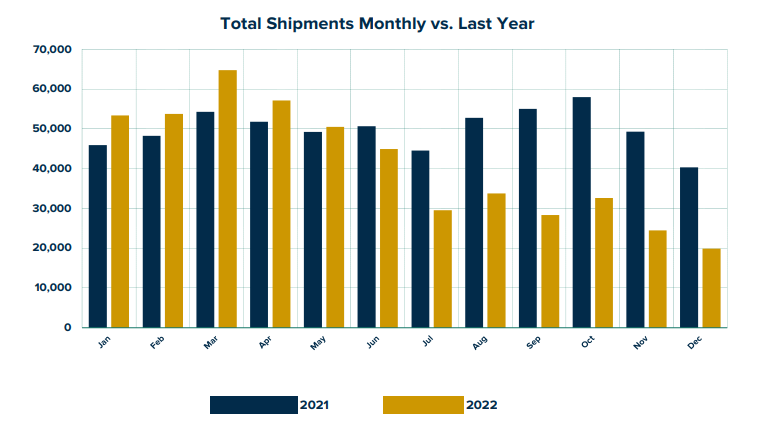
Not sure that's the case, I work in RV, which is a leading indicator for recession and recovery. RV volumes have been getting hammered for the last 8 months. OEM mfg numbers are down over 50% year on year. [1] Sure it's just one small segment of the overall economy, but things are getting strange out there.

[1] https://rv-pro.com/wp-content/uploads/2023/01/Shipments2.png

Re: Can the West’s perplexing employment miracle continue?

#257

Earlier quoted context omitted.

> Is the norm really that home loans are unaffordable even to first-time-buyer DINKs with good-to-decent six figure jobs who just want a place to live? The home loans are unaffordable because the house prices are too high. The median house price in 1989 was around $95K ($230K adjusted for inflation). Today it's about $400K.

Are houses today the same as houses in 1989? Seems like you'd need a much more detailed analysis than median price to compare apples to apples.

Given that the median age of a home in 2019 was 39, that puts half of today's housing stock as being built in 1980 or before. So most of "today's houses" are literally the same houses that were present in 1989, just with three decades of additional depreciation. This is even worse in older, populous parts of the country like California and the Northeast that haven't built as many new homes as in the Southeast. In California and New York, for instance, people are squabbling to pay $1m+ for 43-60 year-old homes. People today are paying more, and getting less for their money.

https://eyeonhousing.org/2021/03/age-of-housing-stock-by-sta...

Re: Can the West’s perplexing employment miracle continue?

#258
post #245

Earlier quoted context omitted.

> The problem is not their refusal to accept foreigners but rather they are not fixing the real problem (low birth rates). How can you fix low birth rates once the process is in decline? Are there any successful examples of a country that has gotten rich, or is getting rich, that has done it succesfully? Every example I've read says no, regardless of geography or culture. It seems an impossible problem to fix. In Sou…

It does not seem impossible to me: once there is a falling population, the house price pressure should ease. And no country has really pushed for paying people to have children.

No country has pushed for paying people to have children... er what? This is simply false.

Plenty of countries have monthly child benefit payments, just a few examples I know of [1], [2] [3] [4]. You can easily google "child benefits [country]" to find loads more examples. There are direct government payments and/or tax breaks in many countries. Countries with decent social welfare systems usually have some form of financial support during parental leave, for both mothers and fathers too.

These efforts don't really have much of an impact to raise birth rates.

[1] https://www.citizensinformation.ie/en/social_welfare/social_...

[2] https://www.iamexpat.de/expat-info/social-security/child-ben...

[3] https://www.citizensadvice.org.uk/benefits/child-benefit/bef...

[4] https://edition.cnn.com/2022/12/03/asia/south-korea-worlds-l...

Re: Can the West’s perplexing employment miracle continue?

#259

Earlier quoted context omitted.

I agree with most of this, but birth rates are not relevant. Note that Japan has had a very low fertility rate for years but still has folks for all those make-work jobs. In the U.S. what changed over the past 5 years is legal immigration: it was drastically cut and has not been restored. So as citizens and existing long-term residents pursue better jobs or time at home, there are far fewer new residents eager for lo…

Immigration is a method of wage suppression. The issue is that the businesses don't want to cut into their profits to raise wages to attract native/local workers.

Immigration can be used to suppress wages, if there are way more workers than jobs.

The other end of that balance produces high inflation, as employers have to continuously raise wages to recruit from competitors, and continuously raise prices to cover increasing wage expense.

Re: Can the West’s perplexing employment miracle continue?

#260
post #110

Earlier quoted context omitted.

There's a serious housing shortage. https://www.npr.org/2022/07/14/1109345201/theres-a-massive-h... Worryingly, the higher interest rates are making it more difficult to construct the housing we so desperately need in so many places.

There is a housing shortage because large, often foreign, organizations are buying up all of the housing stock. Mom & Pop trying to get a couple of AirBnB's ain't helping either.

Institutional investors represent less than 10% of home sales. Even still, they're buying houses because they realize there aren't enough of them. If we had enough houses it wouldn't be profitable for them to buy them.
Post reply on HN