Live data from Hacker News

Connecting a 1980s Pinball Machine to the Internet

eli.lipsitz.net

11–20 of 51 posts

Re: Connecting a 1980s Pinball Machine to the Internet

#11
post #5

Earlier quoted context omitted.

Yeah, definitely if people are interested. Let me clean up the repo a little bit first :) It's probably hard to directly apply this to other machines, but the interposer board idea would make it easy to take the same hardware and use it on any MC6808-based machine.

I am a pinhead! Actually on my way to a tournament right now. So yaaas please more info on this : ). Is the. Openpinball framework involved in this?

Nope, I actually hadn't even heard of Open Pinball before. Looks cool though!

It'd be nice if there were an open standard for pinball machines talking to score servers. For this project I had to do everything custom. If people started putting ESP32s on their pinball controllers there might be some actual demand for something like that.
Re: Connecting a 1980s Pinball Machine to the Internet

#12
Damn, this is amazing. I took up a lot of hobby electronics using Raspberry Pi 4 Model B and Pico Ws during the pandemic. I stopped short of custom PCBs or reviewing circuit schematics, but this makes me want to search out a basic project that would require doing so.

Re: Connecting a 1980s Pinball Machine to the Internet

#13
Amazing, we are currently doing something very similar at our makerspace on a 1987 Road Kings pinball machine.

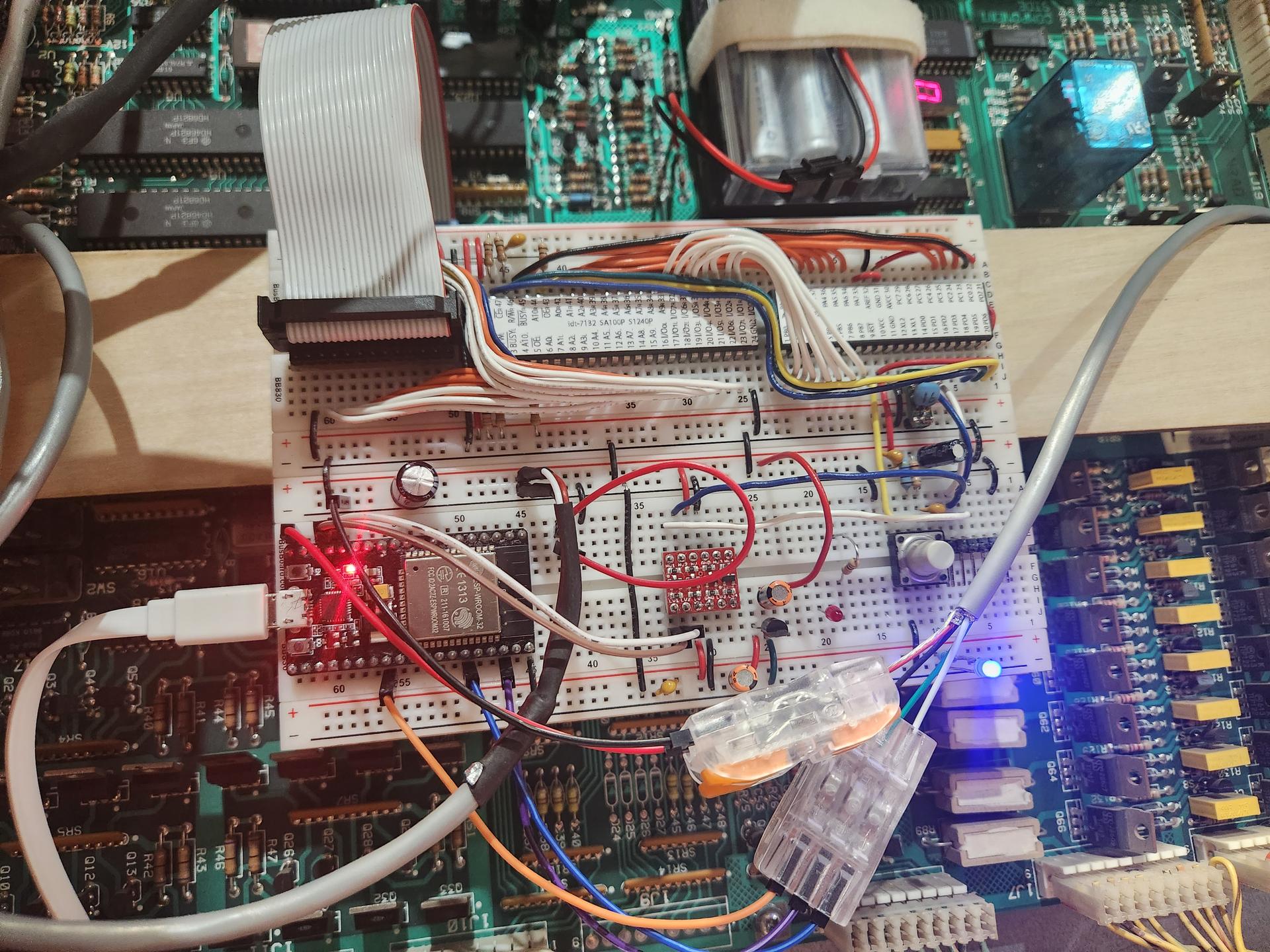
We first replaced the original RAM chip with a IDT 7132 SA100P dual-port RAM that sits on a breadboard:

https://pic.t0.vc/WPUO.jpg

The other port is accessed by an ATmega 1284 to the left of it. Its code responds to simple serial commands and can read and write to the RAM.

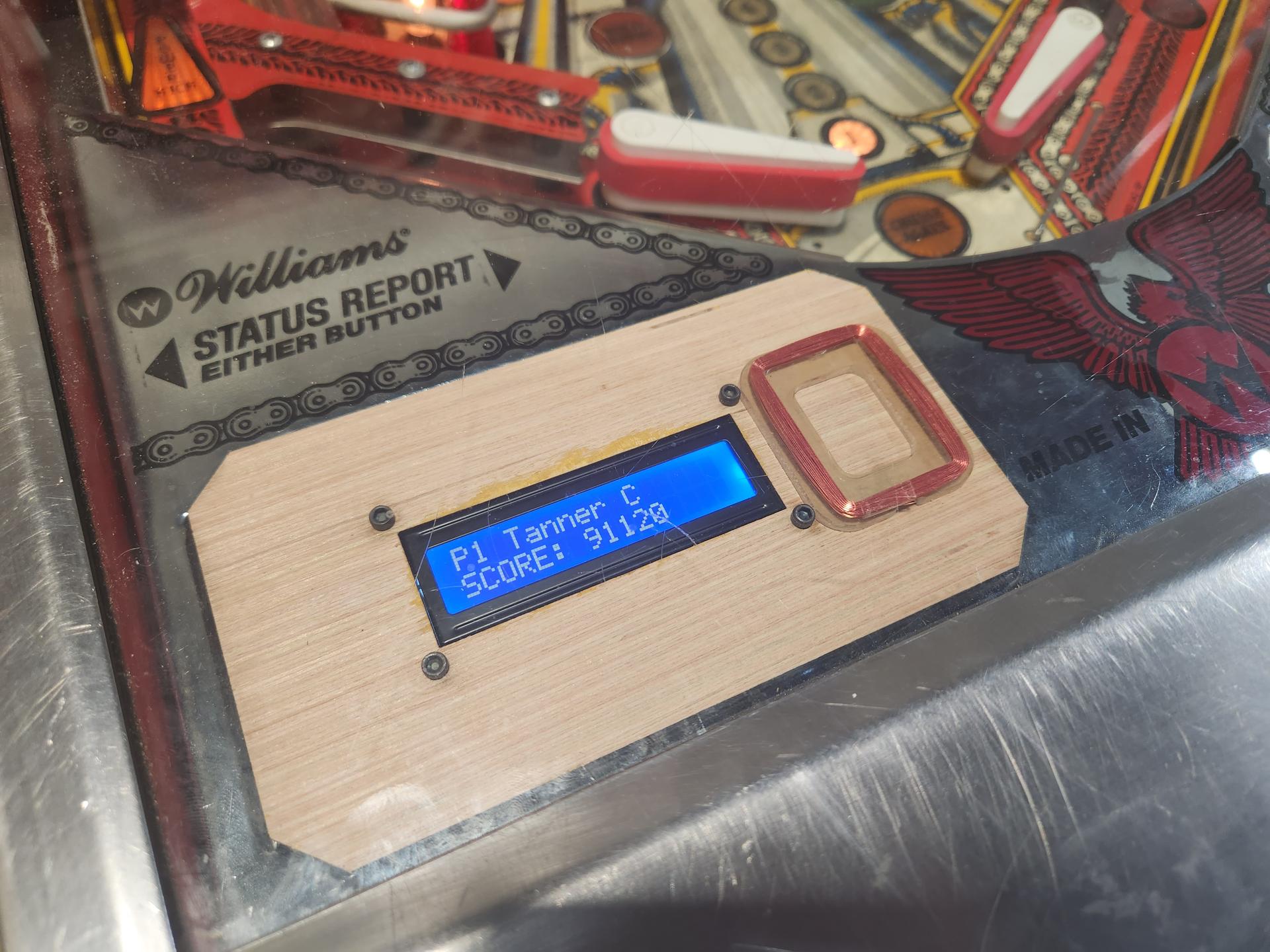
An ESP32 talks to the ATmega over UART and frequently asks it to dump 16 bytes at 0x00A0 to tell the game state and player number, and 0x0100 to get the four player scores. When it detects a new game, it offers the player a chance to scan their RFID member card and keeps track of their score:

https://pic.t0.vc/UQYK.jpg

After the game is complete, any players who have scanned in get their scores uploaded to our member portal where we can sort them by personal best:

https://pic.t0.vc/MZGY.png

We found there were sometimes read collisions and the ATmega would block the pinball machine from writing to RAM which would cause crashes or odd behavior. The latest version uses two RAM chips, one acting as a shadow copy -- similar to yours.

Eventually we'll make a PCB for it and open source everything. Currently only half the code (the ESP32) is on Github: https://github.com/Protospace/pinballwizard

Re: Connecting a 1980s Pinball Machine to the Internet

#14

Earlier quoted context omitted.

JLPCB and a few others offer 2-4 day service as well. The scene exploded a couple years back and it keeps growing.

I started off as an EE in college ~20 yrs ago before switching to CS. I did some circuit board design work (never fab) as part of my coursework, but haven't touched it since. I have some baseline familiarity. I think we used pSpice and Cadence, which (at the time) still had a lot of Win 3.1 era MFC UI elements. I'd like to jump back into it for hobby reasons. Any recommendations on modern low-budget software-tooling?

> Cadence, which (at the time) still had a lot of Win 3.1 era MFC UI elements

I'm not sure how it appeared on windows, but cadence is the kind of software with an extremely long history. I'm pretty sure even recent releases have code that date back to the 70s.

As far as I know, it has always targeted UNIX, then X11, using raw XLIB for drawing? X11 forwarding still seems to be the preferred option for using it.

Anyway, try kicad, which is free and open, it has made great strides recently. You can also look at the gEDA suite, though it may be a bit rough. Commercially, I've also used Eagle and Proteus. LTSpice still is a pretty good no-$ option for simulations (though kicad integrates some barebones SPICE simulator now).

Re: Connecting a 1980s Pinball Machine to the Internet

#15

It just floors me that today you can order up a custom PCB for a few dollars if you are willing to wait a few weeks. What a world.

The pinball community as a whole has been doing really cool things like this for years. Custom soundtracks for older games and now more recently we're seeing total rewrites of the rules/coding flashed onto chips or new PCBs like this. Super cool stuff.

Re: Connecting a 1980s Pinball Machine to the Internet

#17

Amazing, we are currently doing something very similar at our makerspace on a 1987 Road Kings pinball machine. We first replaced the original RAM chip with a IDT 7132 SA100P dual-port RAM that sits on a breadboard: https://pic.t0.vc/WPUO.jpg The other port is accessed by an ATmega 1284 to the left of it. Its code responds to simple serial commands and can read and write to the RAM. An ESP32 talks to the ATmega over U…

Awesome! I really like the idea of scanning an RFID card to identify players.

Re: Connecting a 1980s Pinball Machine to the Internet

#18

Next level awesome stuff! It's like Stern Insider hacked into older games. Amazing! Do you think this could be transferred and applied to other System 7 games?

Thanks! Yeah, it would work on any System 7 game, as long as you’re willing to solder in the 2x20 connector to the MPU. All of the memory locations should be exactly the same.

Re: Connecting a 1980s Pinball Machine to the Internet

#19

Amazing, we are currently doing something very similar at our makerspace on a 1987 Road Kings pinball machine. We first replaced the original RAM chip with a IDT 7132 SA100P dual-port RAM that sits on a breadboard: https://pic.t0.vc/WPUO.jpg The other port is accessed by an ATmega 1284 to the left of it. Its code responds to simple serial commands and can read and write to the RAM. An ESP32 talks to the ATmega over U…

Can this be used on any System 11 game? And can it be used to read the current state of the alphanumeric display?

Re: Connecting a 1980s Pinball Machine to the Internet

#20

It just floors me that today you can order up a custom PCB for a few dollars if you are willing to wait a few weeks. What a world.

The pinball community as a whole has been doing really cool things like this for years. Custom soundtracks for older games and now more recently we're seeing total rewrites of the rules/coding flashed onto chips or new PCBs like this. Super cool stuff.

I have a "reset board" for WPC games that is many years old at this point. It piggybacks on the power connector from the power board to the system board and steps down the unregulated 12v supply to power the 5v rail, bypassing the power board's 5v which can become unreliable as voltage regulators age and fail, triggering a watchdog on the system board that causes a reset. It is a plug-in mod that is reversible (I actually do not currently use it).

Also you can buy new boardsets for System 11 machines in both kit and complete form. They are electrically identical to the Williams parts but use modern components. They even come on red PCBs like the Williams development boards.

Post reply on HN