Live data from Hacker News

We are ‘greening’ ourselves to extinction

aljazeera.com

51–60 of 209 posts

Re: We are ‘greening’ ourselves to extinction

#51

> But this fallacy has been repeatedly exposed. For one, the organisations that are supposed to certify that indeed enough tree-planting has taken place do not have the tools to verify that the declared emissions will definitely be absorbed. Another problem is that many offsetting activities do not actually offset anything. > A recent investigation into the world’s largest carbon standard found that 94 percent of its…

> When I looked at the offset market in the past, I realized that it was one of the few markets where both the buyer and seller are perfectly happy with fraud. > I can't think of many other markets where this dynamic exists. Recycling market is the same - UK government pays you to recycle plastic, £60 per tonne. You find someone in a 3rd world country that will take it off your hands for £30 per tonne, and pocket the…

Or they illegally burn it!

Re: We are ‘greening’ ourselves to extinction

#52
post #40

> the push to replace fuel-engine vehicles with electric ones As opposed to what, replacing cars with public transit? It takes a serious amount of hubris to look at the world and think that we can just wave a magic wand and make public transit work in places that largely rely on cars (even in Europe, which is much denser and more friendly to public transit, there are a lot of personal cars). We will run out of oil wa…

We could make it harder and harder to use/own a car: more expensive, difficult to park, slower to use, etc. Then people would seek out other solutions by themselves, be it using a bike, public transport, or moving less (asking for more remote work options, for instance). We don't seem to even be trying to do this and it's depressing.

This is a matter of politics. Right now the majority of the population doesn't agree with your position. That's the problem you have to solve. The real difficulty there is that people are by nature concerned more about near-term, local events. If you try too hard to make their life more expensive and difficult, they'll just vote you out of power.

Re: We are ‘greening’ ourselves to extinction

#53
post #34

I’m okay with all greening as long as it allows me to continue my lifestyle.

Unironically this is how most of the first world thinks while expecting us from the third to completely change our lifestyles and don't we even dare to try to develop the same way you guys did.

Re: We are ‘greening’ ourselves to extinction

#54

> But this fallacy has been repeatedly exposed. For one, the organisations that are supposed to certify that indeed enough tree-planting has taken place do not have the tools to verify that the declared emissions will definitely be absorbed. Another problem is that many offsetting activities do not actually offset anything. > A recent investigation into the world’s largest carbon standard found that 94 percent of its…

> both the buyer and seller are perfectly happy with fraud.

Many people fully believe that they are making the world a better place, they are not "happy with being deceived" but they are just ignorant. This is like saying that the tobacco industry lies make both happy. That is only true as far as the buyer, the smoker, does not find the true, sometimes in a very hard way.

And your argument also applies to economic scams. If I invest all my money in a fund and think that I am getting a 20% return, I may be happy because I do not know that the bank has lost all my money. So, I am happy until I know the true.

Here, all the fault is in corporations that lie and scam people. The consumers are just trying to be good people. Your assumption that people does not want to know the true seems very profitable for scammers.

Re: We are ‘greening’ ourselves to extinction

#55
The article accuses greentech and carbon-credits of genocide: "While guaranteeing high returns, this deception is tantamount to the genocide of the hundreds of millions of people who will perish from the effects of climate change within the next century because things are that bad."

That's pretty harsh. But, if you think "things are that bad," let's also consider the moral culpability of people trying to stop the scientific study of geoengineering: https://www.solargeoeng.org/

Scientifically, stratospheric aerosol injection works: IPCC gives "high agreement that it could limit warming to below 1.5°C" with a material cost of less than $10B per year. https://en.wikipedia.org/wiki/Solar_geoengineering

But, as we all know, it is intellectually unacceptable to be an advocate for geoengineering. For some reason, "Thou shalt not believe in a technological solution to global warming." Instead, billions of people need to voluntarily (or not) dramatically reduce their lifestyle. I really don't get it. Any insights?

Re: We are ‘greening’ ourselves to extinction

#56

"Fossil Future" is an interesting book on this topic that argues we need to use more fossil fuels instead of less. And it makes me kind of agree with the author, since I learnt that solar and wind only makes sense to use where it can offset the carbon footprint that it created when it was manufactured. I totally vote for nuclear, and I hope that it picks up, but we'll need fossil fuels for multiple industries anyway…

> solar and wind only makes sense to use where it can offset the carbon footprint that it created when it was manufactured IIRC, PV panels become (on average) carbon neutral after three years of operation. Given the lifespan, this suggests that there are very few locations you can put them where they won't more than pay back the carbon emitted in their production. I'm a former nuclear fan. In anything like its curren…

> PV panels become (on average) carbon neutral after three years of operation

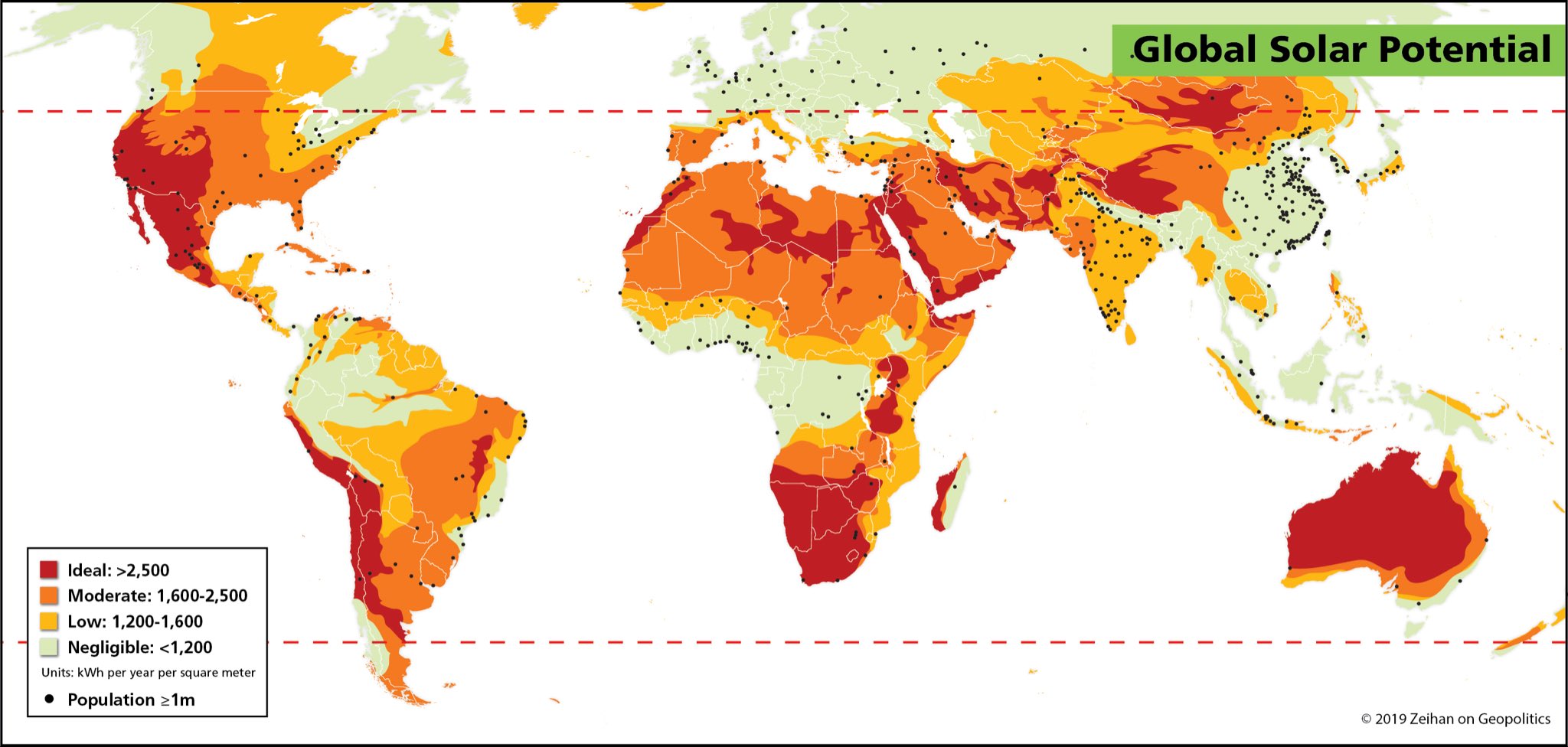
That depends on where you install them. Almost anywhere in Europe it doesn't make sense to use solar, and yet they're doing it.[1]

[1]: https://pbs.twimg.com/media/Fn4clWEWAAkadtu.jpg:large

Re: We are ‘greening’ ourselves to extinction

#57
post #42

Earlier quoted context omitted.

Just a reminder that all this car infrastructure is max ~100 years old, and most non-North-American cities are older than 100 years. Human civilization just might last more than 100 years, so anything done in 100 years can be undone. To put it another way, if you told people 100 years ago that we'd need to build 63,000 gas stations and 4 million miles[1] of highway in the US, they'd think you're crazy. It would seem…

> Just a reminder that all this car infrastructure is max ~100 years old 100 years ago we had one third the population we have today. Undoing that kind of development in another 100 years is plausible, but I suspect the oil problem will have resolved itself around that time anyway. And installing the same size network of public transit is far more expensive than paving that many miles of roads. Vastly, incredibly, in…

> Vastly, incredibly, insurmountably more expensive.

I don't know why you chose to exaggerate here, but rail lines are +/- the same cost per mile as interstate highway, and that's without the economies-of-scale benefit that comes from there being 100x the number of interstate miles. They're also vastly cheaper in terms of materials; the cost is mainly not materials. Concrete production is also extremely CO2 and energy intensive. Unsurprisingly, a boring 19th century technology deployed with vastly less energy and raw materials is more efficient. We're moving backwards in terms of overall system efficiency because of the economics of supporting a individualistic consumer society. And there's a phalanx of people spreading FUD to defend it from disruption.

Re: We are ‘greening’ ourselves to extinction

#58
post #40

> the push to replace fuel-engine vehicles with electric ones As opposed to what, replacing cars with public transit? It takes a serious amount of hubris to look at the world and think that we can just wave a magic wand and make public transit work in places that largely rely on cars (even in Europe, which is much denser and more friendly to public transit, there are a lot of personal cars). We will run out of oil wa…

We could make it harder and harder to use/own a car: more expensive, difficult to park, slower to use, etc. Then people would seek out other solutions by themselves, be it using a bike, public transport, or moving less (asking for more remote work options, for instance). We don't seem to even be trying to do this and it's depressing.

Perhaps don't advocate making good things in life shittier in order to make comparatively shit options you happen to approve of look good by comparison? If you want public transport to be an even barely acceptable alternative to cars:

- Make it door to door, no connections, no hiking to or from a station/stop/port at either end

- Make it on demand, no timetables or shortages

- Make it actually show up, and not be susceptible to strikes or moderately bad weather

- Make a ticket cost the same as or less than the cost in petrol (or electricity) for the same journey

- Make it private, without the need to be crammed into a box with strangers

These aren't unreasonable requirements, or some utopia situation. They're all things that personal cars provide that trains, planes, taxis, subways, and busses frequently (perhaps generally?) do not. I don't even commute, I work entirely remotely, and your proposal would still be a massive decrease in my quality of life whether it achieved your objective or not.

If you want alternatives to be more popular, make them better than the status quo for every individual rather than just waving at "the world in general" and saying it's better for that/them.

Re: We are ‘greening’ ourselves to extinction

#59

"Fossil Future" is an interesting book on this topic that argues we need to use more fossil fuels instead of less. And it makes me kind of agree with the author, since I learnt that solar and wind only makes sense to use where it can offset the carbon footprint that it created when it was manufactured. I totally vote for nuclear, and I hope that it picks up, but we'll need fossil fuels for multiple industries anyway…

> We can go green, but we can't go green and have everyone maintain their living standards at the same time we also grow and perform R&D on multiple areas. I would hope (at least at a physics level, politics would be hard, of course) that cutting down on yatchs and maybe flights might be enough... (i.e.: only cutting for the 1% or maybe 5%)

> I would hope (at least at a physics level)

I think that's all this movement has: hope, but without anything real to back it up.

Virtue signaling seems to be their solution. I'm all for grounding Bill Gates to use a train to go anywhere, but I think we should have a serious discussion on the subject, with facts and not just "let's hope this works".

Re: We are ‘greening’ ourselves to extinction

#60

> the push to replace fuel-engine vehicles with electric ones As opposed to what, replacing cars with public transit? It takes a serious amount of hubris to look at the world and think that we can just wave a magic wand and make public transit work in places that largely rely on cars (even in Europe, which is much denser and more friendly to public transit, there are a lot of personal cars). We will run out of oil wa…

> It takes a serious amount of hubris to look at the world and think that we can just wave a magic wand and make public transit work

It takes a serious amount of hubris to look at the world and not See the fact that most people never had a car and never will. Do you realise that poor people all over the world rely on public transport to survive?

There are 190 countries in the world. United states has 6th highest car ownership per person. 139 countries that Less Than Half cars per person that US does.

US has 0.9 cars PP, Israel has 0.4, China 0.2 India 0.06

https://en.wikipedia.org/wiki/List_of_countries_by_vehicles_...

Yes, it is true that most of Europe has > 0.5 cars PP. So in a way it's a measure of wealth.

More Accurate way of examining this issue, it distance driven per year per person, and I was not able to find such statistics.

Post reply on HN