Live data from Hacker News

Japan's hydrogen strategy does nothing for decarbonisation: study

hydrogeninsight.com

351–360 of 454 posts

Re: Japan's hydrogen strategy does nothing for decarbonisation: study

#351
post #222

Earlier quoted context omitted.

EV batteries are recycled quite easily. The lithium alone makes recycling worth it, but pretty much everything about it can be recycled.

that's like saying plastics can be recycled quite easily. only in theory - the real effects on the environment are staggering.

The primary materials in batteries, mostly metals, do not degrade like plastic. Metals are extensively recycled today, unlike plastic. Furthermore, each battery cell has a potential lifetime after EV usage as part of a stationary storage system, before any recycling.
Re: Japan's hydrogen strategy does nothing for decarbonisation: study

#352

I find it weird how hostile to hydrogen the "renewable energy gang" is. The story of how renewables take over the world and displace fossil fuels and nuclear totally relies on storage, in some cases seasonal storage, IE overproducing in summer and holding on to the energy til the end of winter. Does hydrogen work for it? Well, maybe, it could, there are unresolved issues but hey we are trying to do science here. It's…

> It feels like the "save the planet" movement, or at least some shards of it, come with a very specific notion of how exactly it is ok to save the planet, and what fails on style points. This has always been a pain point for me. If you feel the world is facing an existential crisis (and I do), then it seems weird to go down the list of possible ways of avoiding utter catastrophe like you're at a sushi bar: Solar: Ah…

It is not "tone policing". That is an accusation guaranteed to derail any discussion.

Nukes and geothermal simply cost more than solar and wind: nukes, many, many times more. Spending a billion dollars gets you N GW of solar or wind, and N/M, M>>1, of others. Generally, if you need a steam turbine to keep working, you will trail behind anything with zero opex.

Hydrogen has a plausible place in long-term (i.e. strategic) underground storage, in steel refining and other manufacturing processes, and (as LH2) in the future direction of aviation. It might have other roles, such as an intermediate form when using ammonia. Trying to force it where it is a bad fit adds noise.

Re: Japan's hydrogen strategy does nothing for decarbonisation: study

#353

Earlier quoted context omitted.

I thought the article was fairly to the point: > There is a “common understanding worldwide that hydrogen should be limited to applications where it would be difficult to achieve decarbonisation with other methods”, says the report by the Tokyo-based non-profit think-tank Renewable Energy Institute (REI), but Japan has instead laid out a vision of a “hydrogen society where hydrogen is used in every sector”, while pro…

Pretty much nothing in the renewable sector is a "viable business case" without some sort of government interference. You're speculating that batteries will be better buffers than hydrogen, but in truth nobody can predict the technological trajectories and neither presents a solution in the foreseeable future. If there really is an upcoming climate catastrophe , it would be stupid not to hedge your bets, which includ…

> Pretty much nothing in the renewable sector is a "viable business case" without some sort of government interference.

While not 100% a flat faced lie, this is intentionally misleading.

All energy production is heavily subsidised by the state, but of all methods of producing electricity as of Jan 23 2022, renewables are the cheapest.

Issues with storage, human rights, environmental impact, are a mixture of lies and red herring. How many human / environmental tragedies resulted from fossil fuel extraction?

People against battery storage don't actually care about that but they know that you do. "The card says moops"

Re: Japan's hydrogen strategy does nothing for decarbonisation: study

#354

Earlier quoted context omitted.

The problem isn't "dogma," it's inefficiency. Throwing energy away is counterproductive, and Energy-to-Hydrogen-to-Energy throws away lots of it. If there were no alternative long-term storage plans this might be acceptable, but that's simply not the case. If you're using hydrogen to smelt steel or make ammonia fertilizer, then there's no energy loss (beyond what's needed to decarbonize petrochemicals anyway). The ar…

ICE vehicles conquered the world with abysmal efficiencies, they were around 10-15% when they already ruled the roads and the world. That is after we drill for oil, ship it, refine it, distribute it. Even today, manufacturers boast about engines with 40% efficiency in ideal conditions, which still translates to a meager 20-30% in real world driving. Looking at efficiency alone is not enough. > They're simply so much…

>Looking at efficiency alone is not enough.

In general I would say I actually agree with this. It can be perfectly feasible to use an energy source that's terribly inefficient in some intuitive sense, but as long as it's economical to do so, poses no environmental harm, and you're getting significantly more energy out than you're putting in, you can be as inefficient as you want.

Now that said, I don't think that this kind of general truism is terribly responsive in this particular case, because it's nevertheless going to be true that inefficiency, and whatever sense you construe it, can indeed be a deal breaker and I think that's what GP is intending to communicate with respect to h2, biofuels, etc.

Re: Japan's hydrogen strategy does nothing for decarbonisation: study

#355

Earlier quoted context omitted.

There are ways to work around those limitations, basically removing the "very small and very reactive" part of hydrogen. You can bind it with Nitrogen to gen ammonia - which is till very dangerous, but much easier to contain or work with. The problem with H2, ammonia, biofuels and other synthetic fuels is not that they have some limitations, it's that they are not accepted by the green energy dogma. Some green energy…

The problem isn't "dogma," it's inefficiency. Throwing energy away is counterproductive, and Energy-to-Hydrogen-to-Energy throws away lots of it. If there were no alternative long-term storage plans this might be acceptable, but that's simply not the case. If you're using hydrogen to smelt steel or make ammonia fertilizer, then there's no energy loss (beyond what's needed to decarbonize petrochemicals anyway). The ar…

> Throwing energy away is counterproductive, and Energy-to-Hydrogen-to-Energy throws away lots of it.

Energy to plants to biofuels throws away nearly all the energy. More than all of it, by some accountings.

What are the alternatives for those use cases in which batteries are infeasible?

Re: Japan's hydrogen strategy does nothing for decarbonisation: study

#356
post #225

Earlier quoted context omitted.

I didn't know Toyota was a fossil fuel company, or was owned by one? Japan is uniquely trying to make this thing work. They have no domestic oil production, and so few coal mines as to basically be irrelevant: all their fossil fuel is imported. Anywhere else on the planet: sure, this might be another way for big fossil to push for relevancy, but in Japan's case, hydrogen would be something that they can produce thems…

Not uniquely Japan. China, Japan, South Korea, Germany, in that order, lead the world in hydrogen fueling stations.

That's not what I said, though. China and Germany have massive coal supplies, and oil pipelines at their disposal. They don't have to literally ship (with actual ships from other countries) anything in just to keep the cars going vroom. They'd benefit way more from real batteries rather than using hydrogen as the battery of choice.

Re: Japan's hydrogen strategy does nothing for decarbonisation: study

#357

Earlier quoted context omitted.

Neither solution is really decarbonized. It is also wrong to say only carbon leaves an ecological imprint. Recycling of batteries will be a huge logistical challenge or leave a high ecological impact itself. Still, either a vehicle is more or less drives continuously or batteries will be the better alternative. But that is only for that sector.

Fossil fuel transport is fundamentally carbonized. BEVs are currently about 50% better, but at least it's feasible to achieve full decarbonization. Recycling of batteries is very efficient at >95%[1], and will only get better with time. As for addressing only one sector, welcome to the world of high-complexity problems. Climate change is a "1000 cuts" type, not a "magic bullet" type. [1] https://techcrunch.com/2021/0…

>Fossil fuel transport is fundamentally carbonized.

Exactly, and I wish I understood why people thought this was a smart point.

EVs are a link in the chain that in and of themselves have no fundamental energy dependence on fossil fuels. They have an incidental reliance on fossil fuels to the extent that electricity is generated from fossil fuels. But they're a piece of the infrastructure puzzle that in and of themselves is fully solved and compatible with decarbonized infrastructure. I would like to think that one goal in advancing public understanding of EVS should be educating people to the point that this particular talking point never gets used ever again.

Re: Japan's hydrogen strategy does nothing for decarbonisation: study

#358
post #241

Earlier quoted context omitted.

I am not a fan of hydrogen, because I once worked with a former NASA robotics engineer. We were looking for a way to power terrestrial robots, and we asked him about hydrogen. He told us there were extremely high efficiency hydrogen systems at the time. But they all suffered from similar problems: - Hydrogen is highly flammable (or explosive) in an oxygen atmosphere. - Hydrogen has truly awful power storage density—u…

There are ways to work around those limitations, basically removing the "very small and very reactive" part of hydrogen. You can bind it with Nitrogen to gen ammonia - which is till very dangerous, but much easier to contain or work with. The problem with H2, ammonia, biofuels and other synthetic fuels is not that they have some limitations, it's that they are not accepted by the green energy dogma. Some green energy…

How about binding with Carbon and getting methane (CH4)?

Re: Japan's hydrogen strategy does nothing for decarbonisation: study

#359
post #300

Earlier quoted context omitted.

Li-ion batteries don't contain rare earths. Recycling li-ion is currently a booming business because it requires much less energy than processing raw ores - see Redwood Materials for more info. Everyone takes these calculations into account because batteries come under intense scrutiny from people with ulterior motives.

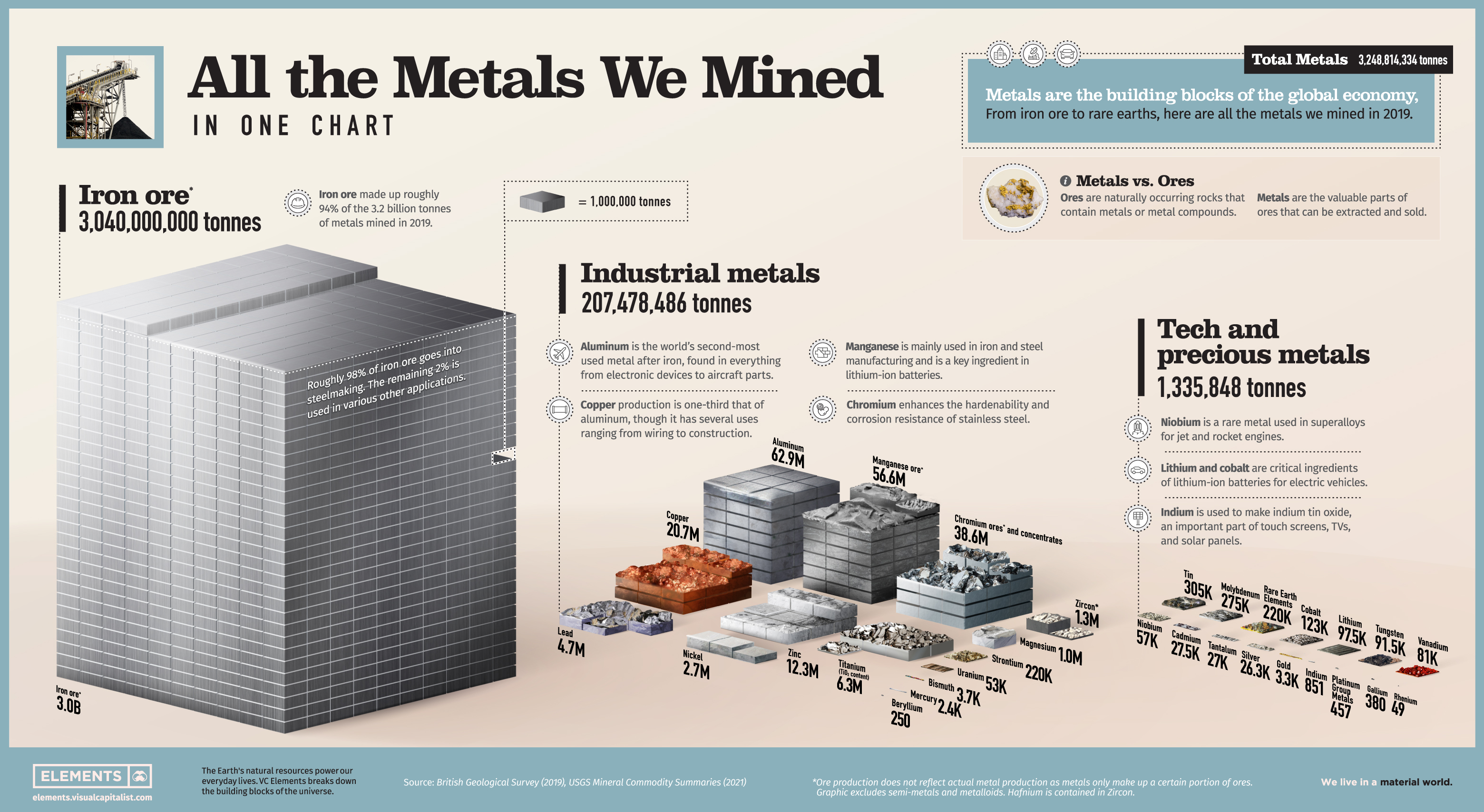
I can't wrap my head around how much lithium or other rare earth metals will need to be mined to transition entirely to solar, wind, and electric cars. What countries are these mined in? What percentage of the US grid is from wind or solar? Like 10%?

Here is a nice infographic of one years mining output for perspective

https://elements.visualcapitalist.com/wp-content/uploads/202...

Re: Japan's hydrogen strategy does nothing for decarbonisation: study

#360

Earlier quoted context omitted.

> It feels like the "save the planet" movement, or at least some shards of it, come with a very specific notion of how exactly it is ok to save the planet, and what fails on style points. This has always been a pain point for me. If you feel the world is facing an existential crisis (and I do), then it seems weird to go down the list of possible ways of avoiding utter catastrophe like you're at a sushi bar: Solar: Ah…

It is not "tone policing". That is an accusation guaranteed to derail any discussion. Nukes and geothermal simply cost more than solar and wind: nukes, many, many times more. Spending a billion dollars gets you N GW of solar or wind, and N/M, M>>1, of others. Generally, if you need a steam turbine to keep working, you will trail behind anything with zero opex. Hydrogen has a plausible place in long-term (i.e. strateg…

It ain't the money cost, we have money coming out our ears.

It's the time cost. Nuclear takes far too long; geothermal merely takes too long. Same with fancy long-distance HV transmission proposals.

Can it be built and commissioned in a year? Do it.

Post reply on HN