Live data from Hacker News

Memories: Artificial Intelligence at Stanford in the 70s

lawrencecpaulson.github.io

11–15 of 15 posts

Re: Memories: Artificial Intelligence at Stanford in the 70s

#11
post #9

> Early robots were put through their paces. Including, if the rumours are to believed, early exercises in teledildonics. (search engines are not confirming at the moment; it would've been late-60's early-70's and the way I heard the story, the geeks at SAIL were shocked —but not that shocked— to discover that two coeds who answered an ad seeking "open minded individuals" turned out to be even freer of hangups than h…

The "farewell address" from the WAITS machine included a reference to the event.

WAITS has the true details; good to see my memory was not any more unreliable than usual.

> The first character alphabet that was programmed for my plotter was Elvish rather than Latin.

To be fair, tengwar is so much more regular than latin, that it only stands to reason one might wish to debug with it, parametrically* generating letterforms, before committing the effort to digitising a full latin alphabet, letter by painstaking letter.

(in our days of cheap bandwidth, it's even easier to download preexisting alphabets; eg https://emergent.unpythonic.net/software/hershey )
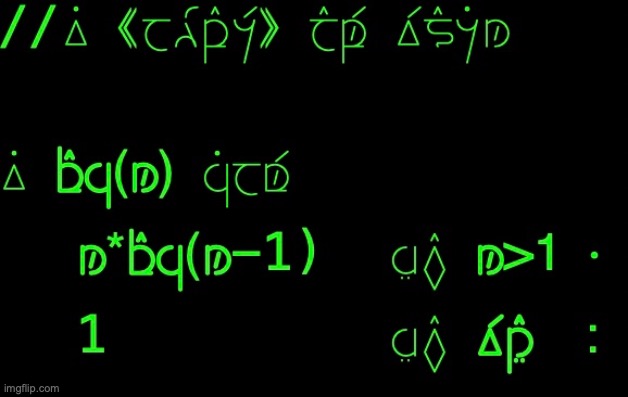
* cf https://i.imgflip.com/7757j9.jpg

Re: Memories: Artificial Intelligence at Stanford in the 70s

#12

> Early robots were put through their paces. Including, if the rumours are to believed, early exercises in teledildonics. (search engines are not confirming at the moment; it would've been late-60's early-70's and the way I heard the story, the geeks at SAIL were shocked —but not that shocked— to discover that two coeds who answered an ad seeking "open minded individuals" turned out to be even freer of hangups than h…

Before I look, do I want this in my search history?

Re: Memories: Artificial Intelligence at Stanford in the 70s

#13

...and then came the first AI winter. Which will certainly happen again, this time, only a few years later ;-)

Why do you think there'll be an AI winter? And in what form — stagnation of neural-network based technologies, a change in the overall paradigm of learning-from-data, or something else altogether?

Because the realization that "no, an AI is not artificial life" will hit, everyone will realize that all an AI does is running a function with millions of unknown state variables, and that this is not helpful when you're tyring to understand why a network does (or doesn't) do something.

Sure, the applications we have (and then some) will stay, for cases where using AI brings real benefits (just like after the first AI winter).

Re: Memories: Artificial Intelligence at Stanford in the 70s

#14

...and then came the first AI winter. Which will certainly happen again, this time, only a few years later ;-)

Bullshit. People have wrongly predicted an AI winter for the last decade. It didn't happen in 2018, it didn't happen in 2022, and it sure as hell won't happen in 2026.

Re: Memories: Artificial Intelligence at Stanford in the 70s

#15
post #7

MIT's PDP-10 OS, ITS, was unrelated to TOPS-10 and in fact predated it (it was the first OS on the PDP-6). AFAIK, SAIL's PDP-10 OS, WAITS, was also written from scratch, as it started on the '6 as well. I DOUBT DEC every provided a PDP-6 OS anyway as it was a research machine manufactured in small volume mainly designed for LISP. ITS's name, Incompatible Timeshare System, came from a prior MIT OS, CTSS ("Compatible T…

IIRC DEC provided a very, very limited OS for PDP-6 called "MONITOR", which later survived long enough to be used as origin point for TOPS-10. The version as arrived with PDP-6 was very, very limited, which didn't help PDP-6's abysmal sales (especially coupled with infamaous unreliability).
Post reply on HN