This is a great synopsis of the state of things..thanks for posting. Having all this information on one page really helped me grok all the action this year. It really highlights that there is a lot of activity in this space, which is great to see, because CL continues to be my secret weapon! ;)
Common Lisp: 2022 in review
21–30 of 77 posts
Re: Common Lisp: 2022 in review
#22Amazing work by the author of the Common Lisp Cookbook. I've hesitated to get into CL for months, but seeing about all the activity going on, I'm in for 2023.
Me too.
Re: Common Lisp: 2022 in review
#23On a slightly different tangent, is anyone using Prolog in production?
Or Mercury?
Re: Common Lisp: 2022 in review
#24Earlier quoted context omitted.
This is the way Clojure works too. Nil is treated as an identity/neutral element. This goes beyond lists: in contrast to Common Lisp who equates nil to the empty list, Clojure maintains a distinction and you're supposed to handle nils by correctly implementing functions. This is as easy as using clojure's core functions, they all have been tailored to handle nil as the neutral element. As a consequence, in Clojure, n…
I like the idea, but JVM is a show stopper for me :/
May I ask why? I've no dog in this fight (I don't work with Java) but I've seen plenty of people against Java the language who were very happy to use Scala or Clojure. I haven't encountered anyone who has specifically said they were against the JVM, so I'm interested whether it's something technical (maybe you do more real-time or work with resource-constrained systems) or if it's something more personal. There are no bad answers, I'm not looking for an argument just genuinely curious :)
Re: Common Lisp: 2022 in review
#25Earlier quoted context omitted.
This is the way Clojure works too. Nil is treated as an identity/neutral element. This goes beyond lists: in contrast to Common Lisp who equates nil to the empty list, Clojure maintains a distinction and you're supposed to handle nils by correctly implementing functions. This is as easy as using clojure's core functions, they all have been tailored to handle nil as the neutral element. As a consequence, in Clojure, n…
I like the idea, but JVM is a show stopper for me :/
Why?
I have no particular feelings for or against the JVM. It always surprises me when people get so passionate about runtimes - how much do you interact with them?
They're just in the background doing their thing.
I can see reasons for not wanting to use the JVM in specific cases. For example, it may not have the performance you want for the application you're developing.
I'm just confounded by general statements such as "JVM = no go", "I want to use C# but I'm more of a JVM guy than dotnet" (or vice versa).
Is this some bizarre nu-console war that's going on in the programming community that I have missed?
Re: Common Lisp: 2022 in review
#26such a powerful language and such an amazing small comunity. learning lisp is not only fun but it can broaden and deepen your understanding of computing far more than what you get from syntax-soup languages. plus with common lisp you can build industrial strength applications with unrivaled interactive development
I use CL for hobby projects and do love it. The main difficulty with “industrial strength lisp” is finding places in the industry that want to do so. :/
We need cl industrial strength lisp
Re: Common Lisp: 2022 in review
#27On a slightly different tangent, is anyone using Prolog in production?
+1
Re: Common Lisp: 2022 in review
#28Re: Common Lisp: 2022 in review
#29Earlier quoted context omitted.
Talking about Common Lisp in the places I worked for in the past has always be met with mockery and disdain. But then again, I have seen this kind of reaction for every non-mainstream language, so it is not really surprising. I'm currently getting back to CL, hoping to do much more with it for 2023. Being able to develop incrementally in SLIME has been a joy. Hopefully I will manage to find the right project idea to…
I was /that guy/ at my last place and I agree that it's not well received. Though once I was writing some lisp to fix a problem we were having and I had a developer beside me and he was blown away by what was happening. I think that the interactivity is something which must be experienced to be fully appreciated. I use it at my current start up and could not imagine using another language. I've become too used to thi…
What is the interactivity that must be experienced to fully appreciate
Re: Common Lisp: 2022 in review
#30Earlier quoted context omitted.
I was /that guy/ at my last place and I agree that it's not well received. Though once I was writing some lisp to fix a problem we were having and I had a developer beside me and he was blown away by what was happening. I think that the interactivity is something which must be experienced to be fully appreciated. I use it at my current start up and could not imagine using another language. I've become too used to thi…
What is the interactivity that must be experienced to fully appreciate
I'd point anyone interested to: http://joaotavora.github.io/sly/
Creating and redefining functions on a running program is incredible to experience. The turn around time for feature is so much quicker because you can, for example, save a web request and continue applying it to functions until you figure what's wrong.
You're also able to inspect data just by clicking on it. For example, I can define a class, create an instance of it and then click on it to see its data. https://i.imgur.com/4jydmBy.png

Another interesting feature is how errors are handled. If you encounter one which causes the program to stop, it'll raise a frame from which you can choose what it should do next. Should it continue anyway or retry, maybe you should redefine a function, maybe you want to change some of the data. Options are endless.
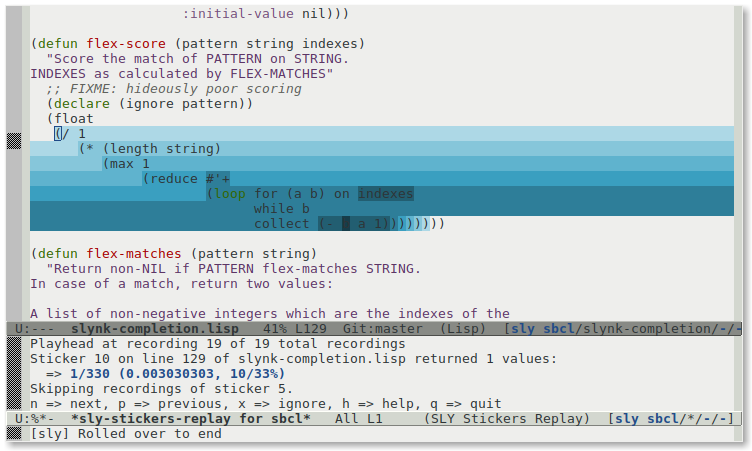
Something else that I don't use nearly as much as I should is the labels feature from SLY, which allows you to mark certain sexps and record the data that gets passed through them. Image here: http://joaotavora.github.io/sly/images/tutorial-6.png
There is so much more that could be mentioned and I'm sure there are other people with their own favourite features but these are mine.