Thelonious Monk’s Tips for Musicians (1960)
openculture.com
Thelonious Monk’s Tips for Musicians (1960)
1–10 of 70 posts
Re: Thelonious Monk’s Tips for Musicians (1960)
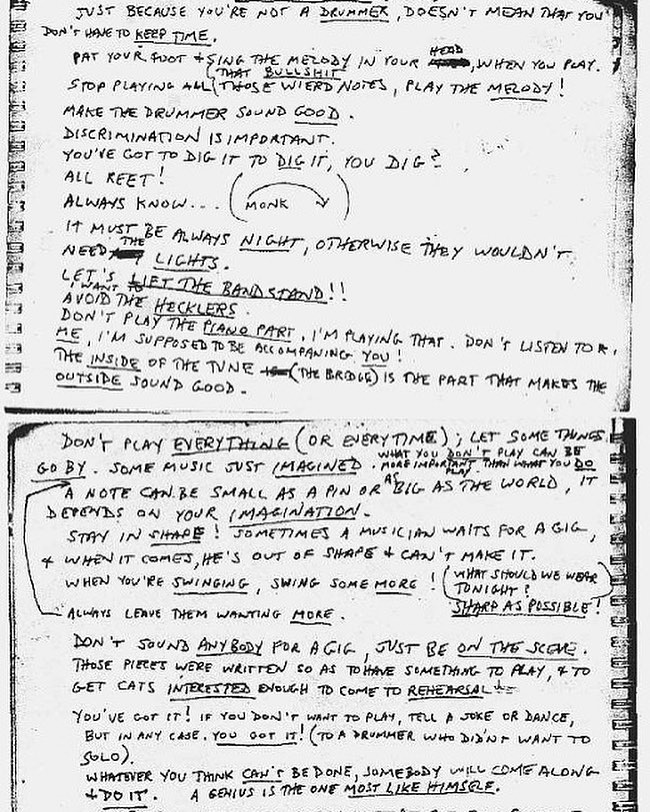
#2“Make the drummer sound good”
Re: Thelonious Monk’s Tips for Musicians (1960)
#3Don’t play everything (or everytime); let some things go by. Some music just imagined.
What you don’t play can be more important than what you do play.
Re: Thelonious Monk’s Tips for Musicians (1960)
#4“Make the drummer sound good”
which makes perfect sense to anyone who believes a band is there primarily for the benefit of those dancing to its music.
https://en.wikipedia.org/wiki/Thelonious_Monk suggests Monk belonged to this confession: ... during performances: while other musicians continued playing, Monk would stop, stand up, and dance for a few moments before returning to the piano.
Re: Thelonious Monk’s Tips for Musicians (1960)
#5Don’t play everything (or everytime); let some things go by. Some music just imagined. What you don’t play can be more important than what you do play.
in visual arts, cf lost edges
Re: Thelonious Monk’s Tips for Musicians (1960)
#6Sadly cannot view the website on mobile. Adblock detected popup is larger than the screen and cannot be dismissed.
Re: Thelonious Monk’s Tips for Musicians (1960)
#7Sadly cannot view the website on mobile. Adblock detected popup is larger than the screen and cannot be dismissed.
try https://cdn8.openculture.com/2017/12/17225415/monkgigtips4.j... for most of it.
Re: Thelonious Monk’s Tips for Musicians (1960)
#8I think the article takes the "discrimination is important" quote as cryptic and philosophical when it has a very real meaning. Compare it to an interview with the great Dizzy Gillespie:
> Interviewer: What’s it take to make a great trumpet player?
> Dizzy Gillespie: (long pause) Well, the first thing is to be a master shit detector. Detect what is valid and what is not.
And to the well-known Feynman quote:
> The first principle is that you must not fool yourself and you are the easiest person to fool.
What Monk is getting at is that when you're woodshedding (practicing by yourself) and trying to build up your playing and improvisation, you have to be your own critic a lot of the time. Are you really playing something hip, or are you playing something corny? Are you swinging? Are you making the chord changes? Are your time and intonation as good as you think? Amongst all the other musicians you hear, live and recorded, are you selecting the influences that are really going to build your playing in the way you want? If you're coming up with ideas on your own, are they really fresh and valid, or are they just the first thing that came to your mind?
Re: Thelonious Monk’s Tips for Musicians (1960)
#9Ooh, some good ones in there even for us concert band folks:
> Pat your foot and sing the melody in your head when you play.
I usually just tap my toes quietly within my shoe.
> Don’t play the piano part, I am playing that. Don’t listen to me, I am supposed to be accompanying you!
Sub piano for whatever solo or soli instruments have the spotlight.
> What you don’t play can be more important than what you do play.
> A note can be small as a pin or as big as the world, it depends on your imagination.
> Those pieces were written so as to have something to play & to get cats interested enough to come to rehearsal!
I love seeing articles like this.
Re: Thelonious Monk’s Tips for Musicians (1960)
#10“Get up and walk around in circles for a few bars.”