Easy: higher ed is all about the credential.
No post body was provided.
91–100 of 188 posts
Easy: higher ed is all about the credential.
Earlier quoted context omitted.
Even in countries where college is free, students do typically give up several years worth of annual income in opportunity costs
You're presenting an entirely new assumption, compared to what most people are discussing: that obtaining a bachelor's degree equivalent education can be done in significantly less than 4 years of full time study. In my experience, I don't believe that to be the case.
I've worked in the ed-tech space for years and am good friends with many of the early pioneers. Most of the capturable value in education is signal of acquired knowledge and other factors. I'll address the knowledge signaling first. It has been possible for a century to self-study to the equivalent of a bachelor's degree using textbooks but it is very difficult to verify in a reasonable amount of time whether someone…
Earlier quoted context omitted.
You are both right, honestly. Much of the value of higher education as it is structured is the credentialing and the networking. Everyone knows what a bachelors is, a master’s is, a doctorate is. This is important. It means something. However you are also right that education works in person for a lot of people and there are a lot of values there. Community colleges are an under utilized resource to learn. Making mon…
I mostly agree. The one place I split with you -- and hard -- is that I view the institutions in my life as charities. I am admittedly blessed in that all save one (my PhD school) really is basically a well-run charity. The only one that isn't public and sparten is not rich amd not elite. All are way more lean than most businesses ( If you really want to make money off the back of education... don't. Build your thing…
When I talk about making money I am talking about system utilized by colleges like enrollment CRMs, grading software etc. In most cases the only way those get made and are supported is through for-profit businesses.
I've worked in the ed-tech space for years and am good friends with many of the early pioneers. Most of the capturable value in education is signal of acquired knowledge and other factors. I'll address the knowledge signaling first. It has been possible for a century to self-study to the equivalent of a bachelor's degree using textbooks but it is very difficult to verify in a reasonable amount of time whether someone…
It has been possible for a century to self-study to the equivalent of a bachelor's degree using textbooks but it is… With the exception of a small percent of the population this isn’t true. Most people don’t have the ability, patience, wherewithal to self study a topic in depth. HN comments are littered with examples of educated people in one area making foolish comments in other areas with those people thinking they…
Textbooks and/or (current) edtech are not going to be effective there.
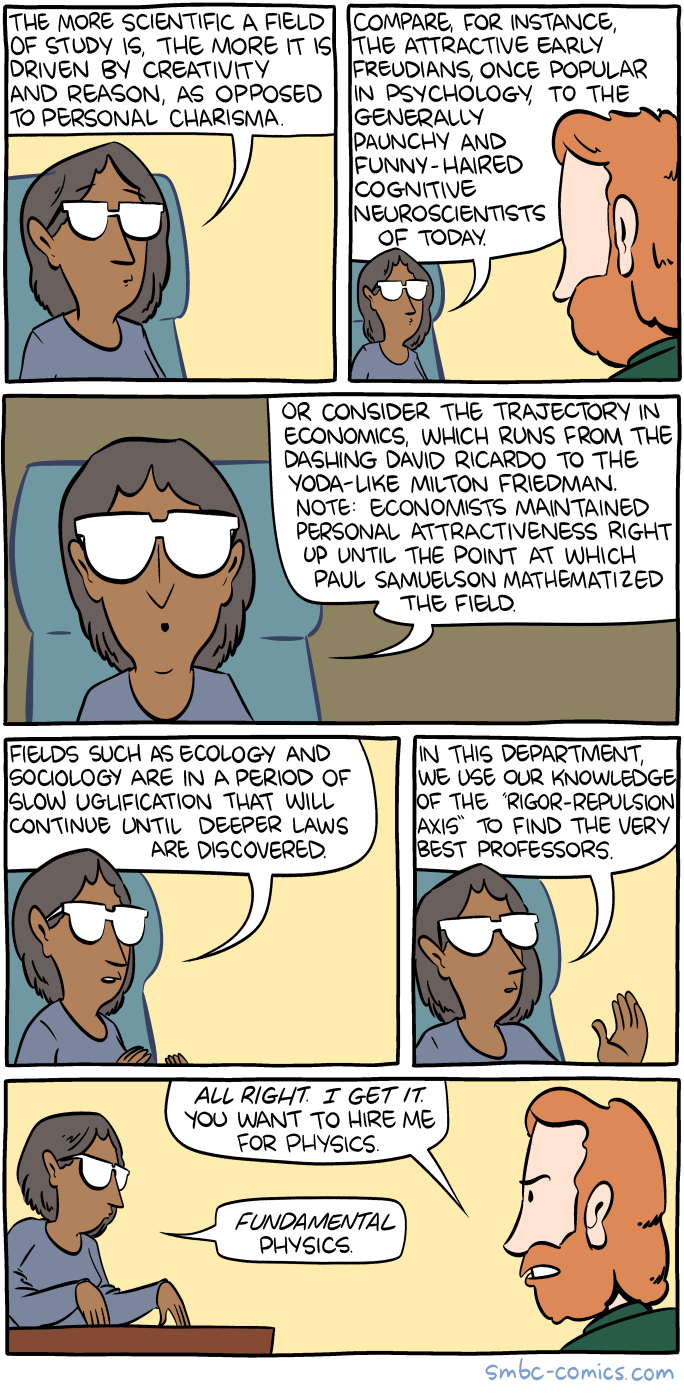
But in hard scientific topics (mathematics, algorithms, engineering) there are facts and ideas that are taught, and it's equally easy or hard to learn from prose as it is from listening. In my experience you can be very effective self-studying as long as you already have basic background about the field and what's the point. I skipped 2-3 years of math in school by simply reading the textbook over the summer, doing the exercises, and just asking to skip to the next class. You do this a few times and then you realize that in-person classes are also just them reading the textbook to you. I don't regret it whatsoever.
I'd argue the difference is how mathematized a field is, probably along the same lines as SMBC:
I've worked in the ed-tech space for years and am good friends with many of the early pioneers. Most of the capturable value in education is signal of acquired knowledge and other factors. I'll address the knowledge signaling first. It has been possible for a century to self-study to the equivalent of a bachelor's degree using textbooks but it is very difficult to verify in a reasonable amount of time whether someone…
Absolutely agree. And because of this, any fantasies from tech of easily disrupting education look rather naive … almost like they’re still in the mindset of the student trying to prove their intelligence. It seems then that the technical challenge is certification/assessment. Here, AI could play a role. If a machine can interactively and dynamically have a “conversation” with a person, that is randomised/unique and…
A more likely use of AI would be to expand the candidate pool by changing the nature of the jobs that are being hired for. An example is the automation of engineering calculations by high level software such as CAD.
I've gone through the system. I wouldn't hire someone based on their credentials alone. On the other hand, a person who gets through the "weeder" courses in engineering or the physical sciences at the state university, but is outright faking it, would be a black swan event, not worth planning for.
I've worked in the ed-tech space for years and am good friends with many of the early pioneers. Most of the capturable value in education is signal of acquired knowledge and other factors. I'll address the knowledge signaling first. It has been possible for a century to self-study to the equivalent of a bachelor's degree using textbooks but it is very difficult to verify in a reasonable amount of time whether someone…
What about signaling of not just acquired knowledge, but the ability to apply it in a meaningful way? in other words - education and what it measures (grades) may or may not correlate with a successful person. is there a way to measure or predict if a person is or will be successful? And this isn't just for hiring, it is also part of a good feedback loop for helping people get an education.
The best predictor of being able to apply knowledge is better mastery of that knowledge and the context in which you are applying it, e.g. to be a creative mathematician you must know some things relating to the problems you're solving deeply.
> is there a way to measure or predict if a person is or will be successful
Most companies use the following signals
1. A track record of success
2. Intelligence
3. Consentiousness - the willingness to do required work even if you don't want to
4. Stress tolerance
This is somewhat unsatisfying. One would hope you'd also try to detect attitudes or ideologies that blind you to entire solution spaces or being a massive jerk and alienating people around you.
I've worked in the ed-tech space for years and am good friends with many of the early pioneers. Most of the capturable value in education is signal of acquired knowledge and other factors. I'll address the knowledge signaling first. It has been possible for a century to self-study to the equivalent of a bachelor's degree using textbooks but it is very difficult to verify in a reasonable amount of time whether someone…
What about signaling of not just acquired knowledge, but the ability to apply it in a meaningful way? in other words - education and what it measures (grades) may or may not correlate with a successful person. is there a way to measure or predict if a person is or will be successful? And this isn't just for hiring, it is also part of a good feedback loop for helping people get an education.
You survived the 3-5 year ordeal and got your BSc or MSc, this implies you can apply some knowledge in some way.
> in other words - education and what it measures (grades) may or may not correlate with a successful person.
The signal universities provide is not perfect, or even very strongly correlated with anyone's ability to excel in a specific domain. But it is somewhat positively correlated, which means using it as employment filter will weed out more bad than good candidates, which makes hiring cheaper and less risky. In other words: however bad the correlation is, it's already good enough to be useful.
> is there a way to measure or predict if a person is or will be successful?
I worry this is an anti-inductive problem: i.e. if you can measure the right factors and predict if a person will be successful accurately enough, you can make people successful (look at it as closed-loop control problem) - but it's most likely cheaper to just make them seem successful instead. The measure becomes a target, and so eventually will cease to become a good measure.
(In a sense, BSc and MSc titles are suffering from just that. They're no longer anywhere as strong a signal than they were 50 years ago.)
> And this isn't just for hiring, it is also part of a good feedback loop for helping people get an education.
Unfortunately, the two goals - teaching for economic prospects, and educating for a rich and successful life in a more general sense - are at odds with each other.
I think this significantly misses the point of higher education. By far the most valuable parts are 1) peer interaction, and 2) lecturer-audience interaction. I learned way more from discussing the topic with my classmate during breaks than I ever did from the course material itself. Learning a fact is easy, deeply understanding it is not - and discussing it with your peers is the best way to discover each others' fl…