No post body was provided.
The mid in fake midcentury modern
321–330 of 512 posts
Re: The mid in fake midcentury modern
#322Earlier quoted context omitted.
More down-to-earth and simplistic answer: the classless society (Socialism and derivates like Social democracy) with the need to provide reasonable housing for the masses and the spread of industrial concrete[0] took us to the optimal solution: the concrete box. Once Alvaro Siza (Pritzker prize) was asked if his architecture was minimalist. He answered (paraphrasing): "No, it's just a minimalism of costs". From wikip…
Architecture has almost nothing to do with it... Hipodromo in Mexico City is one of the most beautiful neighborhoods in the world. Architecturally, it's a bunch of hideously ugly buildings. But there's trees and plants everywhere, and they're beautiful, and that's all you see. The reason everything is ugly is because we don't have trees and nature anymore - we just have roads and parking instead. There's tons of beau…
> The reason everything is ugly is because we don't have trees and nature anymore - we just have roads and parking instead.
I've spent a bunch of time on the 1940s.nyc site and the most striking difference between 1940s NYC and 2022 NYC is the lack of trees in 1940.
Re: The mid in fake midcentury modern
#323There's so much in this essay to unpack, it's all over the place -- more of an extended rant than any particularly cohesive argument. But one of the early points is "why is everything so gray instead of colorful?" Which is easy to answer -- when all your cars and buildings are super-colorful, they clash. They become garish and ugly and screaming for attention. Thank god we've moved to more neutral tones that actually…
The folks in Eastern Canada would happily disagree that their bright and primary colored homes are ugly, and after having seen them in person, I also think they're beautiful.
https://i.pinimg.com/originals/44/0e/32/440e32a0e0c8fdececf6...

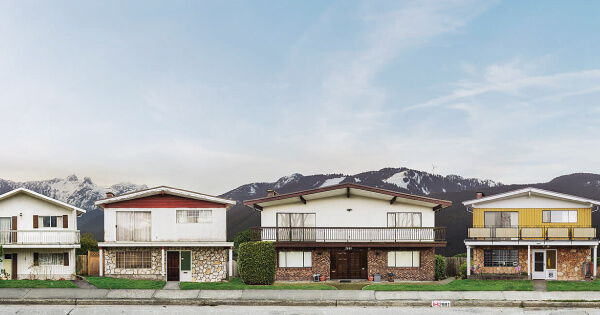
I get where you're coming from with grays clashing less than the highlights. But given the choice, I'd always take the loud bright colors of the Maritimes over the inoffensive neutral shades of our West Coast.
https://www.tqconstruction.ca/wp-content/uploads/vancouver-s...
Re: The mid in fake midcentury modern
#324In the case of that page, the answer is "because somebody's setting line-height to 1 for the body copy and the paragraphs are Too Damn Long"
Re: The mid in fake midcentury modern
#325This is the equivalent to "why does modern music suck" (said by every generation of the next generation's music) Scott Alexander posted something similar https://astralcodexten.substack.com/p/whither-tartaria And the response he got was arguably predictable..., others didn't agree that modern architecture is ugly. Sure there are some ugly buildings. But, for example, for me. I went to some 1929 building that I'm sure…
I had a hard time taking this article seriously after seeing the first picture with the caption "new ugliness". The picture depicts art by KAWS, arguably a very successful modern artist - someone must think what he is doing is worthwhile. I personally don't like his art, but saying it's "ugly" is rather subjective..
Doesn't that assume that people only think beautiful art is "worthwhile"? People - in particular the sort of people who deeply care about art - may see value in ugly art, if the ugliness helps achieve the goals of the artwork.
Re: The mid in fake midcentury modern
#326Earlier quoted context omitted.
It seems more likely that brutalist architecture is uniquely terrible, and the ascendant architects of the 1960s simply had horrific taste. If anything, architecture seems to have been almost entirely captured by the avant-garde; people more interested in “new and different” than “classic and beautiful”. I don’t think modern audiences are suddenly falling in love with brutalist architecture; even the best examples lo…
>It seems more likely that brutalist architecture is uniquely terrible Interesting, it seems to me that brutalist architecture is actually pretty appealing aesthetically. I might go so far as to say that objective beauty and taste simply does not exist and anyone claiming that it does hasn't thought about it very hard yet.
> anyone claiming that it does hasn't thought about it very hard yet.
Or maybe you haven't given enough thought to what "beauty" might mean such that it could be objective. Not everyone means by "beauty" "that which I find appealing". Some mean "the will's response to truth": https://en.wikipedia.org/wiki/Transcendentals
A wonderful example of this is given in _All Hallows Eve_ by Charles Williams:
> "Over here," Jonathan said, and took his friend round to the other side of the room. A second easel was standing back to back with the first, also holding a canvas, but this uncovered. Richard set himself to look at it.
> It was of a part of London after a raid—he thought, of the City proper, for a shape on the right reminded him dimly of St. Paul's. At the back were a few houses, but the rest of the painting was of a wide stretch of desolation. The time was late dawn; the sky was clear; the light came, it seemed at first, from the yet unrisen sun behind the single group of houses. The light was the most outstanding thing in the painting; presently, as Richard looked, it seemed to stand out from the painting, and almost to dominate the room itself. At least it so governed the painting that all other details and elements were contained within it. They floated in that imaginary light as the earth does in the sun's. The colours were so heightened that they were almost at odds. Richard saw again what the critics meant when they said that Jonathan Drayton's paintings "were shrill" or "shrieked", but he saw also that what prevented this was a certain massiveness. The usual slight distinction between shape and hue seemed wholly to have vanished. Colour was more intensely image than it can usually manage to be, even in that art. A beam of wood painted amber was more than that; it was light which had become amber in order to become wood. All that massiveness of colour was led, by delicate gradations almost like the vibrations of light itself, towards the hidden sun; the eye encountered the gradations in their outward passage and moved inwards towards their source. It was then that the style of the painting came fully into its own. The spectator became convinced that the source, of that light was not only in that hidden sun; as, localized, it certainly was. "Here lies the east; does not the day break here?" The day did, but the light did not. The eye, nearing that particular day, realized that it was leaving the whole fullness of the light behind. It was everywhere in the painting—concealed in houses and in their projected shadows, lying in ambush in the cathedral, opening in the rubble, vivid in the vividness of the sky. It would everywhere have burst through, had it not chosen rather to be shaped into forms, and to restrain and change its greatness in the colours of those lesser limits. It was universal, and lived.
~ All Hallows Eve: II. — THE BEETLES by Charles Williams https://gutenberg.net.au/ebooks04/0400061h.html
See also: * _Beauty as a transcendental in the thought of Joseph Ratzinger_ by John Jang for University of Notre Dame Australia at https://researchonline.nd.edu.au/cgi/viewcontent.cgi?article...
Re: The mid in fake midcentury modern
#327Why would a property developer finish a new build with hardwood, stone, brass, etc when they can double their volume and return by building towers of cheaply-clad flammable doggy crates?
It's a misallocation of incentives for what gets built these days.
There's also a huge survivorship bias with old buildings that nobody ever seems to talk about, but that's a whole other thread...
Re: The mid in fake midcentury modern
#328Earlier quoted context omitted.
> Obviously wrong. America has an enormous amount of beautiful "old" architecture. [...] It all predates WW1 Your comment shows the difference between American "old" and European "old". In Europe, there are people who live in homes far older than that.
My grandma went to San Antonio to visit one time and said of the Alamo, "This looks like a warehouse. We have furniture at home that is older, prettier, and has been through more wars than this". She's right, too. I did not translate her comment to English for my local friends though!
The "ugly $NATIONALITY" trope goes both ways, and isn't just for Americans visiting other countries. I don't know why tourists think it's a competition.
Re: The mid in fake midcentury modern
#329World Wars 1 & 2 happened, shattering the remaining sense of aesthetic unity we had that was followed by modernism which purity spiraled into the ubiquitous glass box, which was then followed by a post-modernist surface-level, purely negative rejection of modernism the post-modernists were unable to return to any pre-modern sense of aesthetics due to their ideological commitment to the ur modernist impulse of pride (…
I don't really follow what your point is.
But, developers will build what maximizes profits. They are just answering to wallets. If it was mostly the ultra-wealthy purchasing real estate (as it mostly was pre-WW2), then the developers will build what the ultra-wealthy want to spend their money on.
Post-WW2 saw the rise of the middle class and their ability to purchase homes. Especially with government-backed mortgages (FNMA, Freddie Mac, and etc). Most of the middle class would rather spend less on gorgeous architecture and get more square footage inside their home.
Re: The mid in fake midcentury modern
#330Earlier quoted context omitted.
> Overall, I see no evidence of problems of proportion getting worse. Except if you ask people, specifically the people who *have to work in, live in and around these buildings*, and given the choice, they will choose, time and time again, architectural styles which have fallen out of favour with the vandals. Some think beauty is simply in the eye of the beholder and it's the plebs who have a false consciousness. Per…
What does any of that have to do with proportion, which is the subject you actually brought up? When I think of people who like older buildings, it's because of the materials, the ornamentation, the history, the culture, the craftsmanship, the uniqueness, I could go on. All of which makes total sense. But proportion just isn't something that usually comes up. And none of this has anything to do with false consciousne…
> it's because of the materials, the ornamentation, the history, the culture, the craftsmanship, the uniqueness
Reactions to beauty are instinctive, immediate, emotional. The average person on the street knows little about any of the post-hoc rationalizations you mention.
The topology of beauty has been studied, and we know that proportions are important in art, architecture, sculpture, the human body itself.
It costs nothing to create beautiful buildings.